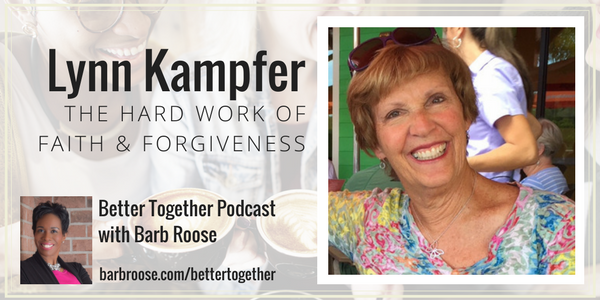
The Hard Work of Faith & Forgiveness – Lynn Kampfer

The Hard Work of Faith & Forgiveness – Lynn Kampfer

 “I read Bill’s words as he confessed that he had lied to his family and had stolen, and spent, $1,000,000 from his aunt’s trust fund. It was obvious he confessed at trial to get a reduced sentence. I was numb and in shock. I had asked God for the total truth but had never dreamed that the truth would be so painful. 

How could my husband and best friend, who I had known since I was five, be a liar, a thief , and a convicted felon? It was excruciating.” -from Lynn’s Story: A Journey of searing, Inspiring Growth and Ultimate Healing

For over 30 years, former corporate trainer Lynn Kampfer lived what most people would consider the American Dream. Married to her childhood sweetheart and raising two kids, Lynn and her family enjoyed the best that life had to offer.

Yet, as Lynn began to search for God the outer edges of her lovely life began to crack and crumble. In this episode of the Better Together podcast, Lynn shares not only her dramatic story but more importantly, incredible lessons learned about God’s faithfulness, provision, forgiveness, and hope. Lynn will definitely inspire you as she shares about surviving breath-taking heartache and how to thrive even as life takes an unwelcome left turn.

As you listen to today’s podcast, I want you to draw hope and encouragement from Lynn’s story especially if you feel like your life is falling apart.

What you’ll hear from today’s podcast:

  • How God plants seeds in our lives, even when we’re unaware;
  • Even after rock bottom, things can always get worse;
  • When you don’t forgive, you’re in a prison doing hard time with the person who hurt you;
  • Two important things to know and do when beginning the journey toward forgiveness;
  • How God never abandons us when the unthinkable in life actually happens.

Forgiveness is a difficult and often misunderstood concept.

There’s not enough space in this post to properly cover the topic, but I hope that you listen to Lynn’s podcast because you can learn a lot from her journey to forgiveness. It wasn’t easy, but she is so wise in how she journeyed through it.

POST A COMMENT BELOW: Can you tell us about your forgiveness journey? What was hard? How did God help you? If you’re still struggling, how can we pray for you? 

The Night Someone Called Me a N*gger…

The Night Someone Called Me a N*gger…


blog graphic - Night someone called me a n

One night, I walked into a neighborhood pub. As soon as the door closed behind me, an unknown voice yelled: “What’s that nigger doing in here?”

Was someone talking about me?

I stopped. The room silenced. An electric pause buzzed the air.

My mind calculated what I’d just heard. Then, a thought:  Oh, I KNOW that he did not just say that to me.

Another moment passed. A volcano of rage started to bubble deep within. Let me take my shoes off. Earrings, too. Somebody – SOMEBODY, hold my purse.

That incident happened over 20 years ago, however, I remember it like yesterday. On that night, I walked in to enjoy some dinner. Except someone decided that I didn’t belong.

Not based on my personality,
Not based on my family background,
Not based on my ability to pay,
Not based on my company,

BUT based on my skin color, I was unacceptable.

I gazed around the room wondering if anyone would speak up or even say something – anything.

Silence.

So, what did I do?

I held my head high, glided through the hushed crowd and took my seat at the table. Yes, I did.

I suspect that some of you are questioning, “Was it really that bad?” or “Are you sure?” You’re shocked that those things could have happened to me. 

But they did. In my early adult years, I learned how to ignore the sales staff that helicoptered while I shopped for shoes. I learned the importance of not messing with my purse while browsing merchandise. I embraced driving 10 miles UNDER the speed limit in certain communities – especially if I was driving at night.

Those situations never shocked me, but I hesitated to recount them because of the shocked-responses from others. Racism thrives in part because it shocks the majority into disbelief. I’ve heard responses such as:

“Are you sure?”
“I can’t believe it…”
“That can’t be!”
“Say it ain’t so!”

Unless you’ve been a direct victim or eyewitness of someone who’s experienced racism, stories about racism will always be shocking.

Yesterday, a cell phone camera captured police restraining an African-American man named Alton Sterling on the ground. Then, those same officers fatally shot Sterling while restraining him. Much of America is in shock. But, not those who’ve been wrestled to the ground like Sterling. Not those of us who’ve witnessed our fathers and brothers stopped for no reason, hassled or pulled from their cars. We’re not in shock. We’re a lot of things – angry and sad sums up a lot. It seems that each #shootingincident buries us deeper into the struggle over of the color of our skin and the fear that lurks within.

There’s nothing about our first-world mindset that wants to accept that racism could be just as pervasive as it was when men began wearing white sheets and Africans exited boats in chains. Apparently, we’re not as awesome as we think we are. Seriously, we discovered how to fly, found a vaccine for polio, developed a nuclear bomb, put a man on the moon, learned how to record on a VCR, taught Grandma how to use Facebook and elected a black man as president twice —

Yet, we can’t accept that racism is woven deeply into the fabric of our American experience.

In our mental model, racists hang out with murders or pedophiles. So, a racist couldn’t possibly be the fun neighbor up the street or the sales manager in your office. We don’t want to call someone a racist unless we can SEE them being racist.

But, how do we call out people who harbor racism in their hearts? Even more so, how do we call it out in ourselves?

You just thought that I called you racist. I didn’t. Only you can answer that. But,  I do want you to consider how you’ve been impacted by the roots of racism in your family of origin. 

What you believe about race is influenced by the generations of conversations and experiences that happened long before you were born. Your great-grandparents sat and around the table and talked about race. Your grandparents heard them. Your parents heard your grandparents. You listened to your parents. I’m not saying that you agreed with all that was said, but you’ve got to be aware of how those words and stories influenced your thoughts, feelings or behaviors.

Questions to consider:

  • When you were a kid hanging out at family gatherings, how did your family talk about race or people from different races? 
  • Are there any race-related incidents in your family’s history that turned into stories that you were told as a child? How did those incidents impacted how your family lived?
  • What are your operating stereotypes?  (Asians are smart, black women are loud, black men are scary, white people are fake)
  • What are some of the hot-button issues that you know would create tension if you discussed them with someone of another race? Why would those issues create tension?
  • What would a friendship with someone from another race look like? (It would not be a true friendship unless you could talk about race.)

So, what now? 

  1. Love must lead the way. 

Some of you are tired of hearing people like me talk about ‘love.’ For you, love is for Valentine’s Day. Love is something that gets hot and heavy on Friday night. You don’t really believe that love is a potent power in our universe that can actually affect change. Maybe it’s because we really don’t know how to love. We’ve cheapened it and now, we think that the strategy of love has failed us. Except, our back-up plans of ignorance, hate and anger haven’t worked either.

I love Martin Luther King Jr’s vision for the future. He had hope because he believed in people. He believed in us! He knew that racism would never be eliminated by laws or lawsuits – even though he fought for legal and social justice. But Dr. King preached the same thing Jesus preached long ago: Unconditional love is the only road to the elimination of racism. Racism will die once our unconditional love for each other comes alive.

Love is not a feeling. Love is an action. Love is THE ONLY strategy that can save us from society-destructing ourselves. You’ve got to remove your limits on your love for people. Here’s the ultimate test for love: Decide now that you will lay down your life for another human, no matter their race or culture. When you decide to display that kind of love, then you carry the torch of hope for our tortured nation.

Check out Dr. King’s words:

  “I refuse to accept the view that mankind is so tragically bound to the starless midnight of racism and war that the bright daybreak of peace and brotherhood can never become a reality… I believe that unarmed truth and unconditional love will have the final word.”

MLK quote unarmed truth love

2. Labels lie. Relationship reveals the truth.

Here’s the thing: We feed what we believe. As long as we believe that all black men might steal our purse or that all white people will stab us in the back, those lying labels will keep us far apart from each other. When we stop looking for evidence to feed our faulty beliefs, then we’ll be willing to open ourselves up.

What would it look like for you to develop a relationship with someone from another race? It’s more than having a “black friend at the office” or “having a white girl to roll with on Friday night.”  It means that you get to know someone well enough that you can talk about the things that matter in life. It means that you can agree to disagree –  still love each other. It means that you can come from different cultural or socioeconomic perspectives and still respect each other’s viewpoint, even though you may not completely understand it.

3. Start new conversations with your family

If you ever expect that future generations will move away from where we are today, then we have to give them a new target. Focusing them on the target of developing authentic relationships begins with authentic conversation.

How can you have new conversations with your kids or older family members?  Consider this:

  1. Eliminate “them” and “they” when talking with your kids about race. Use actual names and tell personal stories when you talk with your kids about people from different races or cultures.
  2. Discover how race has impacted your family by talking  with older members of your family. Start with the question: “What do you think about what happened to Alton Sterling?” Now, the tension reappears once they finish talking. How do you respond to their answer? Pastor Andy Stanley suggests these questions that you can ask without fear of offending: What led you to that viewpoint? Have you always believed this way? 
  3. Can you promise me that you’ll memorize this verse before talking to ANYONE? Here it is: “Be quick to listen, slow to speak and slow to get angry.” -James 1:19

Speaking out about race isn’t easy. Our experiences with race are just as personal as they are collective. So, thank you for stopping by and checking out this post. I’d love to hear your thoughts on how we as individuals can be the light of hope in American’s dark night of racism. Please leave a comment below. 

Barb Roose Signature


God is in control and He will take care of “it”

God is in control and He will take care of “it”

I like to keep it real.

Why? Because it’s a compete waste of time for me to pretend that I’m all put together. My house is somewhat messy these days. I’m doing pretty well when it comes to making dinner, but where’s something tragic happening in my backyard. The weeds are winning, friends…

For the most part, I’m just trying to get through each day. Like you, I have happy days, cranky days, bossy days and sometimes, just plain ‘ole you-totally-don’t-want-to-be-around-Barb days. Yesterday, I spent the afternoon wearing dirty white socks and a bad attitude.

Sometimes, I get overwhelmed. Do you? When my life is full, that’s when the tears often overflow. I’m totally not complaining, but I hope that someone can relate to seasons of life that seem to hold more experiences that my tender heart can handle.

At times, I feel like I’m holding my life together with pieces of Scotch tape. Ever worked with Scotch tape? That stuff is so good when you’re taping paper together. However, Scotch tape is a fail if you want to join two items with any weight. That’s why Scotch tape needs to stick with paper and leave the heavy lifting to something better suited. No matter how hard we try, there is a limit to what Scotch tape can do.

Sometimes, it feels like I’m trying to fix the big, important things in life with my human effort, which often resembles Scotch tape. I can do a lot of things. But, when I’m faced with some situation that I can’t fix, my first reaction is to get mad.

from bucks.blogs.nytimes.com

from bucks.blogs.nytimes.com

What is the thing in your life that you can’t control? How do you react in that disappointing moment? How does your behavior impact your relationships and your faith? 

A few months ago, I was getting frustrated over a number of situations that were out of my control. This lack of control led to disappointment and anger because what I expected didn’t match the reality of was truly happening.

After I journaled about those disappointments, I put an asterisk by the situations/events that I could control or improve. Out of seven disappointments, I could only place two asterisks. Ouch.

So, I realized I had two choices:
#1 – I could be perpetually ticked off about the situations that were out of my control;
#2 – OR, I would discipline myself to accept reality (I have no control!) and create a response to my disappointment that was consistent with reality.

Here is a phrase that I have decided to repeat when disappointment descends into my life:

MEME - God is in control and he will take care

Here are somethings that I try to remember:
1. Even when life is tough, I know God loves me and will take care of me. (Proverbs 3:5-6, Romans 8:31, Philippians 4:6-7)
2. God has a plan and purpose for my life. He’s in control, even when I am not. (Jeremiah 29:11)
3. Difficult circumstances are often what God uses to help me become a better, more faithful person. (Romans 5:3-5)

I don’t know what you are up against today, but I do know that there are disappointments that frustrate and anger you. I also know that dealing with disappointment is often as difficult as dealing with the situation. So, I’m going to challenge you to say this phrase: “God is in control and He will take care of it” the next time you are faced with an uncontrollable situation.

While the situation might be difficult to get through, you’ll be able to endure the difficulty with confidence in God and His ability to take care of things in a way that you never could.

If you need to let God be in control of something in your life, let us know how we can pray for you in the comments below.

Thanks for stopping by! If you think that this post would bless a friend, feel free to share it!

Barb Roose Signature

Pin It on Pinterest