Preparing Your Heart for Their Return to the Father

Preparing Your Heart for Their Return to the Father

Happy Monday, friends!
 
Welcome to the final week of our series on praying for our loved ones. Today’s devotion closes out the final part of Jesus’ teaching in Luke 15.
In today’s devotion, we’re going to prepare our hearts in anticipation of our unsaved loved one’s salvation or our prodigal’s return to faith. Let’s read one of our favorite parts of Jesus’ teaching:
 
“So he (the prodigal) returned home to his father. And while he was still a long way off, his father saw him coming. Filled with love and compassion, he ran to his son, embraced him, and kissed him. His son said to him, ‘Father, I have sinned against both heaven and you, and I am no longer worthy of being called your son.’” -Luke 15:20–21 NLT
 
Next, let’s look at how the father handled himself. There is some important guidance we can draw from this story.
 
1. Be Patient and Hopeful
First, notice how the father was watching and waiting. This speaks to patience and hope. Just as God the Father is patient (2 Peter 3:9) with our unsaved loved ones, the father waited with patience. He did not give up in discouragement or anger.
 
Let’s imagine ourselves in the place of the father. Take a moment and picture your loved one proclaiming Jesus. Together, we are believing God for that. Let it be soon, Lord!
 
Yet for some of us, it feels like that day may never come. I have heard from some of you who feel deeply discouraged because your loved ones still seem so far from God. Can I encourage all of us to remember this:
There is nothing too hard for God. No one is too far from God.
Let’s hold on to that hope today.
 
2. Don’t Bring an “I Was Right” Attitude to Your Anticipated Reunion
Next, notice that when the father saw his son coming, he ran out to meet him. Some of us may think, “The father shouldn’t move one inch until the son makes it right,” or “Does that prodigal even realize everything he put his family through?”
But that is not God’s way. In Romans 5:8, we are reminded that while we were still sinners, God moved toward us by sending Jesus to die for us. God came to make a way, not make us pay. We are called to carry that same spirit toward our unsaved loved ones and prodigals.
 
May I ask a question - and I'm asking with all due respect: Is there any chance that you give off an “I’m right, you’re wrong” attitude toward your unsaved loved ones or prodigals because you’re saved?
 
Our unsaved loved ones and prodigals can sense that “I have Jesus, so I’m better than you” self-righteousness. We may not intend to give it off, but this attitude can quietly creep in.
 
Here are a few signs it might be happening:
  • Your love and engagement flow freely when they make decisions you approve of, but you pull back when they do not.
  • You lose your temper when they express beliefs or behaviors different from what you want for them.
  • Deep down, you know you are judging them for not believing or living the way you do.
Friend, they can sense inconsistency and self-righteousness from a mile away.
We are blessed because we are saved, but we are not better than them. It is only by the grace of God that we live and breathe.
 
God convicted me of this kind of self-righteousness when my former spouse stopped going to church and fell into alcohol addiction. During the early years of that struggle, I was afraid, angry, and confused. To make myself feel better, I compared myself to him and believed I was better. Instead of giving thanks for the faith I could lean into, my pride looked and sounded like the Pharisee in Jesus’ story who prayed, “At least I’m not like this tax collector because I’m doing all the right things” (Luke 18:9–14, paraphrased).
 
As we pray for our unsaved loved ones and prodigals to come home, let’s make sure we carry the father’s heart when we run out to welcome them.
 
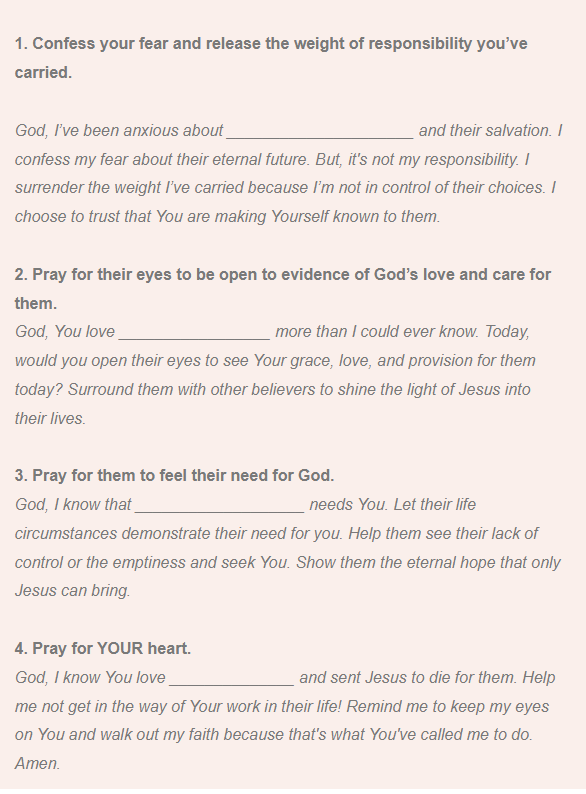
3. PRACTICAL STEP: Take the Temperature of Your Heart
First, write down the name(s) of an unsaved loved one or prodigal you have been praying for: ________________________.
 
Next, read the following passage from Colossians 3:12 and ask yourself if you are living out these qualities in your relationship with that person:
 
“Since God chose you to be the holy people he loves, you must clothe yourselves with tenderhearted mercy, kindness, humility, gentleness, and patience.” -Colossians 3:12 NLT
 
REFLECTION: Which of these qualities are you doing well? Which ones feel difficult? Which ones do you need to pray about and ask God to help you grow in?
 
My prayer for you today is that God would gently deal with any areas of self-righteousness or anything else in your heart, so you stay prepared for the day when your loved one crosses the line of faith or repents. When you allow God to convict your heart and you respond with repentance, you will be more available for God to use you, bless you, and give you peace while you pray and wait.
 
I’D LOVE TO HEAR FROM YOU! Did today’s devotion give you hope or encouragement? If so, leave a comment with “encouraged.” If you have a story to share, I’d love to hear it! 
Read the Entire Series: Praying For Our Loved Ones

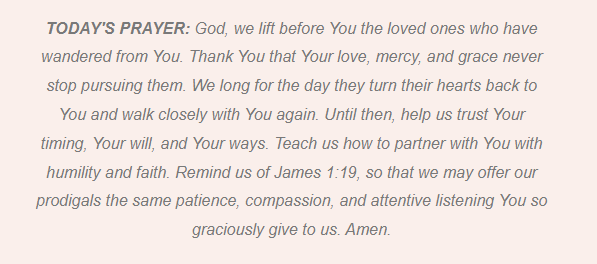
How to Help Your Unsaved Loved One or Prodigal

How to Help Your Unsaved Loved One or Prodigal

Hi friends,
 
We’re coming to the end of our series on praying for loved ones. Next week is the final week. Last week, I heard from so, so many of you. Your notes and reflections blessed me. I’m praising God for how He used last week’s Happy Monday to remind you that YOU are precious to Him. If I haven’t responded to your email yet, stay tuned.
 
Let’s jump back into Jesus’ teaching on the prodigal son in Luke 15. Today’s devotion covers my favorite part of Jesus’ story. If you’re new to the series, you can read the previous week’s devotion at the end of this email, but for now, let’s read Luke 15:17-19 NLT:
 
When he finally came to his senses, he said to himself, “At home even the hired servants have food enough to spare, and here I am dying of hunger. I will go home to my father and say, ‘Father, I have sinned against both heaven and you, and I am no longer worthy of being called your son. Please take me on as a hired servant.’” -Luke 15:17-19 NLT
 
If you use holy imagination, can you see the son sitting on a mud splattered fence, tossing pods into the muddy, smelly pig pen? Can you smell his dirty clothes and hear his stomach rumbling? After living recklessly and doing whatever he wanted, the son now sits in his reality.
 
I love this part of the story because the son makes the decision to repent on his own. He alone must recognize his need for God and make the decision to change. Repentance means to change one’s mind and to go in a different direction. This insight elevates something we must remember when praying for our loved ones. When someone is far from God, their decision to return to God is up to them, not us.
 
Ultimately, we can’t want more for someone than what they want for themselves.
The good news is that we can “help” in these four ways, even though we are not in charge of changing them.
 
1. Let Go of Acting Like Holy Spirit Jr. in Their Lives
Friend, God doesn’t need you to run around after an unsaved loved or prodigal nagging or with scare tactics. God is not anxious about your loved one, so you don’t need to be. Your goal is to become a non anxious presence around them that exudes trust in God, your own fully alive faith, and unconditional love for your unsaved loved one or prodigal.
 
What can you do? Turn your worry words and nagging words into praying words. 
 
2. Let Them Experience the Natural Consequences of Their Decisions
We don’t know what prompted the son in Jesus’ story to come back to himself, but I like how Pastor David Guzik explains the first verse. “In his misery, the prodigal son was finally able to think clearly.” The son finally felt the sum total of his wild and reckless choices. That was the aha moment he needed to turn back toward God.
 
Our takeaway here is this: Sometimes, we must let people experience the natural consequences of their decisions. This is not a punishment. You are giving them the gift of experiencing their reality.
 
You are in charge of not panicking when you see problems. Pray for them, but also pray for yourself. Ask God if He is specifically calling you to get involved or if He needs you to let Him do the work that only He can do.
 
I know there are complicated situations involving mental health, grandkids, and more. But for the most part, many of us panic and then try to fix things when we see our adult loved ones struggling after poor decisions. Instead of swooping in, what if you left room for them to experience their need for God?
 
You may need to get comfortable with being uncomfortable and not saving them. Most of us needed to experience big problems or coming to the end of ourselves to turn to God. Don’t rob them of the same opportunity.
 
3. Pray for Them to Reach Up to God Instead of Praying for Their Rock Bottom
I’ve heard many people pray for a wayward person to hit rock bottom. We think rock bottom means they will have to come back to God.
 
I used to pray for my former addicted spouse to hit rock bottom. I figured that when life was painful enough, he'd change. But I learned something painful. When someone hits rock bottom, they still have a choice. They can call on God for help, or they may dig out a shovel and dig themselves in deeper.
 
Some of us have witnessed our unsaved loved ones or prodigals fall into terrible situations. We’ve seen them get arrested, lose jobs, or experience financial disaster. Just when we think they’ve had enough to finally turn toward God, they keep going down the destructive path.
 
Rather than praying for someone to hit rock bottom, pray for them to reach out to God before they hit bottom. Speak God's promises over them instead of asking God to send them into more pain or loss.
 
4. Finally, Keep the Love Lane Open and Forgive Them If Needed
You never know the day when your loved one will be ready to come back to God. Be ready. Stay ready. Pray for God to give you the unconditional love that He has given you.
 
Often, our prodigals break our hearts because of what they’ve said or done. You may need to forgive them for the heartache you’ve experienced along the way. You may need to grieve the picture you had in your head of what you thought life would look like. This is the work God calls you to do while He is working in their lives.
 
I'D LOVE TO HEAR FROM YOU! Did today's devotion encourage you or help you change direction in your prayer strategy for your unsaved loved one or prodigal. Share your reflection with me or where you sensed God prompting you to approach prayer differently.

Read the Entire Series: Praying For Our Loved Ones

Your Prayers for Your Prodigals Aren’t Wasted

Your Prayers for Your Prodigals Aren’t Wasted

Happy Monday!
 
Have you been praying for someone to come to Jesus for so long that you fear it may never happen? Does your prodigal feel so far from God that it seems like your prayers aren’t powerful enough to make a difference?
 
Before we jump into today’s devotion on praying for our unsaved loved ones and prodigals, let me share a story with you:
 
After I filmed my I’m Waiting, God Bible study in Nashville, my 60-something Uber driver, William, shared his testimony as he drove me to the airport. The son of a Pentecostal pastor, William ran from God for more than fifty years. He described years of alcohol addiction, rebellion, and broken relationships. I’ll never forget the moment William looked at me in the rearview mirror with tears in his eyes and told me about the people he'd hurt and lied to, including his wife. 
 
Four years before I met William, the song “Amazing Grace,” shook him to the core. It was the line “Twas grace that taught my heart to fear. And grace my fears relieved.” On that day, William knew that he needed to stop running from God and he recommitted his life to Jesus. He ended his story by saying, “Barb, I’m so glad my family and friends never stopped praying for me.”
 
These are the stories we need to hear, right? But fifty years? My goodness—that’s a long time. William's parents may not have lived to see their prodigal return, yet they prayed faithfully until their last breath. Every prayer mattered!
 
This week’s Happy Monday is for those of you who’ve been praying for a long time for your unsaved people and prodigals. By the way, if you’re new to this series, you can find previous devotions linked at the end. Over the past three weeks, we've covered how to pray for unsaved loved ones and addressed the embarrassment, shame, and frustration that often come with loving a prodigal. Last week, we looked at James 1:19 and how fear and pride can make healthy communication nearly impossible.
 
Today, let's talk about prayer and what we need to remember about God when we wonder if He’s listening. Let's be honest with some of the thoughts we don't like to admit to others - or even to God: 
 
“Does it even matter if I pray?”
“They’re so far from God that it feels foolish to keep praying.”
“How long, Lord?!”
 
If that’s you, come with me to Daniel 10 for a powerful reminder that God hears your prayers and an important reminder of how God feels about you, dear friend.
 
In Daniel 10:2, we find Daniel grieving and praying. God’s people had been in captivity for seventy years. Although they’d been allowed to return and rebuild Jerusalem, they faced intense opposition. Daniel set aside his usual comforting food and personal luxuries to pray for them:
 
I, Daniel, had been in mourning for three whole weeks. All that time I had eaten no rich food. No meat or wine crossed my lips, and I used no fragrant lotions until those three weeks had passed. -Daniel 10:2 NLT
 
Then, Daniel saw a vision. A heavenly figure appeared, and Daniel collapsed from weakness. Here’s what happens next - and notice the underlined portion:
 
“Daniel, you are very precious to God, so listen carefully to what I have to say to you. Stand up, for I have been sent to you.” -Daniel 10:11 NLT
 
Let that sink in. In this vision, Daniel is reminded of God’s heart. This is reinforced by what the messenger says next. Again, check out the underlined portions:
 
Then he said, “Don’t be afraid, Daniel. Since the first day you began to pray for understanding and to humble yourself before your God, your request has been heard in heaven. I have come in answer to your prayer. -Daniel 10:12 NLT
 
From the first day. At this point, Daniel was likely in his eighties or nineties. From his teenage years in exile to the lions’ den and beyond, God wanted Daniel to know this truth: every prayer had been heard. Next the messenger explains the delay in Daniel's recent prayers:
 
But for twenty-one days the spirit prince of the kingdom of Persia blocked my way. Then Michael, one of the archangels, came to help me, and I left him there with the spirit prince of the kingdom of Persia. -Daniel 10:13 NLT
 
If you’re familiar with this passage, there’s a lot that we could discuss, but the main point is that the messenger let Daniel know that the supernatural battle raged between God and evil, so the answer to Daniel’s prayer was caught in that battle.
 
As you and I contend in prayer for the salvation of our loved ones or the spiritual chains of rebellion or pride to break off our prodigals, our prayers are also a part of the great spiritual battle between God and Satan. While we don't always understand who that battle works, it's important for us to remember that a delay does not mean denial. Two things are true: The battle is real and our prayer matter. So, don't stop praying!
 
Here's a reminder of a verse that I've shared during this series about God's heart toward those far from Him. I hope this comforts some of you:
 
The Lord is not slow to fulfill his promise as some count slowness, but is patient toward you, not wishing that any should perish, but that all should reach repentance.  -2 Peter 3:9 ESV
 
Here are a few takeaways to hold onto today:
 
1. You’re praying for your loved one—but don’t forget that you are precious to God. Here's a reminder from Psalm 139:17: How precious are your thoughts about me, O God. They cannot be numbered!
2. From your first prayer for your loved ones, God has heard every one! Remember, you don't need to carry the weight of their salvation, just pray for it.
3. When you feel weary, ask God for strength. 
 
At the end of Daniel’s vision, the messenger touches him again and says:
“Don’t be afraid, for you are very precious to God. Peace! Be encouraged! Be strong!” —Daniel 10:18 NLT
 
Friend, that’s how I want to close today. Never forget: You are very precious to God. Don't stop praying! He hears your prayers.
 
I'D LOVE TO HEAR FROM YOU: Did you need today's encouragement? If so, hit reply and type “encouraged.” Did you need to be reminded that God has heard every one of your prayers? You're welcome to share how today's devotion ministered to you, especially if you needed to be reminded that you're precious today. 
 
Thanks for joining me today!

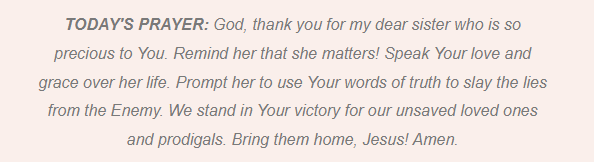
P.S. If you've been praying for a long time and trying to hold onto hope, here are two songs I've been listening to lately and I pray they bless you like they've blessed me.

Read the Entire Series: Praying For Our Loved Ones

Got a Prodigal? Eight Conversation Starters You Can Use

Got a Prodigal? Eight Conversation Starters You Can Use

Hi Friends,
 
Welcome to week three of praying for our unsaved loved ones and prodigals. For those who have written to me over the past few weeks, I am so honored that you have shared your stories and prayer requests. God hears every single one of your prayers. Keep praying!
 
In this series, we are walking through the story of the prodigal son in Luke 15. Last week’s devotion touched on the sadness, embarrassment, confusion, and even anger we feel over our prodigals’ decisions to walk away from their faith. Yet they can run as far as they want, but they can never outrun the love and power of God. Hallelujah!
 
Today, let us talk about how we connect with our prodigals while they are far from God. Many of us have had faith-related conversations that ended in arguments or even damaged relationships. Maybe you've stayed silent because you don't know what to say about their prodigal journey or how to say it.
 
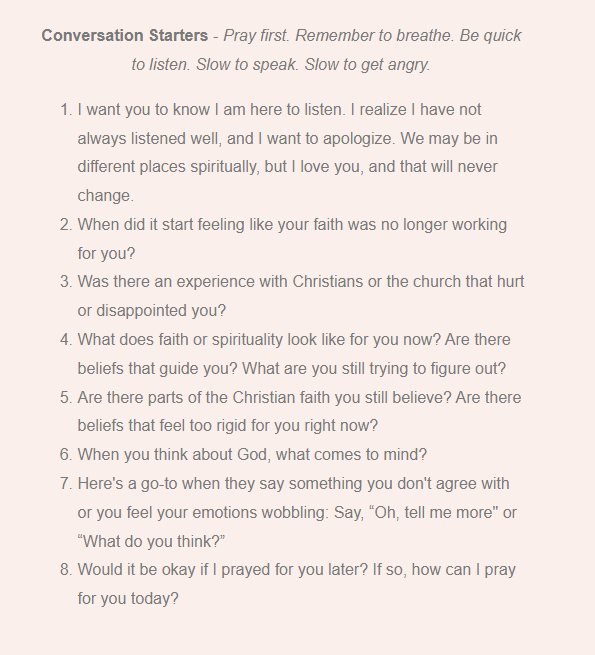
Today’s Happy Monday focuses on one powerful verse and eight conversation starters to help you shine the light of Jesus without getting in the way of what God’s Spirit is doing in your prodigal’s life.
 
This wisdom comes from Jesus’ half-brother, James, a key leader in the early church. Here is what James wrote that applies directly to how we approach our prodigals:
 
“Understand this, my dear brothers and sisters: You must all be quick to listen, slow to speak, and slow to get angry.” James 1:19 NLT
 
1. Quick to Listen
God gave us two ears and one mouth, not the other way around. I am not criticizing anyone for expressing concern or sharing God’s truth. At the same time, I would gently suggest that in our urgency to push our prodigals back toward faith, many of us have not listened deeply enough to understand why they stepped away in the first place.
 
Being quick to listen means we care more about what they are saying than what we plan to say next. When we talk too fast or too much, we miss what is underneath their words. Often, prodigals drop clues about lies they have believed, hurts that were never healed, or confusion they do not know how to resolve.
Be aware, prodigals test the waters before opening up. They want to know if we will listen or argue. Listening communicates safety. It does not mean you agree with everything they say. You can listen in the same way God listens to you.
 
Afterward, you can tell them you will pray about what they shared. Many times, it is best not to respond immediately. Pray first. Talk with trusted friends, a pastor, or a counselor before responding. 
 
Reflection Moment: When it comes to your prodigal, are you quick to listen or quick to speak?
 
Two things often block good listening: fear and pride. Fear says, “We have to fix this now or something terrible will happen.” Pride says, “I am right, and they are wrong, so I need to convince them.” Neither fear nor pride leaves room to trust God’s work in their life.
 
Being quick to listen looks like taking a deep breath and asking God to help you be a calm, non anxious presence when you communicate with your prodigal. God is in control. You do not have to carry the pressure of fixing their walk with Jesus.
 
Here's Your Breath Prayer: (Inhale) God is in control, (Exhale) God, help me listen with Your heart and Your ears.
 
2. Slow to Speak
I struggle with this one. When I see my prodigals struggling, my heart wants to jump in and tell them exactly what to do. I am convinced I can help if they would just listen, right? But most prodigals already know what we would say. Especially for those raised in Christian homes, the issue is rarely lack of information. What they need is a personal, transformative encounter with God.
 
Being slow to speak means we pause and check in with God before opening our mouths. Sometimes God invites us to speak truth and love. More often, He prompts us to do less and say less, so His Spirit can do more. Our silence can create space for God to speak in ways we never could.
 
3. Slow to Get Angry
Do you get angry with your prodigal? Anger is the cover over deeper emotions like fear, grief, and sadness. Which one fits you best? Anger is often an expression of our powerlessness. We cannot fix or rescue them, and those emotions spill over.
 
How do we release the anger? The same surrender prayer we have used each week works here too: God, I can’t. But You can. I will let You. Amen.
 
Let’s Get Practical
Here are some conversation starters you can use if or when you sense God opening a door. Sometimes prodigals hesitate to bring up faith because they feel embarrassed or are not ready to repent deeply, but they may be willing to take one small step toward God.
 
This is why we stay prayed up. We never know when an opportunity will come, so we ask God to prepare us with wisdom, courage, self control, and grace.
If we do this right, we will partner with God in His work in our prodigal's life.  Choosing to live out James 1:19 is an act of faith. We show up, and we trust God’s Spirit to work in us and through us.
 
I pray today's devotion offered the hope you needed today, especially if past conversations have not gone well. It may take time for your prodigal to trust you again. Keep reaching out. Keep extending love.
 
I'D LOVE TO HEAR FROM YOU: Which part of James 1:19 do you most need to apply in your relationship with your prodigal? Share whichever phrase resonated with you: “quick to listen," “slow to speak,” or “slow to get angry.”

Read the Entire Series: Praying For Our Loved Ones

How to Pray After They Walk Away From God

How to Pray After They Walk Away From God

Hi Everyone,
 
First, a big welcome to our new Happy Monday friends from the Aspire Women’s Events. Ladies, I am so glad you are here!
 
Today, we are tackling the topic I receive the most emails about: how to pray for loved ones who have turned away from God. You are not alone if you are praying for someone to come back to their faith. I'm praying for many loved ones, too!
 
This devotion is the second in our series on praying for our loved ones. If you missed last week, you can read it here. We are continuing our journey through the story of the prodigal son in Luke 15. Jesus taught this story to demonstrate God’s heart for the lost and how much they matter to Him. 
 
What is so hard when we see our loved ones turn away from God?
- We are upset that they are making unwise or destructive decisions, possibly causing pain to others.
- Our imagination fills with fears for their future, and we may worry that God will hit them with a big whammy.
- We grieve that we no longer connect over the most important part of our lives.
- We are frustrated because all of this is out of our control.
 
What resonates with you? If you feel deep grief, anger, or frustration, that's okay. But, I'd like for you to stick with me and read on. First, take a deep breath. Hold it. Exhale. Today's devotion gives you space to process how hard this has been for you - and to invite God to speak His truth and comfort into your hurting heart.
 
Let us step back into the story of the prodigal son. We pick up his story in Luke 15:13: “A few days later this younger son packed all his belongings and moved to a distant land, and there he wasted all his money in wild living.” 
-Luke 15:13 NLT
 
Did you know the Greek word asótós, used for wild or reckless, means “prodigal”? When people walk away from God, they head down the highway in the opposite direction called, Interstate ME. It's a road filled with pride.  As they move along this path, our loved ones may trade prayer for partying or the Bible for other religions. Yet, while they seem happy or relieved, we are often crushed as we watch this happen.
 
For parents, sometimes, our prodigal kids engage in what I call “loud” or visible sin that they post online for everyone to see. We want to die inside. Even if it's a quiet rebellion, their prodigal behavior pierces our hearts because we feel we raised them better. Many of us are embarrassed. We feel like their rebellion reflects badly on us. Where did we go wrong? What will people at church think?
 
Some of us have watched siblings, parents, or friends walk away from following Jesus. You tried to talk to them. You warned them. But they turned their back on God, and you are left feeling helpless. It is a terrible feeling.
 
It's so important to be honest about what you are thinking and feeling. If you need more space to grieve, I have this resource for you. 
 
Now, let us consider four reminders about our unsaved loved ones from God’s point of view.
 
1. God pursues our wayward loved ones. He never loses track of them.
It does not matter how far our loved ones run from God. They can never outrun Him. Think about your loved one right now, then read these verses from Scripture:
 
“For the Son of Man came to seek and save those who are lost.” -Luke 19:10 NLT
“I have loved you, my people, with an everlasting love. With unfailing love I have drawn you to myself.” Jeremiah 31:3 NLT
“I can never escape from your Spirit. I can never get away from your presence!” Psalm 139:7 NLT
 
The good news is that your loved one can run as far as they want, and they will never outrun God. Just because God allows them to go their own way does not mean He has abandoned them or stopped waiting for them to return. Speak these verses to your heart when fear tries to convince you otherwise.
 
There is an old poem called The Hound of Heaven, published in 1890 by Catholic poet Francis Thompson. He struggled with addiction and poverty, yet he wrote this poem about God’s tireless pursuit of his soul even as he ran from Him.
God is the Hound of Heaven pursuing your loved one. Do not forget this.
 
2. Let go of shame or embarrassment. It is time to QTIP!
Maybe you needed today’s devotion just to hear this: you do not need to be ashamed or embarrassed if your loved ones have turned away from God.
If you have been around Happy Monday or completed one of my Bible studies, you know my favorite phrase: QTIP. Quit Taking It Personally.
 
Just as you cannot carry the responsibility for an unsaved loved one’s salvation, you do not need to carry embarrassment or shame for a backslidden believer’s decision to walk away. Taking responsibility for their choices means you are carrying a lie, and that lie can drag you into hopelessness and shipwreck your faith. Do not let that happen!
 
When my former spouse struggled with alcoholism, he stopped attending church and his men’s group. I worked on staff at my church, and I was deeply embarrassed during those early years of our family crisis. People constantly asked where he was. I did not want to lie, but I was too embarrassed to tell the truth. Eventually, I told the women in my Bible study group. It was such a relief. Their support empowered me to begin getting the help I needed in Al-Anon and counseling. As time went on, I gained the strength to look people in the eye and calmly say, “He has chosen not to attend church. I am praying for him, and I hope you will pray as well. Thank you.”
 
I do want to speak to those experiencing emotional or financial consequences because of someone else’s choices. This is when you need support and wise counsel, whether from a Bible study group, trusted friends, or a counselor. There is a difference between not taking something personally and not being safe.
 
Quit Taking It Personally means you do not have to shoulder embarrassment or blame for someone else’s choices. But if you are not safe or the emotional environment in your home is toxic, do not stay silent.
 
3. If they are not losing sleep over how they are living, you should not be either
 
Jesus asks in Matthew 6:27, “Can all your worries add a single moment to your life?”
 
Yes, their choices are a serious spiritual matter. But if they are not losing sleep over their decisions, why are you lying awake at night? You cannot change or rescue them. The good news is that God is watching over them, so you can close your eyes and go to sleep.
 
Worry changes nothing. Worship does. Praising God shifts your focus from what you cannot do to who God is and what He can do. I even have a Spotify playlist called Pray Like This (listen here if you need help worshipping more and worrying less.
 
4. Prayer changes things!
God hears every prayer, but make sure you pray in faith, not fear. Praying in faith means spending more time focused on God instead of spending all your prayer time rehearsing your fears. He already knows. God invites you to surrender your fears and your attempts to control the situation so you can trust Him.
 
If you need words to pray, here is the simple surrender prayer from my Stronger Than Stress book: God, I can’t. But You can. I will let You. Amen.
 
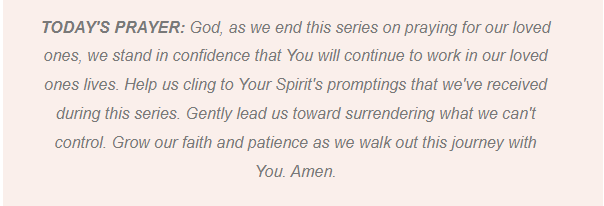
As we wrap up today’s devotion, let us apply that surrender prayer to our loved ones who are not walking with God. Pray this with me:
 
God, I cannot change the path that __________ is on right now. My heart grieves that they are so far from You.
 
Yet there is nothing too hard for You. I know You are a miracle-working God who pursues those who wander. Your Word is a sword that cuts through lies, so I pray that Your Word, already planted in their heart and mind, would come alive. Let it work within them and draw them back to You.
 
Finally, I release the embarrassment I have been carrying. I surrender my attempts to push or pressure them, and I choose to trust You to work. Amen.
 
I'D LOVE TO HEAR FROM YOU: I hope today’s devotion encouraged and comforted your heart. Which of the four reminders stood out to you? Is there something you wish I had addressed that you are still struggling with?

Read the Entire Series: Praying For Our Loved Ones

Praying for Our Unsaved Loved Ones

Praying for Our Unsaved Loved Ones

Happy New Year, friends!
 
It is time to kick off our new Happy Monday series on praying for our loved ones. After I announced this series last week, many of you emailed me with family prayer requests. I stood at my kitchen sink with tears in my eyes as I read your messages. As we pray together over the next few weeks, I'm trusting God to work miraculously in our families. He can do it!
 
Today’s topic focuses on praying for our unsaved loved ones. We will address loved ones who have walked away from their faith next week.
 
You are not alone if you begged God to make sure your loved one had “fire insurance.” (If you grew up in the 80s like me, this was slang some Christians used for salvation.) Of course, we want our loved ones to experience the power and presence of God. We also worry they won't spend eternity with us.
 
Let's be honest about the frustration. Have you prayed for them and still gotten mad at them because they refuse to say yes to Jesus? You can see the emptiness in their lives as they chase money or possessions. You keep reaching out with invitations to church or Bible verses and they brush them aside. Watching them run from God can leave us sad, discouraged, or anxious.
 
You're not in this alone! I am so glad you are on this journey with me today. Come with me into the story of the prodigal son in Luke 15. We will spend the next couple of weeks here. Jesus teaches this story to highlight how much lost people matter to God.
 
The story begins like this: “A man had two sons. The younger son told his father, ‘I want my share of your estate now before you die.’ So his father agreed to divide his wealth between his sons.” -Luke 15:11 NLT
Imagine watching this scene. A son announces, “Give me my money so I can get out of here and live how I want.” Jesus’ audience would have been offended by the younger son’s request. What an ungrateful son. We can feel the ache in the father’s heart. He sacrificed for his son and knew his son would waste that sacrifice on foolishness and greed.
 
What does the father do? He lets the son have his way and gives him the inheritance. Jesus continues: “A few days later this younger son packed all his belongings…” -Luke 15:13 NLT
 
Even though this is a story from Jesus’ teaching, we can picture a loving father watching his son pack and willingly put distance between himself and the family who loves him. As I picture the father’s face, two words come to mind: heartache and rejection. Still, we need to pay close attention to how the father responds.
 
Based on what we see in the scripture, notice what the father does not do:
• He does not pressure his son to stay.
• He does not panic when the son walks out the door.
• He does not chase after the son.
 
How do you live and pray like the father when your loved ones run far from God? Here are a three thoughts for you to hold onto today:
 
First, the weight of your unsaved loved ones’ salvation is not on your shoulders.
 
Let that sink in for a moment. Drop your shoulders and exhale if you need to. Dear friend, I know you worry about their eternity, but your worry does not equal responsibility.
 
The father allowed the son to choose his own way. God is allowing your unsaved loved one to choose their own way, too. You can't control someone's choice to run from God. 
 
What are some clues you're carrying the weight of their salvation? Nagging (not asking) them to go to church or constant check-ins about their spiritual life are clues you're doing too much. Also, if they're telling you to “back off,” or they shut down in conversations, this is clue for you to shift your words for them into prayer.   
 
Remember, you came to faith on your knees, not on someone else's back. Give them the chance for the same type of  authentic come-to-Jesus experience.
 
Second, God is not holding your loved ones' salvation hostage until you pray the perfect prayer a prayer certain number of times.
 
Again, the weight of your unsaved loved ones' salvation is not on you.
 
Should you pray for their salvation? Yes. James 5:16 reminds us that the earnest prayer of a righteous person has great power and produces wonderful results
 
This does not guarantee God will answer on your timeline or in the way you expect, but your prayers do have a supernatural effect. Do not stop praying! At the same time, put your faith in God's love for them and His timing. Don't put your faith in how much you're praying. That's making prayer about you, not God.
 
(If praying has felt frustrating or you are unsure what to say, January is a wonderful time to begin my Matthew: Pray Like This Bible study. It is designed to help you pray with confidence and clarity. You can find it here.)
 
Finally, God loves them and desires their salvation more than you do.
 
Here is a powerful reminder from Scripture:
“The Lord isn’t really being slow about his promise, as some people think. No, he is being patient for your sake. He does not want anyone to be destroyed, but wants everyone to repent.” -2 Peter 3:9 NLT
 
This verse does not guarantee that everyone will accept Jesus. Sadly, some won't. But, you can rest assured that God loves your unsaved loved one and will give them every opportunity to be saved. Trust Him! 
 
TWO RESOURCES FOR YOU!
Friend, thank you for joining me today.
 
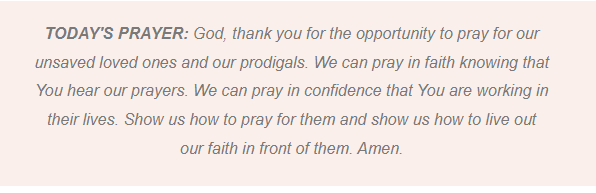
1. I have included an extended prayer below if you need words today. Feel free to share this devotion with friends who are praying for unsaved loved ones.
2. I've included a link to a “Come to Jesus” Prayer card that you can print to help you be intentional about praying for others.
 

BONUS: PRAYER FOR YOU & YOUR UNSAVED LOVED ONES

FREE RESOURCE: Come to Jesus Prayer Card

Praying for others' salvation is an important part of living out our faith! Here's a card to help you be more intentional about praying for people to come to know Jesus. This “Come to Jesus” prayer card was adapted from a resource from my church. I have a card like this taped to my bathroom mirror so I'll see the names of people to pray for other. Click the link below to save this card (there are prayer prompts included!).

Read the Entire Series: Praying For Our Loved Ones

Pin It on Pinterest