by Barb Roose | Dec 29, 2016 | Scripture Devotional, Women's Topics
Has holiday overeating left you feeling horrible? Here’s five positive ways to wrap up your holiday.
By Barb Roose
Anyone feeling guilty over the Mt. Everest-size mountain of food that they’ve consumed over the last couple of weeks?
Are you disappointed that your best intentions for self-control fell apart 88 cookies, 23 pieces of pie, a bazillion wings and 10 glasses of eggnog ago?

Maybe you’re wearing a Charlie Brown-sad face. Maybe not. A few days ago, I asked myself where I was at because frankly, I was feeling a little out of control. Which one describes where you’re at right now:
- Can’t. Stop. Eating.
- Doing okay.
- I’ve had fun, but I’m back on track.
- I can’t answer this question right now.
- Holidays don’t change my habits.
Honestly, I started out on track this holiday season. Yet, a single crockpot of rich, creamy, tangy buffalo chicken dip derailed all of my good intentions.
I attended a Christmas cookie exchange a week ago. When I entered the beautifully decorated home, I smelled the air and saw a crockpot on the counter. My heart fluttered with hope. My mind snapped to alert because I knew that a temptation that lurked within. Could I resist?
I grabbed a plate and made my plan. I scanned the counter. A giant bowl of Asian salad caught my eye. That’s it! Salad would be my salvation. Why do we women believe that salad will save us?
Let’s be honest: A salad is like wearing shorts during a snowstorm. Technically, you’re wearing something, but you really want to wear something that actually gets the job done. That salad wasn’t going to save me from buffalo chicken dip because I REALLY wanted buffalo chicken dip.
Still, I heaped my plate full of Asian kale salad hoping that my healthy food choice could change my heart’s desire.
Not a chance.
As I neared the crockpot of my downfall, my fork magically pushed back the hopeful avalanche of vegetables to create room for what I really wanted.
But wait. I paused to create a failsafe (kinda). I asked a woman that I’d just met that night to be the light of accountability for me: “Honey, I LOVE buffalo chicken dip. Can you make sure that I only have one serving?”
She agreed, but with a knowing smile on her face. We both knew that I wasn’t going to have just one serving, but I still gave myself an A for effort.
When I removed the lid, the rich, tangy smell hypnotized me with its heady scent. I scooped a not-too-big, yet not-too-small dollop of dip on my plate and quickly surrounded it with the wall of sturdy nacho chips.
Friends, I sat down, placed my napkin across my lap and proceeded to ravage that dip like a starving man who found water in the desert.
To be fair, that kale salad was amazing, too! But once I finished the salad, I immediately started thinking about how to justify getting another serving of Buffalo chicken dip. In fact, my life would no longer be complete unless I had another serving of that rich and creamy dip.
My name is Barb, and I am obsessed with buffalo chicken dip.
Filled with glee, I pranced back to that crockpot ‘o delicious wonder and loaded up again. However, the sweet ending fell flat. That second helping was too much and my tummy started to rumble. It sounded like, “You idiot! What have you done to me?” Remorse and guilt settled atop the once desired, now demonized substance. All I felt was the weight of rich and creamy regret.
What now?
For many of us, our relationship with food turns the most wonderful time of the year into the most horrible time of the year as we near the new year. The holiday food preparation and celebrations that brought us joy before Thanksgiving are occasions tinged with regret. How many of us feel anxious or regret over our lack of control. How many of us are tempted to shout, “I give up! I’m just gonna keep eating all.the.food because I’ve blown it already.”

I wrote this post, because I know how you feel. Just because I write to encourage women to see themselves as God sees them, doesn’t mean that I don’t have to fight off the feelings of overwhelmed and out of control.
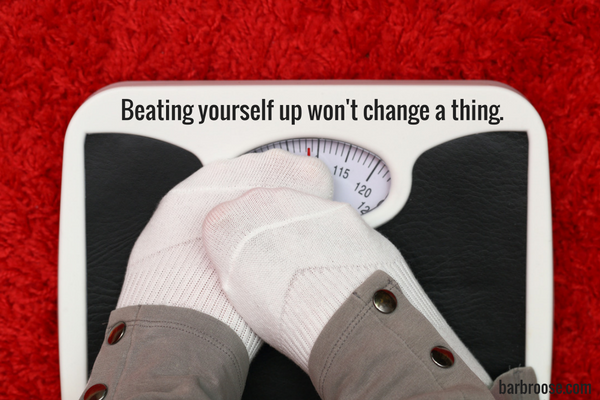
There’s one thing that I want to say to you: Beating yourself up won’t change a thing.
Beating yourself up doesn’t burn calories.
Beating yourself up won’t change your behavior.
Beating yourself up will make you feel bad enough about yourself and drive you to consume much more.
5 positive ways to wrap up your holiday
We’ve got just a few days left in the holiday season, and I want to share with you five tips to help you move away from beating yourself up to blessing yourself with kindness. Treating ourselves with kindness is the only path away from shame and guilt.
- Stop your stinkin’ thinking!
When you hate yourself for your behavior, you undermine your ability to see what God wants to do in you. Here’s something else: Shaming yourself with self-hating talk won’t help you make lasting changes.
Here’s a tidbit from my Enough Already book: “Stop blaming yourself for what you’ve allowed to happen. Whether because of gaining weight, letting your appearance fall apart or allowing yourself to become bitter, shame isn’t going to dig you out of the hole.”
Sweet sisters, self-hatred obscures the revelation of God’s love in our lives. When we see ourselves as God sees us, we’ll treat ourselves like women who are loved and valued.
ACTION STEP: If you’ve gotten in the habit of talking badly to yourself, try saying this each time you look in the mirror for the next seven days: “I am God’s beautiful, unique daughter.”
2. Get real about the real you.
Comparison is killing us, sisters! We’re so busy criticizing ourselves for not being like someone else that we’ve forgotten how to celebrate who God created us to be. Stop comparing yourself to other women, their diets or exercise habits. Comparison is a killer of self-esteem, motivation and joy.
ACTION STEP: Make a list of 10 things about yourself. Celebrate what you do well and where you aren’t perfect. God loves the real you. It’s time for you to love yourself like He loves you.
- Pick ONE thing.
How do you eat an elephant? One bite at a time. So, instead of tackling weight loss, new eating habits and a new workout all at once, just pick ONE thing to do for the next 30 days. You’ll feel better about yourself for doing one thing than the avalanche of failure when you blow it trying to do too many things.
If you need a few ideas for your one thing, consider choosing ONE from this list:
-Eating some fresh fruit and fresh/steamed vegetables each day
-Drinking 8 glasses of water per day.
-Eliminate one unhealthy food
-Taking 10,000 steps per day or working out
(By the way, this list is actually from my own personal experience. On days when I’m overwhelmed or feeling blah, I simply choose to focus on doing one thing that day. Today, my energy was low so I focused on 10,000 steps.)
- Phone a friend
Don’t your friends get mad at you when you beat yourself up? Yes! So, let them hold you accountable to stop stinkin’ thinking or hold you accountable for the one healthy behavior that you choose. Give her permission to text you so that you can let her know how you are doing.
ACTION STEP: Choose a friend to help you stay on track. It’s best to find a friend who also wants to be held accountable. Make a pact to text each other for 30 days and then re-evaluate if you want to continue.
- Make imperfect progress
This phrase “imperfect progress” is taken from best-selling author Lysa TerKeurst’s book, Unglued. This brilliant phrase captures how we can continue to move forward while recognizing that we may stumble or even fall on occasion.
No one’s perfect! Friends, it’s time that we stop using perfection as the standard for our dietary or weight loss lives. I’ll never eat perfectly. I’ll never workout perfectly. Neither will you.
But, we CAN make imperfect progress. We can hold yourself accountable to the goals that we set. We can follow the conviction that God has given us about our health and lifestyle. That doesn’t mean that we’ll be perfect, but it does mean that we’ll be committed to “imperfect progress” and always moving forward.
TELL US ABOUT YOUR EXPERIENCE: Do you struggle with holiday eating? Which one of these five tips encourages you the most today?
by Barb Roose | Jul 7, 2016 | Reflections

One night, I walked into a neighborhood pub. As soon as the door closed behind me, an unknown voice yelled: “What’s that nigger doing in here?”
Was someone talking about me?
I stopped. The room silenced. An electric pause buzzed the air.
My mind calculated what I’d just heard. Then, a thought: Oh, I KNOW that he did not just say that to me.
Another moment passed. A volcano of rage started to bubble deep within. Let me take my shoes off. Earrings, too. Somebody – SOMEBODY, hold my purse.
That incident happened over 20 years ago, however, I remember it like yesterday. On that night, I walked in to enjoy some dinner. Except someone decided that I didn’t belong.
Not based on my personality,
Not based on my family background,
Not based on my ability to pay,
Not based on my company,
BUT based on my skin color, I was unacceptable.
I gazed around the room wondering if anyone would speak up or even say something – anything.
Silence.
So, what did I do?
I held my head high, glided through the hushed crowd and took my seat at the table. Yes, I did.
I suspect that some of you are questioning, “Was it really that bad?” or “Are you sure?” You’re shocked that those things could have happened to me.
But they did. In my early adult years, I learned how to ignore the sales staff that helicoptered while I shopped for shoes. I learned the importance of not messing with my purse while browsing merchandise. I embraced driving 10 miles UNDER the speed limit in certain communities – especially if I was driving at night.
Those situations never shocked me, but I hesitated to recount them because of the shocked-responses from others. Racism thrives in part because it shocks the majority into disbelief. I’ve heard responses such as:
“Are you sure?”
“I can’t believe it…”
“That can’t be!”
“Say it ain’t so!”
Unless you’ve been a direct victim or eyewitness of someone who’s experienced racism, stories about racism will always be shocking.
Yesterday, a cell phone camera captured police restraining an African-American man named Alton Sterling on the ground. Then, those same officers fatally shot Sterling while restraining him. Much of America is in shock. But, not those who’ve been wrestled to the ground like Sterling. Not those of us who’ve witnessed our fathers and brothers stopped for no reason, hassled or pulled from their cars. We’re not in shock. We’re a lot of things – angry and sad sums up a lot. It seems that each #shootingincident buries us deeper into the struggle over of the color of our skin and the fear that lurks within.
There’s nothing about our first-world mindset that wants to accept that racism could be just as pervasive as it was when men began wearing white sheets and Africans exited boats in chains. Apparently, we’re not as awesome as we think we are. Seriously, we discovered how to fly, found a vaccine for polio, developed a nuclear bomb, put a man on the moon, learned how to record on a VCR, taught Grandma how to use Facebook and elected a black man as president twice —
Yet, we can’t accept that racism is woven deeply into the fabric of our American experience.
In our mental model, racists hang out with murders or pedophiles. So, a racist couldn’t possibly be the fun neighbor up the street or the sales manager in your office. We don’t want to call someone a racist unless we can SEE them being racist.
But, how do we call out people who harbor racism in their hearts? Even more so, how do we call it out in ourselves?
You just thought that I called you racist. I didn’t. Only you can answer that. But, I do want you to consider how you’ve been impacted by the roots of racism in your family of origin.
What you believe about race is influenced by the generations of conversations and experiences that happened long before you were born. Your great-grandparents sat and around the table and talked about race. Your grandparents heard them. Your parents heard your grandparents. You listened to your parents. I’m not saying that you agreed with all that was said, but you’ve got to be aware of how those words and stories influenced your thoughts, feelings or behaviors.
Questions to consider:
- When you were a kid hanging out at family gatherings, how did your family talk about race or people from different races?
- Are there any race-related incidents in your family’s history that turned into stories that you were told as a child? How did those incidents impacted how your family lived?
- What are your operating stereotypes? (Asians are smart, black women are loud, black men are scary, white people are fake)
- What are some of the hot-button issues that you know would create tension if you discussed them with someone of another race? Why would those issues create tension?
- What would a friendship with someone from another race look like? (It would not be a true friendship unless you could talk about race.)
So, what now?
- Love must lead the way.
Some of you are tired of hearing people like me talk about ‘love.’ For you, love is for Valentine’s Day. Love is something that gets hot and heavy on Friday night. You don’t really believe that love is a potent power in our universe that can actually affect change. Maybe it’s because we really don’t know how to love. We’ve cheapened it and now, we think that the strategy of love has failed us. Except, our back-up plans of ignorance, hate and anger haven’t worked either.
I love Martin Luther King Jr’s vision for the future. He had hope because he believed in people. He believed in us! He knew that racism would never be eliminated by laws or lawsuits – even though he fought for legal and social justice. But Dr. King preached the same thing Jesus preached long ago: Unconditional love is the only road to the elimination of racism. Racism will die once our unconditional love for each other comes alive.
Love is not a feeling. Love is an action. Love is THE ONLY strategy that can save us from society-destructing ourselves. You’ve got to remove your limits on your love for people. Here’s the ultimate test for love: Decide now that you will lay down your life for another human, no matter their race or culture. When you decide to display that kind of love, then you carry the torch of hope for our tortured nation.
Check out Dr. King’s words:
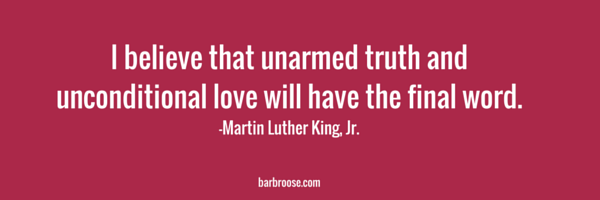
“I refuse to accept the view that mankind is so tragically bound to the starless midnight of racism and war that the bright daybreak of peace and brotherhood can never become a reality… I believe that unarmed truth and unconditional love will have the final word.”
2. Labels lie. Relationship reveals the truth.
Here’s the thing: We feed what we believe. As long as we believe that all black men might steal our purse or that all white people will stab us in the back, those lying labels will keep us far apart from each other. When we stop looking for evidence to feed our faulty beliefs, then we’ll be willing to open ourselves up.
What would it look like for you to develop a relationship with someone from another race? It’s more than having a “black friend at the office” or “having a white girl to roll with on Friday night.” It means that you get to know someone well enough that you can talk about the things that matter in life. It means that you can agree to disagree – still love each other. It means that you can come from different cultural or socioeconomic perspectives and still respect each other’s viewpoint, even though you may not completely understand it.
3. Start new conversations with your family
If you ever expect that future generations will move away from where we are today, then we have to give them a new target. Focusing them on the target of developing authentic relationships begins with authentic conversation.
How can you have new conversations with your kids or older family members? Consider this:
- Eliminate “them” and “they” when talking with your kids about race. Use actual names and tell personal stories when you talk with your kids about people from different races or cultures.
- Discover how race has impacted your family by talking with older members of your family. Start with the question: “What do you think about what happened to Alton Sterling?” Now, the tension reappears once they finish talking. How do you respond to their answer? Pastor Andy Stanley suggests these questions that you can ask without fear of offending: What led you to that viewpoint? Have you always believed this way?
- Can you promise me that you’ll memorize this verse before talking to ANYONE? Here it is: “Be quick to listen, slow to speak and slow to get angry.” -James 1:19
Speaking out about race isn’t easy. Our experiences with race are just as personal as they are collective. So, thank you for stopping by and checking out this post. I’d love to hear your thoughts on how we as individuals can be the light of hope in American’s dark night of racism. Please leave a comment below.



 I wrote this post, because I know how you feel. Just because I write to encourage women to see themselves as God sees them, doesn’t mean that I don’t have to fight off the feelings of overwhelmed and out of control.