by Barb Roose | Jan 15, 2017 | Better Together Podcast

Have you ever felt like your child was your parenting report card? If he or she was doing well in school, then you felt great. But, if your precious cherub was causing the teacher to pull her hair out, then you were failing.
How do we snap out of making our kids our “report card” and instead love and raise them as God calls us to do?
Proverbs 22:6 tells us to direct our children onto the right path so that when they are old, they will not leave it. If the Bible tells us to teach our kids God’s ways, how do we teach when we’re not always sure on how God wants us to live?
Today’s guest, Melissa Spoelstra coaches moms through eight areas that we need to teach our children so that they can develop their own relationship with God. As the mother of four kids, Melissa understands the difficulties and hard decisions that go along with parenting. According to Melissa, parenting is never about perfect, but intentionally planning out how to disciple our children so that they can learn to love Jesus.
In her book, Total Family Makeover, Melissa discusses how Jesus modeled certain disciplines, like prayer, mentoring and service. Then, Jesus taught the disciples how to integrate those same disciplines into their lives. Melissa will share her experiences as a mom, stories about how she’s “failed forward” as a parent and encouragement for any mom who’s at the end of her rope.
In today’s podcast, listen to my interview with Melissa as we discuss:
- Why we make our children into our parenting report card;
- How not to disciple your children into worriers;
- The CRUCIAL importance of finding a mentor mom to help you stay sane during your parenting years;
- The differences between parenting young kids and parenting older kids;
Melissa Spoelstra’s Website
Melissa’s Recommend Parenting Resources:
About Melissa…
Melissa Spoelstra is a popular women’s conference speaker, Bible teacher, and writer who is madly in love with Jesus and passionate about helping women of all ages to seek Christ and know Him more intimately through serious Bible study. She holds a Bachelor of Arts in Bible Theology and enjoys teaching God’s Word to diverse groups and churches within the body of Christ.
She is the author of the First Corinthians: Living Love When We Disagree, Joseph: The Journey to Forgiveness, Jeremiah: Daring to Hope in an Unstable World Bible studies, and the soon to be released Total Family Makeover: 8 Steps to Making Disciples at Home book.
She lives in Dublin, Ohio, with her pastor husband and four kids. Find her on Twitter @melspoelstra and Instagram @daring2hope, and follow her blog at MelissaSpoelstra.com.
by Barb Roose | Jan 9, 2017 | Christian Living/Discipleship, Women's Topics
by Barb Roose
I knew something was up when I received a link to the same blog post from several women’s Bible study leaders from around the country. The writer sent out a plea to women’s ministry leaders asking them to stop telling women that they are beautiful if that beauty message wasn’t tied to the gospel. Her blog connected with women across the country. What caught my attention were the comments from her readers. There were a lot of opinions and negative feelings out there about how beauty was addressed at women’s conferences and how beauty is taught by women’s ministry leaders.
As a communicator who speaks and writes about Christ-centered identity and beauty, I’ve heard women’s ministry leaders question whether beauty is a worthy spiritual topic. Some even rate beauty as watery spiritual milk rather than stick-to-the-bones spiritual meat. There’s a confusion about how we should talk about beauty, so without a clear way forward, women’s ministry leaders may settle for the simple “You are beautiful” cheer with no foundation or refuse to address the topic of beauty for fear of criticism from other Christians.
In either case, I fear that those two positions could actually hinder the effectiveness of women’s ministry now and into the next generation.
As long as we’re silent or hostile about talking about beauty, Satan will own the beauty dialogue. He already does. We’re seeing the results of his deception everywhere. There’s nothing fluffy or cute about beauty. The topic of beauty has become a bloody battlefield. Young girls are being bullied to death over their looks or weight. The lure of online fame compels our daughters and granddaughters to mimic the lifestyles of those that our culture worships and adores.


So, what should we be teaching women, both Christian and non-Christian women, about beauty? I believe that there are two things we must teach:
First, beauty is a topic that is wholly biblical!
Let’s stop treating the topic of beauty like an ugly scriptural stepsister. Did you know that the words “beauty” and “beautiful” appear in the Bible over 100 times?* In fact, beauty is a quality associated with the character of God, meaning that He has no ugliness or distortion.
One thing I ask from the Lord, this only do I seek: that I may dwell in the house of the Lord all the days of my life, to gaze on the beauty of the Lord and to seek him in his temple. –Psalm 27:4 NIV
The Bible talks about beauty on many levels and its impact on our lives. At its worst, we see how beauty fueled Rachel and Leah’s baby daddy rivalry and caused Abraham to fear for his life. At its best, God used beauty to influence the selection of Esther as Queen as well as her gentle and quiet inner beauty to gain favor with the king to save the Jewish people.
For a topic that is written about in many ways in scripture, it feels like we’re more in touch with culture’s perspective on beauty than God’s perspective. We define beauty by what we see in advertisements, social media “likes” and celebrity chatter. As Christian women, we find all of those expressions of beauty distasteful. But we don’t really have a good scriptural foundation, so we declare beauty a bad word.
Last week I interviewed Christian fashion expert Shari Braendel on my Better Together podcast. Shari is a bold woman of faith and considered America’s leading voice in fashion, beauty and dignity for Christian women. Yet she has been criticized by Christians who don’t believe that outer beauty is a spiritual topic that Christian women should care about. Regardless, over the past 12 years, God has used Shari to speak hope, truth and freedom to thousands upon thousands of women.
FULL DISCLOSURE: I’m a Christian women’s speaker and author who stands on platforms around the country and boldly tells women that they are beautiful because God created them. It’s biblical and needs to be said. Why? Because most women have no idea how God sees them! Far too women see themselves dipped in ugliness, guilt and shame over sin-related life experiences—some at the hands of another.
Women’s ministry leaders, we can tell a woman that she’s beautiful AND tell her that she is in need of a Savior. We can tell her about who God created her to be and how Jesus came to die so that she could experience life to fullest without guilt or shame. We can and should give both of those messages and repeat them as often as possible. Just the same as we never stop saying Jesus loves you because we think people should get it by now, we can never assume that a woman always remembers that her beautiful identity is solidified in God.
Secondly, when the Bible talks about beauty, it’s addressing both inner AND outer beauty.
When it comes to beauty, what’s on the inside does matter most, but it’s not the only thing that matters.
We’ve gotten in a habit of elevating inner beauty because of a few verses (Proverbs 31: 30 and 1 Peter 3:3-5) and pretending that we don’t care about outer beauty or that it’s bad. But God cares about both.
Who created the sunsets, flowers and rainbows that we obsessively photograph and post to social media? God created them to show us what He thinks about physical beauty.
In Genesis 1, God creates our physical world and the first humans. How often do we see the phrase “God saw that it was good” in this chapter? When God created the sun, moon, stars, trees, flowers and animals, God looked at their physical structure. The Hebrew word for good is towb, which is translated beautiful.
And God saw that it was beautiful.
In a world where women are targeted with 400-600 media advertisements a day, we cannot forget that God is the Creator of beauty, both inner AND outer beauty.
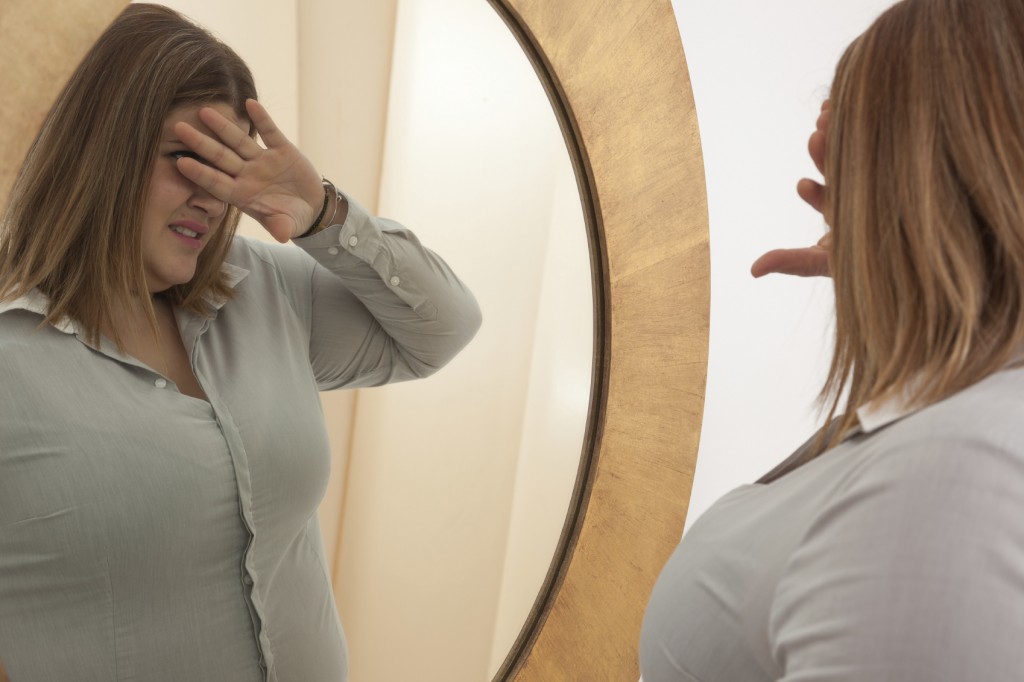
And what about us? What about adult Christian women? How many of us are silently bearing the scars and shame of outer-beauty issues? Sister, I know that you love Jesus. But I also know that you’ve probably stood in front of the mirror at one time or another whispering that you are “fat” or “ugly.” If God were standing next to you, how would you explain that?
So, here’s an incredible opportunity for us to reach women with the hope and freedom of Christ IF we remember the big picture:
Talking about beauty is an open door to talk about redemption and restoration.
In Matthew 6, Jesus teaches a crowd on a hillside. He uses the beauty of flowers as a teaching tool to remind us of how God sees us and cares about our physical needs. Jesus also refocuses our perspective:
31 So do not worry, saying, ‘What shall we eat?’ or ‘What shall we drink?’ or ‘What shall we wear?’ 32 For the pagans run after all these things, and your heavenly Father knows that you need them. 33 But seek first his kingdom and his righteousness, and all these things will be given to you as well. –Matthew 6:31-33
Raise your hand if you’ve ever felt angst, guilt or shame over “What did I just eat or drink?” or “For the love, my pants are too small. What am I going to wear today?”
First, Jesus acknowledges the struggle. Then, He tells us what to do. For every struggle, Jesus shows us the solution: See God first.
There’s a lesson in that for women’s ministry leaders, small group leaders and all mature Christian women: Acknowledge your struggle. Share Jesus’ solution.
How can the women in our churches and communities come to Christ and confess their guilt and shame if we’re silent about ours?
Maybe this is why a certain segment of women aren’t registering for conferences or retreats. When a broken woman attends an event and all she can see are well-dressed, plastic-smiling women that look shiny and perfect, she’ll struggle to relate and leave still starving for connection.
If you plan women’s events, remember that women attend conferences because they want to find solutions for what’s missing, broken or changed in their lives.
Women don’t want perfect. Women want real. Real answers. Real stories. Real women who aren’t trying to market their Pin-Perfect lives.
If you want to draw women into your next women’s event, then think about what the women in your church and community are praying about. Where are they begging God to show up in their lives? Match up those prayers with God’s hope and truth. Now, those are the topics to plan around and invite speakers to address.
And to us speakers, we’ve got to show up and tell our “But for Jesus” stories. If we’re going to stand on the platform, it’s because we’ve got a story of how Jesus rescued us from the pit. We’ve got to talk about surrender and sanctification so that the women can see that we’re putting one foot in front of the other just like they are.
And we’ve got to talk about beauty.
When I talk about the topic of beauty, I begin with a photo of what I look like first thing in the morning. Why? Because I may show up to an event looking put together, but I don’t want the women in the audience to think that’s how I roll 24/7. They need to see the “before-and-after Barb.” I show them the physical before-and-after and talk about my spiritual before-and-after. I want every woman to know that what Jesus did for me, He can do the same for her.
I dream of the day when every Christian woman has the strength and conviction to also declare that she is beautiful—not just for her sake, but also so that she can be the city on a hill to reach the millions and millions of women out there lost in the land of guilt and shame.
Just to make sure that you know, I’m going to keep telling women that they are beautiful. I don’t need to know your name in order to look you in the eyes and tell you that you are beautiful. I can do it authentically and truthfully because God’s Word guarantees the truth of that statement with 100% certainty.
Thanks for stopping by and checking out this post. I’d love to hear your thoughts. Share your comments below.
*NIV version
by Barb Roose | Oct 28, 2016 | Christian Living/Discipleship, Women's Topics
I don’t know about you, but sometimes it can be tough for me to distinguish between my need for food and my desire to eat.

Without being critical of my body size, I’m fairly certain that quite a bit of what I consume isn’t related to my biological need for food.
A couple of years ago, my friend Jera made a pecan pie for me. I love pecan pie! I took that pie into my house and set it on the counter. While I wasn’t physically hungry, that pie started to look really good to me. In fact, I could hear that pie talking to me. Seriously, it was! It said, “Barb I’m over here. It’s so lonely over here. I think I’d like to be in your tummy more than I’d like to be sitting on this counter.”
Have you ever had food speak to you like that?
I tried not to listen to that pie, but it kept talking! The only way for me to quiet the pie was for me to eat it.
So I did.
I ate the ENTIRE pie in one afternoon.
Are you horrified? Trust me, I was – especially since I wasn’t event hungry. So what happened? My appetite, that’s what happened!
God created our bodies to need food. However, God gave us appetites as well. In addition to an appetite for food, we are born with an appetite for love, acceptance, satisfaction, achievement, and connection. Think about those things you long for every day, such as someone to love, acceptance by others, or a deep sense of connection. Each of those things represents a craving or an appetite.
Here’s the most important part: How you manage your desire for love, acceptance, security or connection determines whether you are controlling your appetite or your appetite is controlling you.

As women, this concept is critical because we always have unfulfilled appetites; and when our craving for love, acceptance or connection goes unfulfilled, we often turn to food in order to temporarily satisfy that unmet need. Does the term, “comfort food,” sound familiar?
How often do we toss into that void a half dozen cookies or a carton of ice cream? One of my favorite quotes is from character Lavon Hayes from the tv show, Hart of Dixie. After his girlfriend breaks up with him, Lavon shows up on his friend’s doorstep with a big of donuts and says, “Help me eat my feelings.”
In the Old Testament, Esau was a man with the ability to hunt his own food, but he struggled with an unidentified hunger. Maybe he wanted approval from his father or he was jealous of his brother – we don’t know. Something deep inside of him was hollow and empty enough to feel like hunger. Esau’s sneaky twin, Jacob took advantage his hunger and Esau ended up trading away his future.
How often do you eat when you feel lonely, angry, tired or sad? What are the foods that you pick up and have difficulty putting down when you are hurting?
If you get the chance, check out Matthew 4:1-11. It’s the story of Jesus’ temptation in the dessert, I mean desert. Why did God lead Jesus into the desert to be tempted by the devil anyways? It was because God wanted us to see how the power of God living within can overcome our human desires that can get out of control.
How do we deal with our hunger for love, acceptance, security, satisfaction or connection? In my Beautiful Already Bible Study, we talk about the tools that we can use to surrender our hunger to Christ and allow Him to fill us. Why? Because only Jesus satisfies!
If you struggle with emotional eating and want God to work in this area of your life, I’ve developed a HALT Food Diary. HALT stands for hungry, angry, lonely, tired. These are often to triggers for binge eating. Click here to access a copy. Print it and tuck it into your purse. Keep track of what you eat for the next few days and make circle the emotions that you were feeling while eating. Once a day, talk with God about your eating habits and your unmet deep needs.
Give your unmet desires to God instead of giving in out of frustration to food. Let God fill you up!
SHARE A COMMENT WITH US: What’s your go-to comfort food? Are you more likely to eat it when you are hungry, angry, lonely, tired or all of the above?
by Barb Roose | Mar 26, 2015 | Scripture Devotional
 I’m a food thinker.
What’s a food thinker? A food thinker is someone who is ALWAYS THINKING ABOUT FOOD!
That’s me.
In fact, when I eat breakfast, I want to know what I’m going to eat for lunch. After lunch, I thinking ahead to dinner, but not before pondering the snack that I’ll have in-between.
Any other food thinkers out there? Let me hear you!
As a food thinker, I’m not just thinking about the food that I want to eat, but I’m also run an internal dialogue about the food that I just consumed.
Oh, I wish that I wouldn’t have eaten that!
I.want.more. Yum!
I really wish that I eat another Mr. Freeze Wow Cow Peanut Butter No-fat, no sugar ice cream with hot fudge, pecans and real whipped cream ALL OVER AGAIN!!!!
(That last one was a true thought from last week. I miss that sundae.)
Some of us think about food a lot and our attitude drive our thoughts.
We can get a little nutty defending our right to eat our way – and sometimes, we can sniff our noses at those who may have a differing opinions. I’ve noticed that the topic of food can divide up women pretty quickly. Organics versus Mac-n-cheesers or the Vegetarians versus More Meat-eaters or the Vegans versus Burger King Whopper lovers.
I don’t think that God wants food to divide us or disconnect our hearts from each other – and food surely isn’t supposed to siphon away our desire to focus wholly on God.
How do keep our relationship with food in its rightful place in our lives? How we can enjoy eating, without using food as a way of subtly asserting superiority or using food as drug to cure emotional pain?
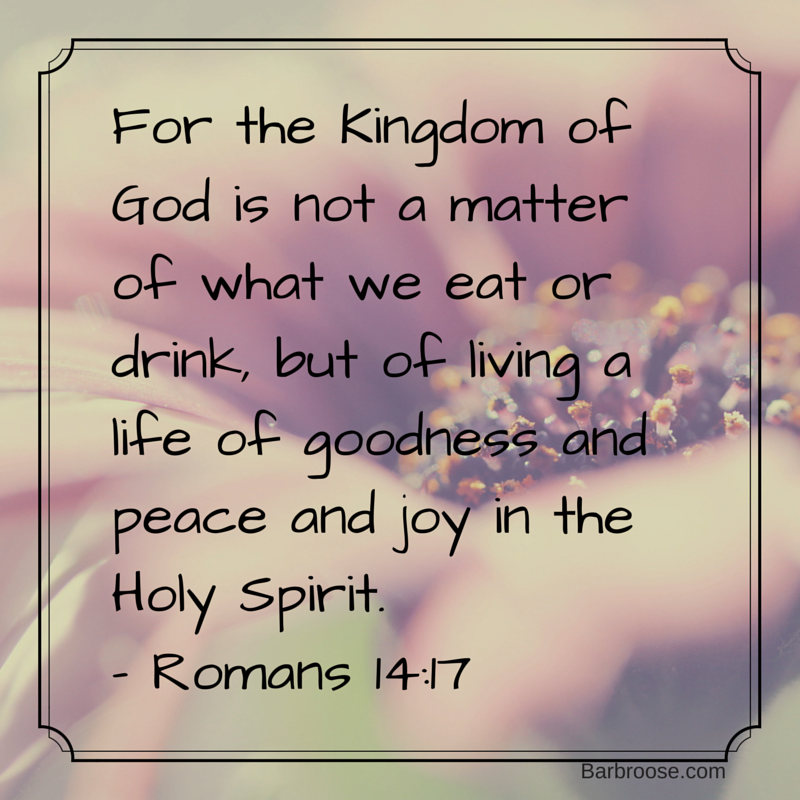
I ran across this verse a few months ago, it got my attention:  In other words: What you eat shouldn’t be your measure of righteousness or condemnation AND what/how you eat shouldn’t occupy your thoughts more than your desire to live God’s call for your life.
In Romans 14:17, the scriptural author, Paul, wanted to redirect the people from thinking that they could gain spiritual and social superiority by eating and drinking the right things. Obsession over “right” and “wrong” foods distracted the people from what really mattered: Worshipping God with their lives and focusing on Him rather than self. Rather than over-focusing on are we eating the right or wrong things, how do we focus on what the Apostle Paul calls us to focus on instead:
Goodness: Pleasant inward disposition or attitude toward others
Peace: reconciliation with others and reconciliation with God
Joy: Unfailing inner brightness regardless of our circumstances
Awww, snap.
Here I am more worried about whether or not I’m still gonna be hungry after eating my salad-in-a-jar and it seems that God wants to shift my perspective. Instead of focusing on calories, metabolism, steps walked or what’s been crossed and fitted, the real kingdom question is: How am I doing with goodness, peace and joy in God’s eyes?
How are you doing?
Q4U: On a scale of 1 (bad) – 10 (great), how are you doing with living out God’s definition of goodness, peace and joy? Where are you doing well and where are you struggling? Let’s have a discussion below!
Thanks for stopping by for today’s Beautiful Devotional! Want to receive the rest of this Beautiful Devotional series or weekly encouragement from me about your shape, style or soul? Just click here to subscribe to barbroose.com. I won’t fill up your inbox, but once a week, I’ll encourage you and make you smile!


by Barb Roose | Jun 28, 2013 | Uncategorized
Planners comfort me. Always have. I love that there is something out there that is supposedly organizing my chaotic life. Even if that is not actually true, I like to believe that it is…
Before there was iCal or Outlook, I used a Blackberry to schedule my appointments and remind me to take my medicine. Before that, my Palm Pilot ruled my world! Remember how we loved the sleek, sexy design – but we didn’t love the little stylus that kept getting lost! Before Palm Pilots, we planned by paper. Of course, the Rolex of paper organizers was the good ole’ Franklin Planner. Owning a Franklin Planner was the ultimate confirmation that whatever I was doing must have been important. Yes, I was doing something important enough to write down in a $300 PAPER planning system. Anyone else feel silly knowing that we can get an iPad Mini for the amount we used to spend on a Franklin Planner? Sheesh!
I may not always follow the schedule I’ve written down, but I like knowing that it is there – that at some point I was smart enough to think ahead of the game. Yes, I love to plan.
Except for when it comes to food. No plans. I just want to eat what I want, when I want and how much I want.
I’m leading a group of women through Lysa TerKeurst’s best-selling book, Made to Crave. There’s a phrase that has been ringing in my ears every time I think about eating a second helping or a third cookie: unrestrained pleasure.
That phrase usually triggers the words of 1 Corinthians 10:23 – “Everything is permissible, but not everything is beneficial.” And, then I get a little annoyed (and even a little panicked!)
Why? When it comes to food, I want what I want when I want it. I love how Lysa’s personal journey in this area of her life has had such a tremendous impact on the lives of so many others, including myself. I love how she challenges women to discipline themselves to find comfort and pleasure in Christ, not food. Let’s face it, whenever we have an extreme emotion – happiness or sadness, we automatically reach for something to put into our mouths. Yet, when we finish our consumption, we end up with an entirely different set of feelings…and most of those feelings are of shame or regret.
So, this past week, the ladies in my group and I agreed if we plan for the things that are important, then we would commit ourselves to planning our meals for the next two weeks. Our agreement isn’t because we’re all trying to look like some size 2 supermodel. Rather, we’re making a plan to put food in its nourishing, rightful place and for us to focus on finding comfort and pleasure in God alone.
Truth is, I was sweating as I was posing the challenge. This means that I have to lead by example and frankly, I’m not sure I want to. But, I will. I hope.
Wish me luck. And don’t send me any chocolate.