by Barb Roose | Apr 13, 2015 | Scripture Devotional, Women's Topics
 Friends, the pace of our lives is exhausting. Who’s exhausted?
Thanks to technology and innovation, our complex world has created more complexity for our lives. Since we can do more, we do more. My iPhone is the best and worst thing that has ever happened to me. It allows me to talk, text, email, shop, schedule, purchase, play, and watch every single minute of every single hour of each day – even when I shouldn’t be doing all of those things.
Then, there’s life. Life wears us down, right? Every 24 hours, we cycle through highs, lows, smiles and struggles. We can be celebrating in one minute and feeling like our life is over in the next. It’s exhausted just navigating the emotional and relational swings we must manage throughout the day. How in the world can we stack the deck in our favor so that we don’t break down under the pressure of life. In a word: REST.
When was the last time that you completely disconnected from your life and did absolutely nothing?
Folding laundry while watching television doesn’t count.
Worrying about how you are going to get your life done doesn’t count.
Neither does paying bills on your iPad in bed.
When was the last time you rested? Rest happens when we stop working at our jobs AND at home. Rest happens when we choose to disengage our minds from thinking about those tasks and life’s other pressures. Let me ask you again: When was the last time you rested?
I’m not good at resting. (My friends are laughing at me right now.)
I think some of you are bad at it, too. We don’t want to be bad at resting, but we are – for good reason, right? We are always taking care of someone or something. It doesn’t matter if you are single, married or single again, our feminine mindset drives us to constantly nurture or fix our environments. It doesn’t matter if you are motivating your sales staff, raising children, cleaning the house, listening to friends on the phone or growing our garden, most of us are ALWAYS doing something. Good things.
But, here’s a truth: At some point, we’ve got to press the “power down” button and voluntarily – even forcefully remove ourselves from the worship of Busyness. We must take time to sit our down and rest.
God Blesses Rest
I love that God blesses rest in Genesis 2:2-3:
“On the seventh day God had finished His work of creation, so He rested from all His work. And God blessed the seventh day and declared it holy, because it was the day when he rested from all His work of creation.”
Here is how God models rest for us:
1. God prioritized what He needed to do.
2. When God’s work was finished, He stopped and didn’t add anything else to it.
3. He didn’t let the pressures of future tasks get in the way of rest.
The Jewish word we use to describe the kind of rest God models for us is called a Sabbath. During Sabbath rest, we cease our labor. So, if you are employed, you’ll need to establish your Sabbath on your day off. If you work seven days a week, you need to rethink your job. Why would I make such a bold statement?
This is why: When we rest, we turn the care and custody of our lives into God’s hands for Him to protect and provide for us while we rejuvenate.
I understand that there may be certain periods of life when we work more than usual, but this should not be your constant rhythm of life. For the months that I was writing this book, I missed out on regular rest. When the book is over, reinstituting this discipline is my first task. (Even before catching up on my laundry!)
Friday is my day of rest. I love Fridays! I work about six days a week, except on Friday. Thursday nights are exciting for me because I know Friday’s up next. My toughest challenge is shutting down my brain from thinking about work. So, I read fiction books and eat grocery store sushi in bed. I take long walks and practice deep breathing. I sit and pray. Sometime, I just wander around my house in the quiet.
No matter the stress and pressure of my life, by the end of each Sabbath rest, my soul is refreshed and I feel alive again. I’m much more equipped to handle those pressures and bear up under those stresses after choosing to rest. Life happens, so we must rest in order to deal with life. I want you to be able to deal with life from a place of strength, rather than a place of just-barely-hanging-in-there. The choice is up to you.
When will YOU take the time to rest?
Practical Tips:
1. When you choose your day of rest, keep it as consistent as possible. Be vigilant until this becomes a part of your regular rhythm of life.
2. Do not schedule anything on that day! It’s not rest if you’ve got a schedule to follow. Just be.
3. What about mothers with children or women caring for elderly loved ones? God still wants you to experience rest! This means that you might need to get creative with solutions such as trading babysitting or even paying for respite care. Trust me, any expense or effort you put into arranging for your Sabbath rest will have an incredible ROI (return on investment)!
QUESTIONS FOR YOU? If you had a free day with nothing to do, how would you rest? Would it be easy or difficult for you to wind down and just “be”? How would you know that you actually rested?

by Barb Roose | Apr 8, 2015 | Scripture Devotional, Women's Topics
 One day, I took my then five-year-old daughter, Abbie, shopping with me. I needed to check out some new clothes and didn’t want to pay for a sitter. My youngest little girl has a kind and loving heart, so I can always count on her to have sweet and supportive things to say. After we arrived at the store, it took a few minutes for me to choose some clothes to try on in the dressing room. As we went entered the hallway of the dressing room area, I realized that there wasn’t a place for Abbie to sit. So, I brought her inside of my small dressing room and settled her on the little perch in the corner of the room.
Promising to be quick, I handed Abbie some crackers and turned to disrobe. Since the dressing room can be a judgment room, I mentally prepared to get half-naked and try on clothes that may or may not fit. What if it doesn’t fit? I should have worked out more. I wish that I was 10 pounds thinner! My little cherub munched on her crackers as I slipped out of my coat and turned to remove my top. Then, her munching stopped and her little voice piped up: “It’s OK, Mommy. I won’t laugh.”
So much for thinking that I had kept my insecurities to myself!
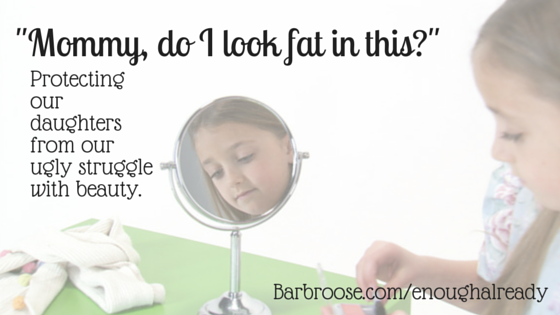
I was wrong. Somewhere along the line, my five-year old daughter picked up on my frustration over my size, shape or style, otherwise known as my “ugly struggle with beauty”.
“Why don’t I ever look good in anything?”
“My feet are SO big! Goodness, someone could use these for a boat!”
“Look at these hips! Nothing ever fits right over these hips!”
I never wanted Abbie or my other daughters to sense my discomfort with my body. Yet, I had passed my negative thinking and feelings about my size and shape onto my daughters.
In October 2013, I surveyed over 500 women about the topic of beauty and how beauty has impacted their lives. Many women reflected on how their mothers’ ugly struggle with beauty was passed along to them. Here’s one woman’s story:
My mother is a beautiful woman by anyone’s standards, but she does not see it that way. To this day, she works to support her beauty habits. She’s had breast augmentation, countless peels and laser resurfacing and practically lives at the salon. This was my model. I remember my mother telling me that I was beautiful, but I also remember her worrying about what I was eating, and how my hair looked and what other people would think about me. I scrutinize every imperfection on my face. I have long, full hair that other women compliment me on, but it’s fake. I shop a lot. I constantly size myself up against other women. It is honestly exhausting at times.
Clearly, her mother never intended for her daughter to inherit her ugly struggle with beauty, but our words and actions influence our daughters more than we realize.
Protecting our daughters from our ugly struggle…
Moms, we never want for our daughters is to experience the same sadness and frustration that we encounter in the mirror, right? If our daughters express a beauty-related struggle, we’re quick to go out an buy something to help. We make sure they have acne-free skin, pay for nose jobs or by them stylish clothes. Yet, trying to address their physical struggle doesn’t matter if our girls are also carrying around OUR beauty-related pain in their hearts and minds.
So, what do we do to influence our daughters away from our ugly struggle? The best way to keep our daughters from inheriting our ugly struggle with beauty is for us to win OUR ugly struggle with beauty!
There are three things that we need to do in order to win our ugly struggle or reduce our struggle’s impact on our daughter’s lives:
1. Understand your “beauty narrative” – What’s your beauty story? Talking about beauty is more than just talking about how we look, it’s about understand it’s impact on how we think and live. Are there nicknames or painful memories that you’ve carried around since childhood that whisper back to you each time you look in the mirror? When we don’t acknowledge the things that happened to us, we carry them around and give them the power to influence our thinking, feelings.
2. Re-Think Your Body – Your relationship with beauty begins in your mind. What you think drives how you feel and behave. If you struggle with you’re a certain body part or facial feature, then a practical tip would be re-frame how you think about that feature. How does that body part bless your life? What purpose does that body part serve in helping you love and care for the people around you? I struggle with the gap between my front teeth. Yet, my mouth affords me the opportunities to speak with women and encourage them. I know that my voice and smile would not be as effective without my two front teeth. So, those teeth are a blessing because they allow me to encourage others.
3. BE Beautiful! Beauty isn’t about our size, shape or style. Instead, we are beautiful when we recognize ourselves as creations of an Almighty God. We are not doomed because our hips may be too wide or our skin isn’t youthful or smooth. We are beautiful because God created us. Period.
When our daughters see us smiling at ourselves in the mirror, our daughters will remember and mimic that behavior. When our daughters overhear blessing our bodies, in spite of what our culture says about beauty, then our daughters will learn to bless their bodies in spite of what culture says about their beauty.
While we can’t protect our daughters from their own ugly struggle with beauty, we can protect them from inheriting ours.
QUESTION: How did your mom influence your opinions about beauty? What beliefs or attitudes have you carried from childhood into your adult years? Share your story by leaving a comment below.
Friends, thanks for stopping by today! If you think that this post could bless your friends, I’d love for you to share it!

by Barb Roose | Mar 28, 2015 | Scripture Devotional, Women's Topics
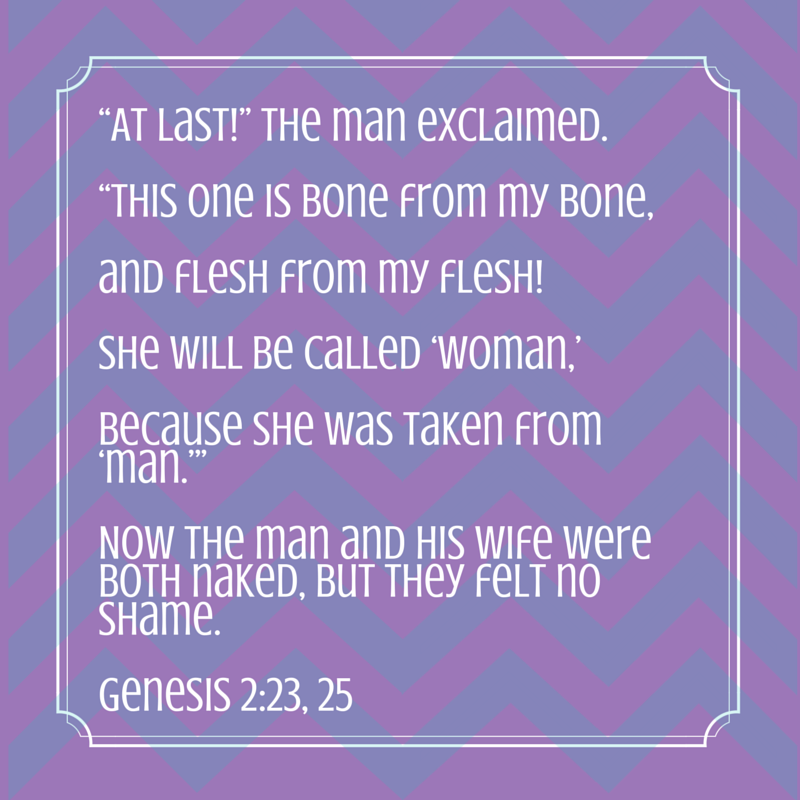
 When was the last time you were naked and felt no shame?
Take a deep breath. We’re not going to talk about being physically naked, or ‘nekkid’ as many like to say. Today, we’re going to delve into what it means to step up and live with authenticity and vulnerability – being real and inviting people to get real with us. That’s what we can refer to as “emotional nakedness.”
Ummm, Barb. Uh, I’m not comfortable talking about this…
I know that you don’t want to talk about this, but stay with me. You NEED to lean into this one. Why? Because I know that there are places in your life where you want MORE than how you are living now! You want to live with purpose. But, you can’t live purpose if you only skim the top of what it means to be real with the people around you that you love and care about.
Living authentically occurs when our actions, beliefs and character are the same, no matter if we’re overheard talking with our kids at the store or we’re hanging out in the lobby at church. Authenticity is best described by the phrase “keepin’ it real.” Like on Saturday, I had to do eight loads of laundry and clean my house. It was a wreck. #keepitSERIOUSLYreal
Vulnerability is much scarier than authenticity. When you’re authentic, you don’t have to care about what people think, you’re just putting you out there. In my opinion, vulnerability is the highest form of emotional and spiritual nakedness.
Storyteller and researcher, Dr. Brene Brown, has elevated the discussion about the power of vulnerability. Here’s how she describes vulnerability: “Vulnerability sounds like truth and feels like courage. Truth and courage aren’t always comfortable, but they’re never weakness.”
Vulnerability seems a little like living at a nudist colony (not that I’ve ever been to one…) You are completely exposed to those around you and they can give you feedback on what they think and see. Yet, under the right conditions, vulnerability is powerful. When we allow people that we love and trust to speak truth into our lives, we learn to see past the blind spots that are holding us back or taking us down. Vulnerability gives us the precious knowledge that we are loved as we are and most importantly, for who we are.
God loves you as you are. But, He loves you too much to leave you as you are. He’s got great plans for you!
As you read that, you may have many reasons why God shouldn’t love you for what you’ve done or how you screamed at your kid today – but He loves you. As the old saying goes: “There’s nothing you can do to make God love you more. There’s nothing you can do to make God love you less.” It’s a shame that some of us are plagued by secret whispers that we don’t deserve or shouldn’t expect God’s best for us. That’s the voice of shame.
When we feel shame, it is a self-imposed shackle that we must break free from as soon as possible. Shame clouds our ability to see what God wants to do in us and through us.
Here’s a few questions for you to consider today. You are welcome to share your answers in the comments below or find a trust Christian friend or counselor to discuss:
- Where are the places where I feel ashamed, or unworthy of love or acceptance?
- How willing am I to let people get to know the real me? Where do I start shutting people out? Do I know why?
- What would it mean for my life if I could live “naked and unashamed?”
Only one more day left in our Beautiful Devotional! Thank you for joining me this week! I’d love to stay connected with you on a regular basis, so make sure to find me on Twitter (@barbroose) or join the community over at Facebook.com/shapestylesoul.

by Barb Roose | Mar 27, 2015 | Scripture Devotional, Women's Topics
Have you ever run into a woman who was bad tempered, rude, or argumentative?
While I don’t watch many reality television shows lately, I see lots of previews or recaps. The shows all seem to have a few things in common: wealthy, physically-attractive women who scream, fight, scheme, claw, cuss, cheat or threaten each other.
These women spend thousands of dollars on hair, make-up, cosmetic surgery and personal trainers to look as beautiful or desirable as possible, yet their on-screen behavior is downright UGLY.
I don’t get it. But, the writer in Ecclesiastes says: There is nothing new under the sun.
In the New Testament, one of the scriptural authors addresses a community of married women who were new to following Christ. These women were wealthy and heavily influenced by their sophisticated, educated culture. They competed against each other for the best hair, make-up, and jewelry using strategies that probably wouldn’t be completely unfamiliar in our modern times. Like many of us, these women wanted to be admired and desired by all who saw them. If there was a reality television show during that time, these ancient women would have been all up in our television screens.
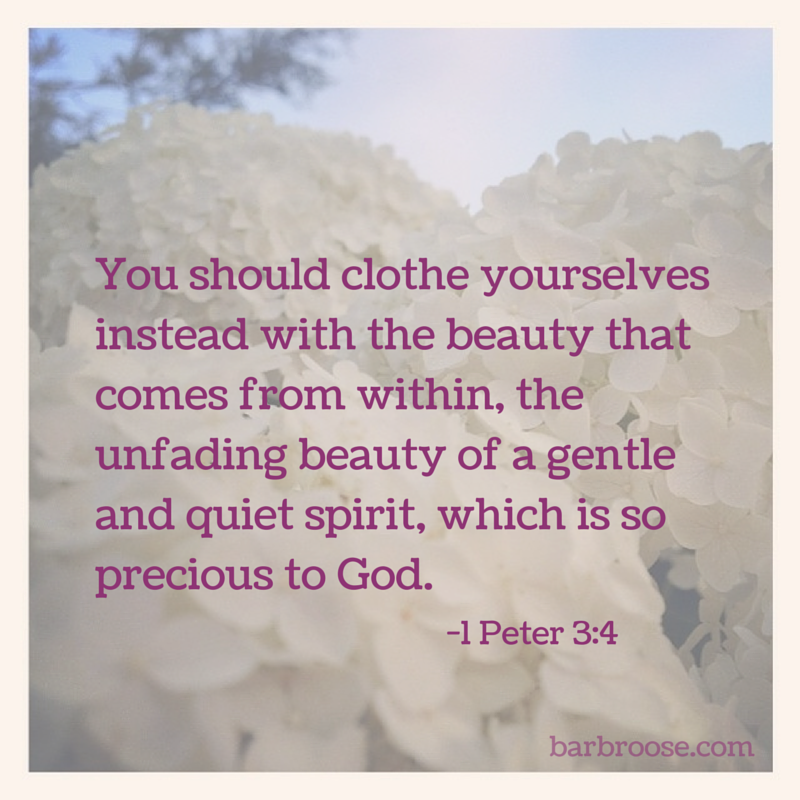
Yet, the scriptural author, Peter, calls the women to aspire to more than competition over hair, clothes or reputation. Check out the verse in the box from 1 Peter 3:4.
Peter, isn’t being harsh when he speaks to the women. He wasn’t bashing beauty enhancements, rather, he contrasts what a woman does with her outer appearance against what God accomplishes by His divine work within us.
There are two descriptives that Peter calls women who aspire toward: gentleness and quietness. These two words used to discourage me on a regular basis.
Friends, there is nothing conventionally gentle or quiet about me. I’m 5’10” with big feet and a loud voice. Everything about me looks like it is moving at 100mph. So, I felt like a failure every time someone shared Peter’s teachings on these two qualities of inner beauty.
Why can’t I be like the nice ladies with the polite smiles dressed in pearls and matching sweater sets. I can get frustrated and loud, yet those women never seemed to get kerfluffled? What’s wrong with ME?!!!
Years ago, I discovered God’s prescription for inner beauty was a mixture of qualities that would complement even my energetic, demonstrative nature. Here are the qualities of a gentleness and quietness:
Gentleness: Maintaining a gracious attitude, friendly behavior and humble character.
Quietness: Choosing to possess tranquility, respectfulness and submissiveness as opposed to worry or rebelliousness.
First, how do we cultivate gentleness? Where do we start? One of the first steps would be self-awareness. I don’t know about you, but sometimes, I don’t know how I look or sound to others. So, practice your conversations in front of the mirror. Pretend like you are talking to your family or friends and look at your facial expressions. Does your face look friendly and kind or put-upon and bothered? After self-awareness comes another tip: Just be nice to people. (Yep, I’m working on that, too…)
Now, quietness might be freaking some of you out right now. You saw the words “respect” and “submit” and you’re concerned that I’m going to try to sell you a page from “The Caveman Times.” I can see you rolling your eyes and saying:
“I’m a modern woman, Barb. Don’t you try to tell me that I should let someone rule over me.”
Ladies, respect and submission have nothing to do with coercion or weakness. In fact, they are wholly the opposite. Both are a 100% free act of the will. You can choose or not choose. Before you choose, answer this: What is the opposite of quietness? If the idea of not having the final say-so (control/manipulation) is so horrible for you, then what’s your other choice? Answer: It’s a life of constant worry and strife.
Some of you know what I’m talking about right now.
When you constantly fight for control or assert your right to be right in front of your spouse, kids, friends or co-workers, chances are that your life is filled with frustration, worry or strife. Might I ask with complete humility: How’s that working for you?
When life isn’t going our way, our first inclination is to rise up and fight for control. And the fighting and the resistance makes us miserable – and our reactions probably look pretty ugly. Yet, God has chosen women to be the standard-bearers of His beauty in our cold, harsh world. What kind of light for Christ could we be if we practiced the beauty of gentleness and humility?
Q4U: Which one – gentleness or quietness – feels like more of a challenge for you? Leave a comment below!
Thanks for stopping by! We’ve got just a few days left in the Beautiful Devotional and I hope that you’ve been blessed. I’d love to hear how God has used this devotional in your life. Feel free to leave a comment below! If this post has blessed you today, please share it with others!

by Barb Roose | Mar 26, 2015 | Scripture Devotional
 I’m a food thinker.
What’s a food thinker? A food thinker is someone who is ALWAYS THINKING ABOUT FOOD!
That’s me.
In fact, when I eat breakfast, I want to know what I’m going to eat for lunch. After lunch, I thinking ahead to dinner, but not before pondering the snack that I’ll have in-between.
Any other food thinkers out there? Let me hear you!
As a food thinker, I’m not just thinking about the food that I want to eat, but I’m also run an internal dialogue about the food that I just consumed.
Oh, I wish that I wouldn’t have eaten that!
I.want.more. Yum!
I really wish that I eat another Mr. Freeze Wow Cow Peanut Butter No-fat, no sugar ice cream with hot fudge, pecans and real whipped cream ALL OVER AGAIN!!!!
(That last one was a true thought from last week. I miss that sundae.)
Some of us think about food a lot and our attitude drive our thoughts.
We can get a little nutty defending our right to eat our way – and sometimes, we can sniff our noses at those who may have a differing opinions. I’ve noticed that the topic of food can divide up women pretty quickly. Organics versus Mac-n-cheesers or the Vegetarians versus More Meat-eaters or the Vegans versus Burger King Whopper lovers.
I don’t think that God wants food to divide us or disconnect our hearts from each other – and food surely isn’t supposed to siphon away our desire to focus wholly on God.
How do keep our relationship with food in its rightful place in our lives? How we can enjoy eating, without using food as a way of subtly asserting superiority or using food as drug to cure emotional pain?
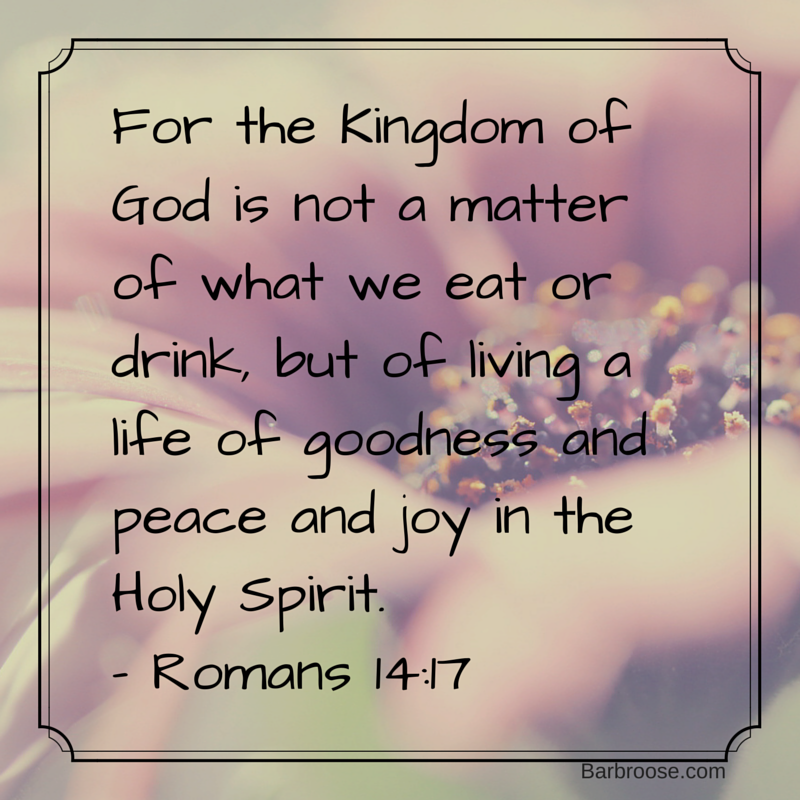
I ran across this verse a few months ago, it got my attention: In other words: What you eat shouldn’t be your measure of righteousness or condemnation AND what/how you eat shouldn’t occupy your thoughts more than your desire to live God’s call for your life.
In Romans 14:17, the scriptural author, Paul, wanted to redirect the people from thinking that they could gain spiritual and social superiority by eating and drinking the right things. Obsession over “right” and “wrong” foods distracted the people from what really mattered: Worshipping God with their lives and focusing on Him rather than self. Rather than over-focusing on are we eating the right or wrong things, how do we focus on what the Apostle Paul calls us to focus on instead:
Goodness: Pleasant inward disposition or attitude toward others
Peace: reconciliation with others and reconciliation with God
Joy: Unfailing inner brightness regardless of our circumstances
Awww, snap.
Here I am more worried about whether or not I’m still gonna be hungry after eating my salad-in-a-jar and it seems that God wants to shift my perspective. Instead of focusing on calories, metabolism, steps walked or what’s been crossed and fitted, the real kingdom question is: How am I doing with goodness, peace and joy in God’s eyes?
How are you doing?
Q4U: On a scale of 1 (bad) – 10 (great), how are you doing with living out God’s definition of goodness, peace and joy? Where are you doing well and where are you struggling? Let’s have a discussion below!
Thanks for stopping by for today’s Beautiful Devotional! Want to receive the rest of this Beautiful Devotional series or weekly encouragement from me about your shape, style or soul? Just click here to subscribe to barbroose.com. I won’t fill up your inbox, but once a week, I’ll encourage you and make you smile!