by Barb Roose | Jan 15, 2017 | Better Together Podcast

Are you tired of watching people fight with each other? Do you get discouraged when you see Christians unfriending each other, not just on social media, but in families and friendships?
If so, then you’ll be encouraged by today’s podcast. I’m sitting down for an important conversation with Bible study teacher and author, Melissa Spoelstra for a kingdom conversation on the Bible teaches Christians to handle disagreement. She recently released a Bible study on the book of 1 Corinthians, a New Testament letter written to church leaders trying to deal with the fighting and drama in their churches. Sound familiar?
Melissa is the author of the Bible study, 1 Corinthians: Living Love When We Disagree. This is such a well-timed topic for our culture today, especially for Christians.
How do we love each other even though we don’t share the same perspective or convictions? We do know this: That when Christians disagree poorly, the gospel message gets lost and lost people stay lost without that message of hope. Friends, we’ve got to change this!
In today’s podcast, Melissa shares powerful content on living love by sharing:
- How Jesus proposed instead of imposed himself on others;
- How we establish middle ground or common ground when we’re in the midst of a disagreement;
- How Paul’s counsel to the leaders of the Corinthian church provides encourage and practical advice for us to apply to our lives today.
Find out more about Melissa’s book and Bible studies by clicking here.
About Melissa…
Melissa Spoelstra is a popular women’s conference speaker, Bible teacher, and writer who is madly in love with Jesus and passionate about helping women of all ages to seek Christ and know Him more intimately through serious Bible study. She holds a Bachelor of Arts in Bible Theology and enjoys teaching God’s Word to diverse groups and churches within the body of Christ.
She is the author of the First Corinthians: Living Love When We Disagree, Joseph: The Journey to Forgiveness, Jeremiah: Daring to Hope in an Unstable World Bible studies, and Total Family Makeover: 8 Steps to Making Disciples at Home book. She lives in Dublin, Ohio, with her pastor husband and four kids.
Find her on Twitter @melspoelstra and Instagram @daring2hope, and follow her blog at MelissaSpoelstra.com.
by Barb Roose | Jan 9, 2017 | Christian Living/Discipleship, Women's Topics
by Barb Roose

I knew something was up when I received a link to the same blog post from several women’s Bible study leaders from around the country. The writer sent out a plea to women’s ministry leaders asking them to stop telling women that they are beautiful if that beauty message wasn’t tied to the gospel. Her blog connected with women across the country. What caught my attention were the comments from her readers. There were a lot of opinions and negative feelings out there about how beauty was addressed at women’s conferences and how beauty is taught by women’s ministry leaders.
As a communicator who speaks and writes about Christ-centered identity and beauty, I’ve heard women’s ministry leaders question whether beauty is a worthy spiritual topic. Some even rate beauty as watery spiritual milk rather than stick-to-the-bones spiritual meat. There’s a confusion about how we should talk about beauty, so without a clear way forward, women’s ministry leaders may settle for the simple “You are beautiful” cheer with no foundation or refuse to address the topic of beauty for fear of criticism from other Christians.
In either case, I fear that those two positions could actually hinder the effectiveness of women’s ministry now and into the next generation.
As long as we’re silent or hostile about talking about beauty, Satan will own the beauty dialogue. He already does. We’re seeing the results of his deception everywhere. There’s nothing fluffy or cute about beauty. The topic of beauty has become a bloody battlefield. Young girls are being bullied to death over their looks or weight. The lure of online fame compels our daughters and granddaughters to mimic the lifestyles of those that our culture worships and adores.

So, what should we be teaching women, both Christian and non-Christian women, about beauty? I believe that there are two things we must teach:
First, beauty is a topic that is wholly biblical!
Let’s stop treating the topic of beauty like an ugly scriptural stepsister. Did you know that the words “beauty” and “beautiful” appear in the Bible over 100 times?* In fact, beauty is a quality associated with the character of God, meaning that He has no ugliness or distortion.
One thing I ask from the Lord, this only do I seek: that I may dwell in the house of the Lord all the days of my life, to gaze on the beauty of the Lord and to seek him in his temple. –Psalm 27:4 NIV
The Bible talks about beauty on many levels and its impact on our lives. At its worst, we see how beauty fueled Rachel and Leah’s baby daddy rivalry and caused Abraham to fear for his life. At its best, God used beauty to influence the selection of Esther as Queen as well as her gentle and quiet inner beauty to gain favor with the king to save the Jewish people.
For a topic that is written about in many ways in scripture, it feels like we’re more in touch with culture’s perspective on beauty than God’s perspective. We define beauty by what we see in advertisements, social media “likes” and celebrity chatter. As Christian women, we find all of those expressions of beauty distasteful. But we don’t really have a good scriptural foundation, so we declare beauty a bad word.
Last week I interviewed Christian fashion expert Shari Braendel on my Better Together podcast. Shari is a bold woman of faith and considered America’s leading voice in fashion, beauty and dignity for Christian women. Yet she has been criticized by Christians who don’t believe that outer beauty is a spiritual topic that Christian women should care about. Regardless, over the past 12 years, God has used Shari to speak hope, truth and freedom to thousands upon thousands of women.
FULL DISCLOSURE: I’m a Christian women’s speaker and author who stands on platforms around the country and boldly tells women that they are beautiful because God created them. It’s biblical and needs to be said. Why? Because most women have no idea how God sees them! Far too women see themselves dipped in ugliness, guilt and shame over sin-related life experiences—some at the hands of another.
Women’s ministry leaders, we can tell a woman that she’s beautiful AND tell her that she is in need of a Savior. We can tell her about who God created her to be and how Jesus came to die so that she could experience life to fullest without guilt or shame. We can and should give both of those messages and repeat them as often as possible. Just the same as we never stop saying Jesus loves you because we think people should get it by now, we can never assume that a woman always remembers that her beautiful identity is solidified in God.
Secondly, when the Bible talks about beauty, it’s addressing both inner AND outer beauty.
When it comes to beauty, what’s on the inside does matter most, but it’s not the only thing that matters.
We’ve gotten in a habit of elevating inner beauty because of a few verses (Proverbs 31: 30 and 1 Peter 3:3-5) and pretending that we don’t care about outer beauty or that it’s bad. But God cares about both.
Who created the sunsets, flowers and rainbows that we obsessively photograph and post to social media? God created them to show us what He thinks about physical beauty.
In Genesis 1, God creates our physical world and the first humans. How often do we see the phrase “God saw that it was good” in this chapter? When God created the sun, moon, stars, trees, flowers and animals, God looked at their physical structure. The Hebrew word for good is towb, which is translated beautiful.
And God saw that it was beautiful.
In a world where women are targeted with 400-600 media advertisements a day, we cannot forget that God is the Creator of beauty, both inner AND outer beauty.
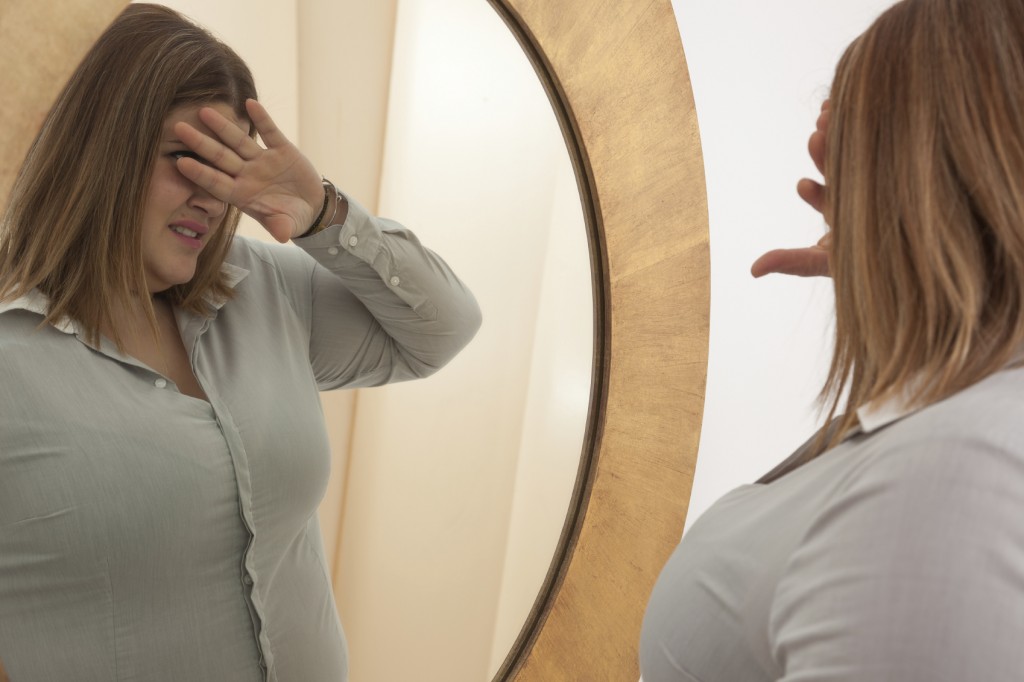
And what about us? What about adult Christian women? How many of us are silently bearing the scars and shame of outer-beauty issues? Sister, I know that you love Jesus. But I also know that you’ve probably stood in front of the mirror at one time or another whispering that you are “fat” or “ugly.” If God were standing next to you, how would you explain that?
So, here’s an incredible opportunity for us to reach women with the hope and freedom of Christ IF we remember the big picture:
Talking about beauty is an open door to talk about redemption and restoration.
In Matthew 6, Jesus teaches a crowd on a hillside. He uses the beauty of flowers as a teaching tool to remind us of how God sees us and cares about our physical needs. Jesus also refocuses our perspective:
31 So do not worry, saying, ‘What shall we eat?’ or ‘What shall we drink?’ or ‘What shall we wear?’ 32 For the pagans run after all these things, and your heavenly Father knows that you need them. 33 But seek first his kingdom and his righteousness, and all these things will be given to you as well. –Matthew 6:31-33
Raise your hand if you’ve ever felt angst, guilt or shame over “What did I just eat or drink?” or “For the love, my pants are too small. What am I going to wear today?”
First, Jesus acknowledges the struggle. Then, He tells us what to do. For every struggle, Jesus shows us the solution: See God first.
There’s a lesson in that for women’s ministry leaders, small group leaders and all mature Christian women: Acknowledge your struggle. Share Jesus’ solution.
How can the women in our churches and communities come to Christ and confess their guilt and shame if we’re silent about ours?
Maybe this is why a certain segment of women aren’t registering for conferences or retreats. When a broken woman attends an event and all she can see are well-dressed, plastic-smiling women that look shiny and perfect, she’ll struggle to relate and leave still starving for connection.
If you plan women’s events, remember that women attend conferences because they want to find solutions for what’s missing, broken or changed in their lives.
Women don’t want perfect. Women want real. Real answers. Real stories. Real women who aren’t trying to market their Pin-Perfect lives.
If you want to draw women into your next women’s event, then think about what the women in your church and community are praying about. Where are they begging God to show up in their lives? Match up those prayers with God’s hope and truth. Now, those are the topics to plan around and invite speakers to address.
And to us speakers, we’ve got to show up and tell our “But for Jesus” stories. If we’re going to stand on the platform, it’s because we’ve got a story of how Jesus rescued us from the pit. We’ve got to talk about surrender and sanctification so that the women can see that we’re putting one foot in front of the other just like they are.
And we’ve got to talk about beauty.
When I talk about the topic of beauty, I begin with a photo of what I look like first thing in the morning. Why? Because I may show up to an event looking put together, but I don’t want the women in the audience to think that’s how I roll 24/7. They need to see the “before-and-after Barb.” I show them the physical before-and-after and talk about my spiritual before-and-after. I want every woman to know that what Jesus did for me, He can do the same for her.
I dream of the day when every Christian woman has the strength and conviction to also declare that she is beautiful—not just for her sake, but also so that she can be the city on a hill to reach the millions and millions of women out there lost in the land of guilt and shame.
Just to make sure that you know, I’m going to keep telling women that they are beautiful. I don’t need to know your name in order to look you in the eyes and tell you that you are beautiful. I can do it authentically and truthfully because God’s Word guarantees the truth of that statement with 100% certainty.
Thanks for stopping by and checking out this post. I’d love to hear your thoughts. Share your comments below.
*NIV version
by Barb Roose | Oct 28, 2016 | Christian Living/Discipleship, Women's Topics
I don’t know about you, but sometimes it can be tough for me to distinguish between my need for food and my desire to eat.

Without being critical of my body size, I’m fairly certain that quite a bit of what I consume isn’t related to my biological need for food.
A couple of years ago, my friend Jera made a pecan pie for me. I love pecan pie! I took that pie into my house and set it on the counter. While I wasn’t physically hungry, that pie started to look really good to me. In fact, I could hear that pie talking to me. Seriously, it was! It said, “Barb I’m over here. It’s so lonely over here. I think I’d like to be in your tummy more than I’d like to be sitting on this counter.”
Have you ever had food speak to you like that?
I tried not to listen to that pie, but it kept talking! The only way for me to quiet the pie was for me to eat it.
So I did.
I ate the ENTIRE pie in one afternoon.
Are you horrified? Trust me, I was – especially since I wasn’t event hungry. So what happened? My appetite, that’s what happened!
God created our bodies to need food. However, God gave us appetites as well. In addition to an appetite for food, we are born with an appetite for love, acceptance, satisfaction, achievement, and connection. Think about those things you long for every day, such as someone to love, acceptance by others, or a deep sense of connection. Each of those things represents a craving or an appetite.
Here’s the most important part: How you manage your desire for love, acceptance, security or connection determines whether you are controlling your appetite or your appetite is controlling you.
As women, this concept is critical because we always have unfulfilled appetites; and when our craving for love, acceptance or connection goes unfulfilled, we often turn to food in order to temporarily satisfy that unmet need. Does the term, “comfort food,” sound familiar?
How often do we toss into that void a half dozen cookies or a carton of ice cream? One of my favorite quotes is from character Lavon Hayes from the tv show, Hart of Dixie. After his girlfriend breaks up with him, Lavon shows up on his friend’s doorstep with a big of donuts and says, “Help me eat my feelings.”
In the Old Testament, Esau was a man with the ability to hunt his own food, but he struggled with an unidentified hunger. Maybe he wanted approval from his father or he was jealous of his brother – we don’t know. Something deep inside of him was hollow and empty enough to feel like hunger. Esau’s sneaky twin, Jacob took advantage his hunger and Esau ended up trading away his future.
How often do you eat when you feel lonely, angry, tired or sad? What are the foods that you pick up and have difficulty putting down when you are hurting?
If you get the chance, check out Matthew 4:1-11. It’s the story of Jesus’ temptation in the dessert, I mean desert. Why did God lead Jesus into the desert to be tempted by the devil anyways? It was because God wanted us to see how the power of God living within can overcome our human desires that can get out of control.
How do we deal with our hunger for love, acceptance, security, satisfaction or connection? In my Beautiful Already Bible Study, we talk about the tools that we can use to surrender our hunger to Christ and allow Him to fill us. Why? Because only Jesus satisfies!
If you struggle with emotional eating and want God to work in this area of your life, I’ve developed a HALT Food Diary. HALT stands for hungry, angry, lonely, tired. These are often to triggers for binge eating. Click here to access a copy. Print it and tuck it into your purse. Keep track of what you eat for the next few days and make circle the emotions that you were feeling while eating. Once a day, talk with God about your eating habits and your unmet deep needs.
Give your unmet desires to God instead of giving in out of frustration to food. Let God fill you up!
SHARE A COMMENT WITH US: What’s your go-to comfort food? Are you more likely to eat it when you are hungry, angry, lonely, tired or all of the above?
by Barb Roose | Aug 29, 2016 | Christian Living/Discipleship, Women's Topics
Did you see the movie “War Room” with Priscilla Shirer?
It came out last year, and I highly recommend it! After watching the movie, I immediately felt compelled to create my own “war room” at home.

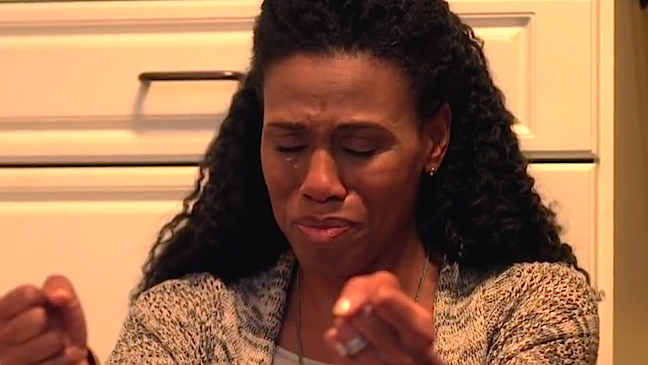
Bible study teacher, speaker and author Priscilla Shirer starring in “War Room.” If you haven’t seen the movie, rent it or stream it online today!
In the movie, Priscilla’s “war room” was a spacious walk-in with a lovely light and carpeting. That’s not my set-up, friends. My “war room” is 112-years old little cubbie with a fickle lightbulb. Since I share the space with my office supplies, I have to fold myself down onto a tiny little cube. I’m a tall girl. It’s a tight fit.
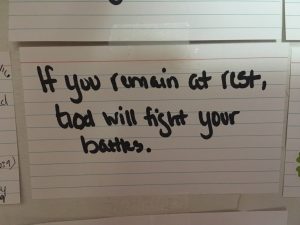
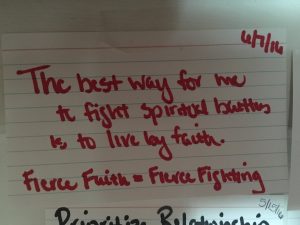
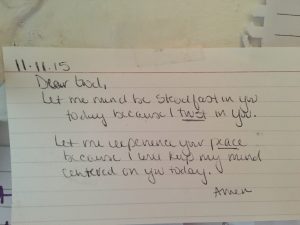
Written prayers and scripture verses decorate the cracking plaster walls. Keep scrolling down and you’ll see some of the cards on my wall. I like to write dates on those cards, so it feels like a spiritual journal when I walk in. I often read the walls and give thanks for how God uses words written weeks or months before to uplift and encourage me. There’s even a blanket in the space for the times when the tears are flowing fast. I use that blanket and pretend that God is wrapping His arms around me.
While lacking ambiance and Joanna Gaines’ touch, my prayer closet is a sacred space is where God shapes me and molds me in spite of myself.

In this space, I pray and I listen for God’s leading in my heart. I pour my praise and cry out my pain before the God who hears and cares for me. (My poor dog sits outside of the door and I’m sure that she must think that I’m crazy!)
Why am I telling you about my prayer closet? Because I think that you should consider making one for yourself. You need a space to shut out the world in order to give yourself completely and God’s attention.
Sweet sisters, we’re all fighting a hard battle. I don’t have to list out what we’re fighting because our personal battles are hand-to-hand combat day after day. Our hearts, minds and bodies are marred with the battle scars of our sinful world.
When we go into our war rooms, we’re reminded of the most powerful truth: The battle is the Lords!
In that war room meeting space, God reminds us that there’s nothing that we’ll fight that He hasn’t already won for us!
How does the power of prayer impact your life? If you’ve got a War Room and want to share a War Room prayer story with us, share it in the comments below! Thanks for stopping by!

by Barb Roose | Aug 15, 2016 | Christian Living/Discipleship
This year’s summer Olympics has been a breath of fresh air!
Have you had a chance to see team USA in action? For the past week, United States athletes like Michael Phelps, Kate Ledecky, Simone Biles, Simone Manuel and so many others have given us so much to cheer about!
For me, when I see are Olympic athletes take the world stage, I am filled with such a deep sense of pride. I feel like those athletes are my people!

photo credit below
Now, I’ve never met any of our Olympic athletes. I don’t know where they are from and I know very little about their lives. Yet, when they compete I cheer like crazy for them because they are wearing red, white and blue.
In fact, I believe that the Summer Olympics has divine timing…
Over the past three months, America has been more divided than it any other time in recent memory. And we are divided over so many things from the hate-filled election season, split opinions over social issues and an escalation in our centuries-old struggle with racism that’s tearing our country in half.
Yet, even as the United States is more divided than ever, this year’s Olympics reminds of how good unity can feel. We’re reminded that we could cheer for people that we don’t know and consider them “our people.” We’re reminded that we can celebrate athletes who don’t look anything like us and yet, feel like we’re winning right along with them.
Other than the Olympics, when’s the last time that you’ve seen that happen in the United States?
I’ve struggled for the past two months because there are no easy answers to the problems that divide us. I’ve been asking, “God, what do you want me to do?” My greatest fear was that I couldn’t make a difference.
After the first police shooting, I shared a story about my experience with race in America. To my surprise, hundreds and hundreds of people responded. A week later I wrote another story about my fears while raising bi-racial children and again, people responded.
Social media has proven over and over again that when our lips or fingers are typing, people are not listening. Our opinions often create more opposition.
But, as I prayed, God seemed to impress upon my heart the power of a story. I shared my story and people listened – and they responded. I began to wonder if God wanted me to create space for people to share where they come from and what they’ve been through.
Friends, let’s be honest: We don’t know how to talk to each other about race. BUT, we do know how to do a share our story.
Recently, I was reminded of the power of our stories.
Two weeks ago, I was in Roatan, Honduras. It’s a beautiful tropical island off the coast of La Ceiba, Honduras. I’ve traveled to La Ceiba many times on missions work. This time, I flew over La Ceiba and landed in Roatan to speak at a women’s conference on that beautiful tropical island.

Beautiful Roatan, Honduras
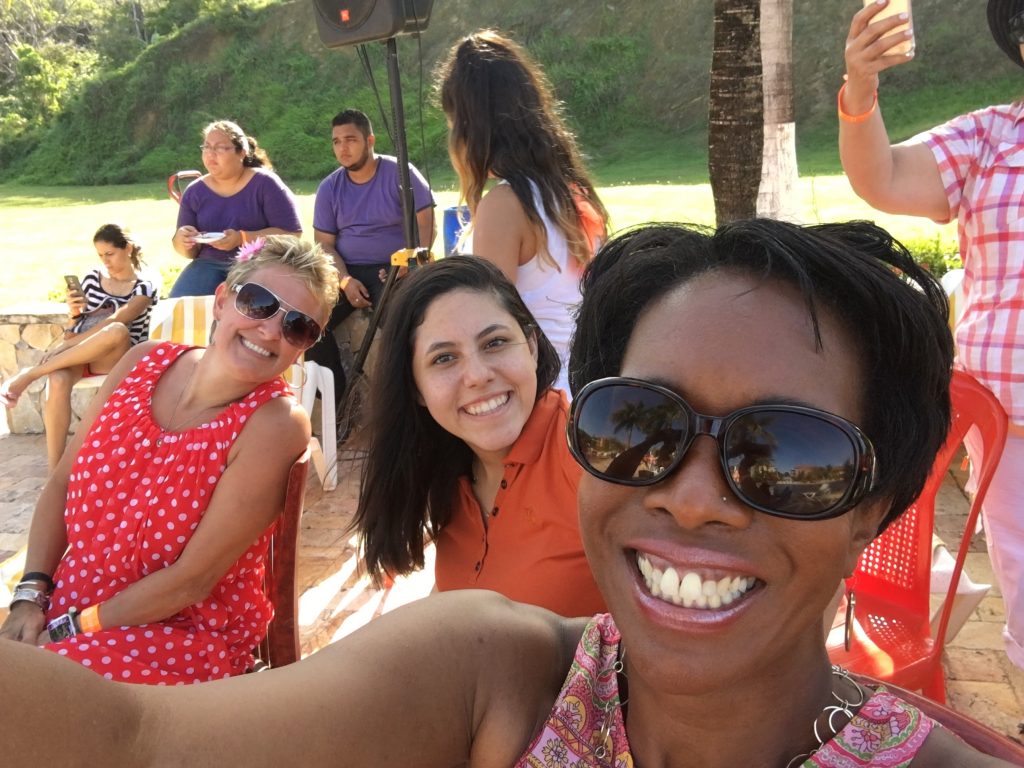
I’m hanging out with my friend and International Missions coordinator, Karen and my lovely translator, Sofia.
A gorgeous view of our final evening at the conference right on the edge of the Caribbean.
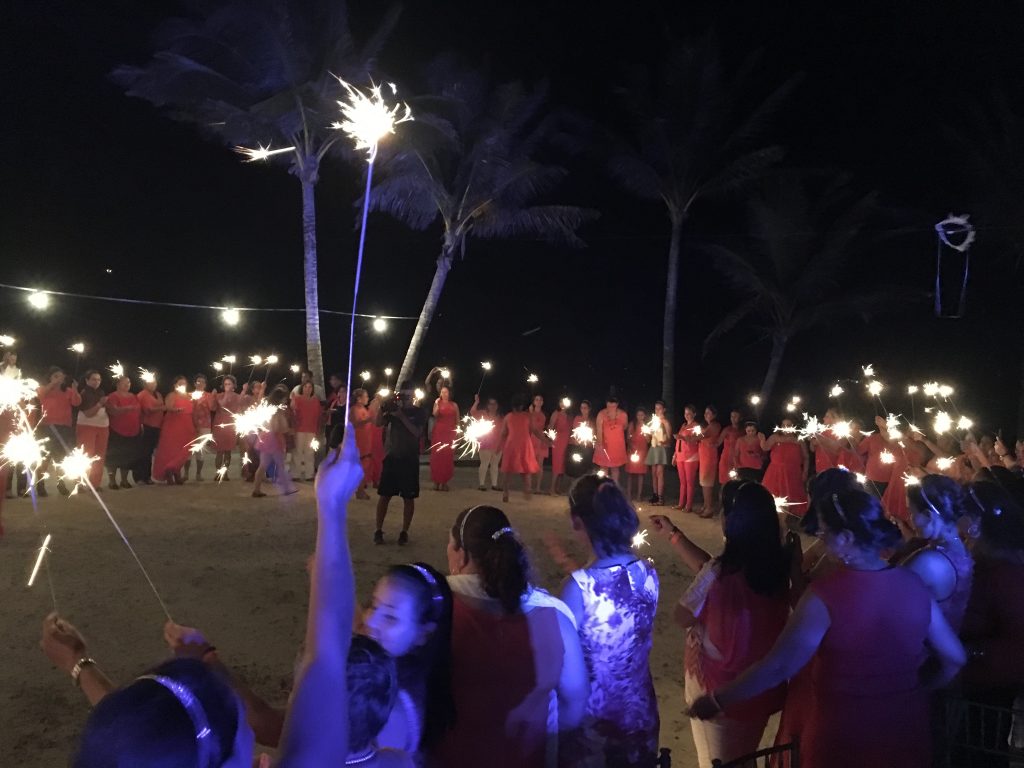
Celebrating the final night of the conference with sparklers and fireworks.
Before I spoke during the morning session, I was sitting at breakfast with my traveling companion, Karen. We joined six other Honduran women already sitting at the table. We were from different countries and spoke different languages. We had different socioeconomic and educational experiences. Yet, we were all sitting around the same table eating the same breakfast. Since my Spanish is muy mal, I asked our translator to offer a question to the women in order to break the silence. I didn’t even know what to ask. But, in that moment, God impressed upon my heart a simple list question: “Would you tell me about your families?”
For the next hour, those women spoke through our translator. They shared eloquently about their heartache, hardships as well as the trials and triumphs in their lives. Each one of the women had been through incredible hardship, yet their eyes lit up as they spoke of God’s faithfulness and how they overcame fear.
One woman told the story of a son who had been imprisoned in another country and she had not seen him in two years. However, the day before she left for the conference, he was miraculously released two years early and on his way home. Another woman shared of the death of her 13-year-old son from hydrocephaly and then a number of years later, she lost a young daughter to Down syndrome. Our translator shared of how her husband lost the use of his legs after suffering nerve damage during surgery. She shared how strong they’ve become in their faith as a result of this situation and she smiles and gives thanks to God anyways.
What a precious experience, friends! I gained a greater perspective on my life because of what those women went through. Spiritually speaking, God became even bigger to me because I had a chance to hear how He worked in their lives and in their circumstance. I was so blessed!
On that morning, I was reminded of how small our lives and faith remains when we only know our own story.
What if the first step was your decision to understand more about race was asking a question to discover more about where people have come from and what they’ve gone through?
Perhaps, you’ll consider asking someone who looks different than you out to coffee or inviting their family over to your home for dinner. Instead of worrying about what to say or obsessing about saying the wrong thing, consider beginning with the question: “Would you tell me about your family?”
Friends, I know that a single question isn’t going to be the magic fix that we need to heal of the miles-wide racial divide in America. BUT, we could reconcile the divide as we learn our stories one at a time?
I’m not sure what the answer to that question is, but what I do believe that it’s a positive step in the right direction.
SHARE YOUR STORIES WITH US!
I’ve launched a 30-day experiment called the “(g)race project.” Over the next 30 days, I’m asking 30 questions about race, grace and faith on this Facebook page. Just click here to join. You are invited to share your stories with us. My prayer is that over the next 30 days, we can begin to reconcile our country’s racial divide, one story at a time.

Photo credit: Aug 11, 2016; Rio de Janeiro, Brazil; Simone Manuel (USA) celebrates after the women's 100m freestyle final in the Rio 2016 Summer Olympic Games at Olympic Aquatics Stadium. Mandatory Credit: Erich Schlegel-USA TODAY Sports ORG XMIT: USATSI-GRP-746 ORIG FILE ID: 20160811_jel_usa_488.jpg