by Barb Roose | Jun 26, 2017 | Women's Topics
by Barb Roose
Fifteen years ago, I lived on empty. Stressful job. Small kids. My issues. Marriage.
If I was a car, my gas gauge warning light was ALWAYS on.
Don’t you hate it when that warning light is on? My gas gauge warning light always comes on when I’m in the middle of doing other things – buy groceries, running errands, picking up kids. That warning light pressures me because fuel is important, but so is everything else in our lives.
How often did I keep around pushing the limits of a near-empty gas tank in order to keep continue trying to accomplish other things?
I used to live the same way.

My “warning-light-life” (say that three times fast) had become a painful and pitiful way of life.
When I ran out of energy at the end of each day, everyone in my household knew about it. Short temper. Snippy Words. Poor listening. Fitful sleep filled with nightmares about unfinished to-do lists and often dreams of running away from it all.
Yes, I was a Christian and I loved my family. I knew that I was blessed. But I for a long time, I was an-empty Christian. Instead of being filled with the Fruit of the Spirit, the only thing that I was full of was exhaustion.
I’m pretty sure that someone out there can relate to what I’m saying…
If your well-being or energy could be measured like a gas gauge, how much gas do you have today?

If you’ve got a full tank, you’re giving thanks right now. You know that it’s not easy keeping a full tank, but bless you to being out there as a beacon of hope that other women can see.
But, if you’re riding your warning light or if you’re out of gas, you may feel a combination of guilt and desperation right now. You feel guilty because you don’t have any more to give, but everyone seems to need you. You feel desperate because you don’t want to live this way anymore BUT you also aren’t sure if you can change (and you aren’t even sure what change is.)
Sweet sister, I know your kind of tired. I know your tears.
I may not know your circumstances, but I know that you don’t want to let the people down in your life. I know that you believe that if you fill in all of the gaps, then that’s how you show you love them.
I know.
I thought that I was supposed to be the gap-filler, too. If there was a gap between someone’s need and their ability, I thought that loving them meant that I should fill in that gap with my energy, my money or time. After all, if I loved them, then I should be there for them no matter when they called or no matter what I was doing, right?
Here’s something that I want to share with you, but not all of you will agree with me. But, keep reading anyways:
Love may mean sacrifice, but love isn’t suicidal.
Love IS sacrificial.
But we’ve got to know the difference between loving sacrifice and killing ourselves when caring for people.
Jesus didn’t run after people wearing himself out trying to fix their problems. We never read about the Savior of the world worn out after serving people. Jesus let people be responsible for themselves. When we show love through sacrifice, our effort is to bring hope to others, but it also should bless us, too. Our sacrifice should satisfy us, not suck us dry.
What do I mean when I say that love is suicidal? Talking about suicide is a tender conversation. If you’ve lost someone to suicide, my heart breaks for you. It’s devastating when a loved one reaches a place where he or she comes to believe that there was no hope left.
Have you worn out, ruined or even killed your health, career, emotional well-being or financial security to try to rescue someone who refuses to be responsible for themselves?
You’re trying to help people, but is it wise to ruin your health, finances or well-being to try to save someone else’s? Only Jesus saves. We can’t. But, without meaning to, you may be sending the message that if you don’t step in and fix their lives, then they have no hope.
When there are gaps in someone’s lives, those are the spaces for God to fill in, not you.
If we’re always filling the spaces for people when they have a track record of not paying their bills, can’t maintain a job, often need bail money or always running short on the rent, then we’re filling the space that just might be keeping them from seeking God. Stop filling the potholes dug up by the irresponsible decisions of others. Don’t kill yourself trying to save someone from their bad choices and decisions. Only Jesus can save them.
Here’s the spiritual implication of it all: Are you praying that someone will come to know Jesus? Keep praying, but make sure that you aren’t filling the spaces in your life that keep them from running into Jesus open arms.
Best advice that I ever received from a friend and therapist, Tim Butler: “We have to let people discover their need for God.”
Most of us came to Jesus because we didn’t have anything left in the tank. That’s why we ran to Jesus. Let’s give our adult children, wayward siblings and parents or friends – give them ALL a chance to run to Jesus, too.
Now some of you are wondering if you stop fixing someone else’s life, then what do you do with yourself? How do you fill your tank back up again? Here are some questions that you need to answer for yourself:
What do you need to thrive spiritually?
What do you need to thrive financially?
What do you need to thrive socially?
What do you need to thrive emotionally?
What do you need to thrive in your relationships?
Thriving means that you are maturing and growing. It’s knowing how to fill your tank and live without draining your tank.
Just because you are thriving doesn’t mean that you don’t love the other people in your life. In fact, when you take care of yourself, you model the right kind of behavior you want for them one day.
Here are three ways that you can begin to focus on how to stop filling the gaps for others and begin filling your tank instead:
- Memorize 1 Peter 5:7: “Give all of your worries and cares to God for He cares about you.” Make sure the first thing you do each day is tell God about all of the situations in your life. Stop carrying those burdens around. When people try to give you their burdens, look them in the eyes and say, “Hang in there! The answers will come. I will pray for you.” Then pray for them, but clamp your mouth shut before you say the phrases, “I can…” or “Would you like me…” or “Let me…”
- Say this: “No is not a bad word.” If you struggle with saying “yes” all of the time, make it a goal to say three “No’s” this week. Are there things that you know that you shouldn’t be doing to fill the gaps in someone else’s life? It’s time to let them do their own #adulting. But be kind: As they say: “Say what you mean and mean what you say, but don’t say it meanly.”
- Check out my list of 101-ways to take care of yourself. Pick one thing to do for yourself each day for the next seven days. Self-care is not selfish. CLICK HERE to access the list.
LEAVE A COMMENT! Is your tank on full, half-tank or are you running on empty? How has God spoken to you through what you’ve read today?
[fbcommentssync]
by Barb Roose | Jun 4, 2017 | Women's Topics
A challenge that just might change how you feel this summer when you’re wearing a swimsuit…
by Barb Roose

A few weeks ago, I went shopping to replace my swim top. I have a great swim skirt, but I’ve had bad luck with swim tops. I scoured the rack for possible hopefuls and with trotted off the dressing room where I spent the next 15 minutes bending and twisting my body in and out of those high-Lycra tops. Getting that material to stretch around my real-woman body is no joke! No doubt the woman in the adjacent room heard my fervent prayer. “God, PLEASE let me get this top off without passing out.”
I leaned, bounced and sweat so much in that dressing room that I counted it as a workout.
Even with everything that I know about how God sees me as His beautiful daughter, swimsuits tend to test me. After a winter of camoflauge clothing, swimsuits expose not just our skin, but how we feel about the skin that we’re in.
When it comes to swimsuits or any other shopping experience, we often engage in one or both of the following:
1. We COMPARE our bodies to other women’s bodies whether our friends, social media images or magazines.
2. 2. We CRITICIZE inner selves for failing to get our act together, whether we beat ourselves up for not eating healthier, not exercising or shame-related issues from our past.
In my Enough Already book, there is a controversial chapter called “The Vagina Dialogue.” I didn’t use any vulgar language or inappropriate content, but I dared to use a word that describes a body part that to the Almighty God created in each and every woman. Vagina. Some of you are quite uncomfortable right now…
Soon after Enough Already released, a Christian woman blasted me for using the word citing that proper Christian women shouldn’t use such language. I respectfully disagree. When we’re afraid to talk about our bodies in a God-honoring way – including the private parts, we’re likely to feel ashamed of our bodies. That shame is so easy to pass down to the daughters and granddaughters in our lives.
In the “Vagina Dialogue” chapter, I reflect on how one of the scripture authors – someone inspired to write by God – described the female body:
You are beautiful, my darling,
beautiful beyond words.
Your eyes are like doves
behind your veil.
Your hair falls in waves,
like a flock of goats winding down the slopes of Gilead.
Your lips are like scarlet ribbon;
your mouth is inviting.
Your cheeks are like rosy pomegranates
behind your veil.
Your neck is as beautiful as the tower of David,
jeweled with the shields of a thousand heroes.
Your breasts are like two fawns,
twin fawns of a gazelle grazing among the lilies.
Your thighs shelter a paradise of pomegranates
with rare spices—
(Song of Solomon 4:1,3-5,13)
What you just read is actually in the Bible. Think about how that man complimented his love. He wasn’t just saying things to sweet-talk her into bed. Instead, the metaphors that he used to describe her feminine body were thoughtful descriptions of the most magnificent and treasured jewels, perfumes, and creatures on earth.
Why can’t we appreciate our bodies like that? How can we testify God’s goodness to others if we can’t proclaim God’s goodness in ourselves? Friends, women are using their bodies like weapons and whipping posts because they don’t know God’s beautiful truth. If we want to shine the light of Christ, we’ve got to make sure that light is seen in us, both inside and out!
Are you ready for a challenge?
Do you want to stop condemning your God-given body and start celebrating yourself, even in a swimsuit?
Today, I’m giving you the same challenge that I gave women in the book: Using the passage that we read as an example, create your own positive descriptive phrases to characterize the following parts of your body:
My lips are like_________________________________
My neck is ____________________________________
My breasts are like _____________________________
My thighs shelter _______________________________
At first, this exercise was really hard for me. I wasn’t used to using positive words to describe myself. Here’s what I finally came up with:
My lips are like fluffy soft pillows that beckon a dreamy night’s sleep.
My thighs are like the strong trees standing tall in my front yard.
While these descriptions might be a little silly, it’s a lot better than standing in front of the mirror crying or eating a quart of ice cream in shame. Instead of cursing our bodies, let’s celebrate them as God’s creation.
Will you please do this exercise? It’s okay if it takes a few days to complete but stick with it. Once you come up with positive descriptions for the body parts listed above, post the descriptions and read them each day for seven days. Instead of repeating the lies that our culture has told us about beauty, learn how to talk to yourself as God sees you! BONUS: Share one of your descriptions in the comments below and I’ll choose a winner on June 12 to win a copy of my Enough Already book.
My sweet friend, how you look in that swimsuit isn’t the issue. The problem is what your mind is saying to your heart about you.
You are God’s beautiful daughter, inside and out. Never tell yourself anything other than that!
P.S. On next week’s Better Together podcast, I’m interviewing my friend, Dr. Susan Pohlod about our female bodies. Sue is a long-time friend of mine and a passionate women’s health advocate. also provided the interview for “The Vagina Dialogue” chapter in my Enough Already book.
by Barb Roose | Apr 20, 2017 | Better Together Podcast

Oh my, goodness!
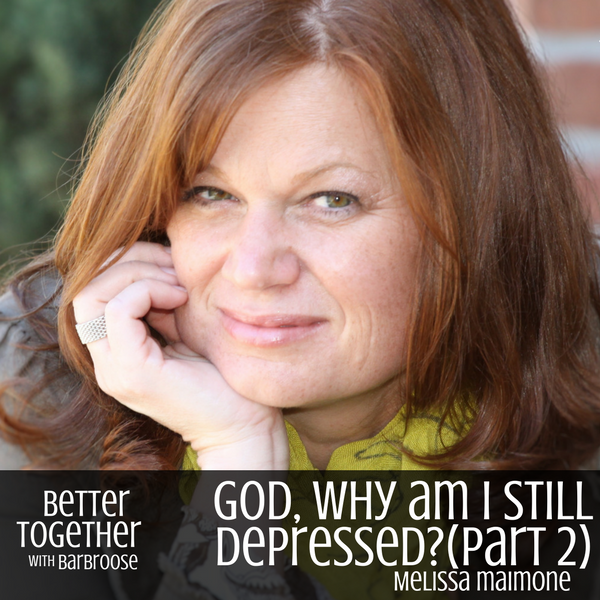
Last week, I shared my story about a year-long battle with depression as well as a powerful podcast interview with my friend, Melissa Maimone.
Boy, did I hear from you! I’ve gotten more notes and messages about this podcast than any other. One woman shared that God used our discussion to confirm that she needed to talk to her doctor about depression. Praise God!
Depression is a medical condition that can make us feel alone, fearful and hopeless. At its worst, depression can make us feel that we’re too broken or damaged to be loved. Even by God.
God loves you just the way that you are. There is nothing that you can do to change His opinion about you.
Christians are uncomfortable with depression. By refusing the recognize depression as a medical issue, Christians often downplay, even dismisses its devastating impact on families, our careers and our health. Too often, Christians feel ashamed about being depressed or they’re shamed by others who tell them to pray harder or think more positively.
In this week’s Better Together episode, Melissa and I tackled depression, God and faith. For years, Melissa felt like she’d disappointed God, which totally wasn’t true! She speaks to us in a powerful way about a compassionate God who loves us as we are and gives us the strength that we need. Melissa discovered that depression doesn’t mean that she’s sentenced to a life of unhappiness. Friends, Melissa is one of the most radiant people that I know!
If you’ve been dealing with depression or you secretly wonder if you are depressed, I hope that you’ll listen to this week’s podcast. Also, check out the resource links provided below. You can take a quick screening quiz to find out if you should talk to your doctor about depression. I’m also sharing some other resources that will equip and encourage you.
Did you enjoy this episode? Tell other women about it! Click here to rate this episode or the Better Together podcast on iTunes. Your review makes it easier for other women to discover the Better Together podcast – thanks!
RESOURCES FOR YOU!
PODCAST: Part 1 – God, Why am I Still Depressed – Melissa Maimone
ARTICLE: “God is not Silent When We Suffer” – Edward T. Welch, Family Life Today
ARTICLE: “5 Things Christians Should Know About Depression and Anxiety” – by Brandon Peach, Relevant Magazine
ARTICLE: “7 Things NOT to Say to a Depressed Christian” – C. Michael Patton, Credo House
ARTICLE: “To the Depressed Christian” – by Mary Leigh Keith, Cru
ARTICLE: “Depression: What it is and How to Help” – by Dr. Tim Clinton, American Association of Christian Counselors
BOOK – Gathering Dandelions: Meditations and Musings on Faith, Fracture, and Beauty Mistaken for a Weed by Melissa Maimone
VIDEO: Mental Health and the Church – Interview with Rick Warren
About Melissa Maimone…
Melissa Maimone is a vibrant, inspirational Christian speaker and author of “Gathering Dandelions: Meditations and Musings on Faith, Fracture, and Beauty Mistaken for a Weed.”
Affected by depression and anxiety from a young age, Melissa inspires women to discover the beautiful strength and grace available to them?even in the darkest of places. With her unique blend of theology, humor, insight, and storytelling, Melissa shares with powerful vulnerability that a hopeful, joyous life is possible no matter what your circumstance.
She lives in Southern California with her husband Danny their two children, Elizabeth and Cole.
Check out this episode!
by Barb Roose | Feb 20, 2017 | Better Together Podcast

Yesterday, I took my two younger daughters to a Black History Month community event at our local art museum. Artists from our community shared their talents inspired by African-American composers and musicians. A multiracial audience experienced a variety of unique expressions from performers of every race and culture.
As the mother of three bi-racial daughters, I wanted to seize this opportunity to let my girls see and hear people who could elevate the unique gifts, talents, and passions of their ancestors.
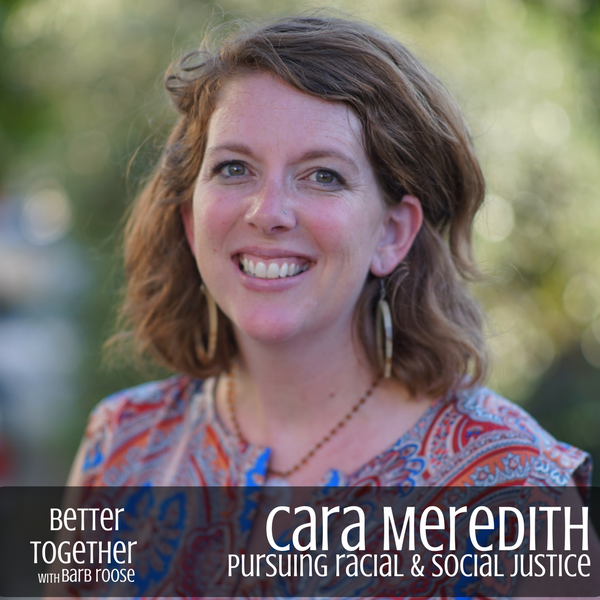
In this week’s Better Together podcast, I want to seize an opportunity to share with you, too. I’m interviewing a Caucasian woman who’s life radically transformed as a result of deciding to use her life and voice to elevate racial reconciliation and social justice. Her name is Cara Meredith, the daughter-in-law of civil rights leader, James Howard Meredith.
This is a candid, authentic conversation about race, family, motherhood. It’s the conversation where you might feel God poking at certain patterns of thinking or challenging different stereotypes. Just know that God’s just waiting for you to give Him permission to dig out that stuff and replace with His love for people.
In this week’s episode, you’ll hear about…
- Cara’s reaction to finding out that her new boyfriend’s dad was a civil rights icon;
- Some of the struggles that Cara and I have encountered while raising bi-racial children;
- How Cara and her husband are intentional about instilling pride in both sides of their children’s heritage;
- Important, but tough internal conversations that we all need to have if we’re ever going to turn the tide on the volatile issue of race.
About Cara Meredith…
Cara Meredith is a writer and speaker from Seattle, Washington. A member of the Redbud Writers Guild, she is co-host of the Shalom Book Club podcast and an adjunct professor at Northwest University. She lives with her husband and two young sons, and consumes guacamole whenever she gets the chance.
Connect with Cara…
Cara’s blog
Connect with Cara on Twitter
Connect with Cara on Facebook
 Cara with her husband, James Henry Meredith and their two sons.
 Cara’s father-in-law, James Howard Meredith talking with Dr. Martin Luther King, Jr during the March Against Fear in June 1966. Meredith organized the small march and planned to walk from Memphis, TN to Jackson, MI. However, Meredith was shot on the second day of the march, but recovered in a local hospital. In the wake of the shooting, civil rights organizations rallied and over 15,000 people marched, including Dr. King.
by Barb Roose | Aug 15, 2016 | Christian Living/Discipleship
This year’s summer Olympics has been a breath of fresh air!
Have you had a chance to see team USA in action? For the past week, United States athletes like Michael Phelps, Kate Ledecky, Simone Biles, Simone Manuel and so many others have given us so much to cheer about!
For me, when I see are Olympic athletes take the world stage, I am filled with such a deep sense of pride. I feel like those athletes are my people!

photo credit below
Now, I’ve never met any of our Olympic athletes. I don’t know where they are from and I know very little about their lives. Yet, when they compete I cheer like crazy for them because they are wearing red, white and blue.
In fact, I believe that the Summer Olympics has divine timing…
Over the past three months, America has been more divided than it any other time in recent memory. And we are divided over so many things from the hate-filled election season, split opinions over social issues and an escalation in our centuries-old struggle with racism that’s tearing our country in half.
Yet, even as the United States is more divided than ever, this year’s Olympics reminds of how good unity can feel. We’re reminded that we could cheer for people that we don’t know and consider them “our people.” We’re reminded that we can celebrate athletes who don’t look anything like us and yet, feel like we’re winning right along with them.
Other than the Olympics, when’s the last time that you’ve seen that happen in the United States?
I’ve struggled for the past two months because there are no easy answers to the problems that divide us. I’ve been asking, “God, what do you want me to do?” My greatest fear was that I couldn’t make a difference.
After the first police shooting, I shared a story about my experience with race in America. To my surprise, hundreds and hundreds of people responded. A week later I wrote another story about my fears while raising bi-racial children and again, people responded.
Social media has proven over and over again that when our lips or fingers are typing, people are not listening. Our opinions often create more opposition.
But, as I prayed, God seemed to impress upon my heart the power of a story. I shared my story and people listened – and they responded. I began to wonder if God wanted me to create space for people to share where they come from and what they’ve been through.
Friends, let’s be honest: We don’t know how to talk to each other about race. BUT, we do know how to do a share our story.
Recently, I was reminded of the power of our stories.
Two weeks ago, I was in Roatan, Honduras. It’s a beautiful tropical island off the coast of La Ceiba, Honduras. I’ve traveled to La Ceiba many times on missions work. This time, I flew over La Ceiba and landed in Roatan to speak at a women’s conference on that beautiful tropical island.
Beautiful Roatan, Honduras
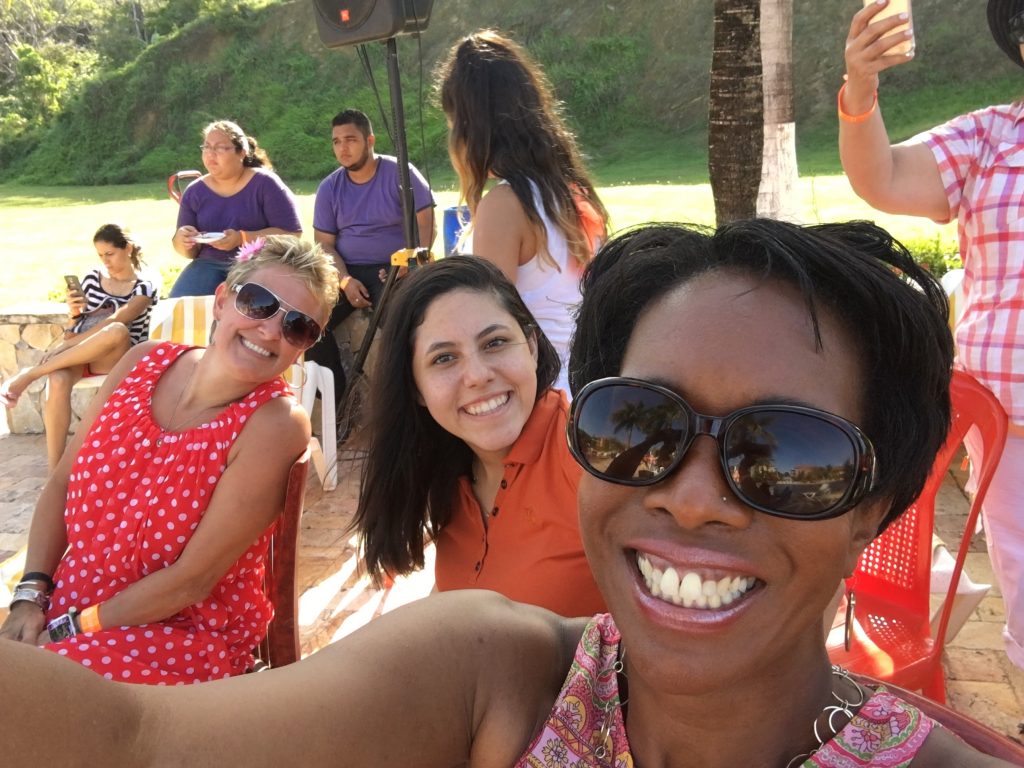
I’m hanging out with my friend and International Missions coordinator, Karen and my lovely translator, Sofia.
A gorgeous view of our final evening at the conference right on the edge of the Caribbean.
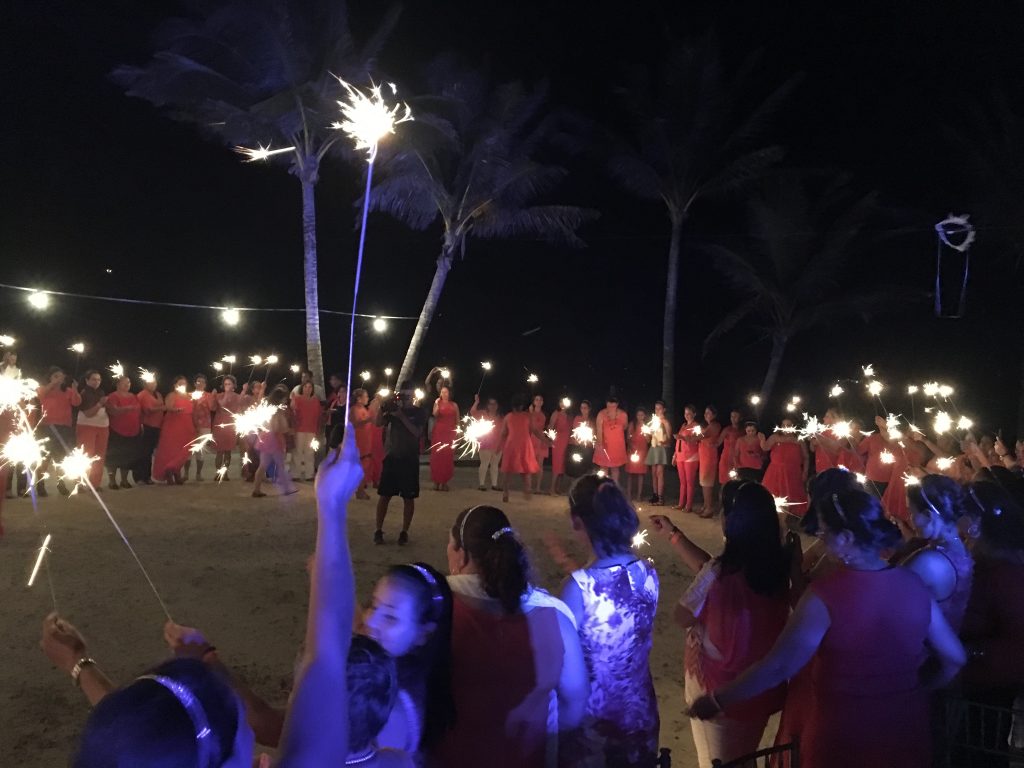
Celebrating the final night of the conference with sparklers and fireworks.
Before I spoke during the morning session, I was sitting at breakfast with my traveling companion, Karen. We joined six other Honduran women already sitting at the table. We were from different countries and spoke different languages. We had different socioeconomic and educational experiences. Yet, we were all sitting around the same table eating the same breakfast. Since my Spanish is muy mal, I asked our translator to offer a question to the women in order to break the silence. I didn’t even know what to ask. But, in that moment, God impressed upon my heart a simple list question: “Would you tell me about your families?”
For the next hour, those women spoke through our translator. They shared eloquently about their heartache, hardships as well as the trials and triumphs in their lives. Each one of the women had been through incredible hardship, yet their eyes lit up as they spoke of God’s faithfulness and how they overcame fear.
One woman told the story of a son who had been imprisoned in another country and she had not seen him in two years. However, the day before she left for the conference, he was miraculously released two years early and on his way home. Another woman shared of the death of her 13-year-old son from hydrocephaly and then a number of years later, she lost a young daughter to Down syndrome. Our translator shared of how her husband lost the use of his legs after suffering nerve damage during surgery. She shared how strong they’ve become in their faith as a result of this situation and she smiles and gives thanks to God anyways.
What a precious experience, friends! I gained a greater perspective on my life because of what those women went through. Spiritually speaking, God became even bigger to me because I had a chance to hear how He worked in their lives and in their circumstance. I was so blessed!
On that morning, I was reminded of how small our lives and faith remains when we only know our own story.
What if the first step was your decision to understand more about race was asking a question to discover more about where people have come from and what they’ve gone through?
Perhaps, you’ll consider asking someone who looks different than you out to coffee or inviting their family over to your home for dinner. Instead of worrying about what to say or obsessing about saying the wrong thing, consider beginning with the question: “Would you tell me about your family?”
Friends, I know that a single question isn’t going to be the magic fix that we need to heal of the miles-wide racial divide in America. BUT, we could reconcile the divide as we learn our stories one at a time?
I’m not sure what the answer to that question is, but what I do believe that it’s a positive step in the right direction.
SHARE YOUR STORIES WITH US!
I’ve launched a 30-day experiment called the “(g)race project.” Over the next 30 days, I’m asking 30 questions about race, grace and faith on this Facebook page. Just click here to join. You are invited to share your stories with us. My prayer is that over the next 30 days, we can begin to reconcile our country’s racial divide, one story at a time.

Photo credit: Aug 11, 2016; Rio de Janeiro, Brazil; Simone Manuel (USA) celebrates after the women's 100m freestyle final in the Rio 2016 Summer Olympic Games at Olympic Aquatics Stadium. Mandatory Credit: Erich Schlegel-USA TODAY Sports ORG XMIT: USATSI-GRP-746 ORIG FILE ID: 20160811_jel_usa_488.jpg








 Cara with her husband, James Henry Meredith and their two sons.
 Cara’s father-in-law, James Howard Meredith talking with Dr. Martin Luther King, Jr during the March Against Fear in June 1966. Meredith organized the small march and planned to walk from Memphis, TN to Jackson, MI. However, Meredith was shot on the second day of the march, but recovered in a local hospital. In the wake of the shooting, civil rights organizations rallied and over 15,000 people marched, including Dr. King.