That’s the philosophy of Vicki Fitch, a top-performing leader, international business consultant and direct sales expert. If you’ve ever dreamed of making extra money to support your family through direct sales or multi-level marketing companies that offer great incentives with flexible schedules for your family, then you’ll definitely want to listen to Vicki’s story on today’s Better Together podcast.
Vicki started her first business when she was 12 years old. She purchased her first home at 19 years old and began her first company a year later. As a “serial entrepreneur,” Vicki builds and sells business as a way of life. She’s been in the direct sales business for 20 years, consistently performing at the top 1% of her company, which allowed Vicki and her family to experience dream vacations and bonuses that have enriched their lives.
But, Vicki’s “never give up” philosophy comes from the difficult experiences in her early stages of her life. In today’s conversation, Vicki and I discuss her struggle to feel loved and valued by her parents as well as her volatile first marriage to a drug addict. As Vicki shares her life and her success, you’ll be encouraged by her authenticity and vulnerability when talking about the highs and lows of her life. Vicki and I are tall girls who share a love of high heels and we share a lot of fun moments during today’s conversation. FOR THE FIRST TIME! You have two options: You can watch my interview above or listen to the podcast audio below:
If you are a leader who dreams of achieving big goals, you’re going to absolutely love my conversation with Vicki. In this episode, you’ll learn more about:
“Evict the bully in your head” that undermine your confidence (that’s the title of Vicki’s second book);
Why mentors are important if you want to achieve your highest dreams;
How to identify whether or not you’re an entrepreneur (even if you think that you’re not).
Why Vicki is so passionate about her new global initiative’s #YouAreEnough as well as her #12Books12Months goal of writing 12 books in 12 months – this is a great story!
PLEASE LEAVE COMMENT BELOW ON THE FOLLOWING: Do you have a big dream that you want to share with us? Do you need permission to dream again?
About Vicki Fitch…
Vicki lives in Southern California with her husband, Terry and their two boys. She is blessed to have two amazing stepchildren and five grandchildren that fill Vicki’s heart with great joy. Her business is her ministry and she believes that God has blessed her greatly and she gives back every chance that she can.
Barb Roose is a popular speaker and author who is passionate about equipping women to win at life with Christ-empowered strength and dignity. Barb loves speaking at women’s conference and leadership events such as the Aspire Women’s Events, She Speaks Conference and the UMC Leadership Institute.
Barb is the author of multiple books and Bible studies, including her newest releases: Winning the Worry Battle: Life Lessons from the Book of Joshua and Bible study called Joshua: Winning the Worry Battle. Barb’s writing has been featured in magazines or blogs such as Simple Truth Magazine, iBelieve.com, Crosswalk.com, More to Life Magazine, Just Between Us Magazine, Cherished, InCourage and Women of Faith.
An avid traveler, reader, and lover of all things chocolate-peanut butter, Barb and her family live in NW Ohio with their dog, Quimby and a very grumpy 10-year rabbit. Visit Barb’s online home at barbroose.com.
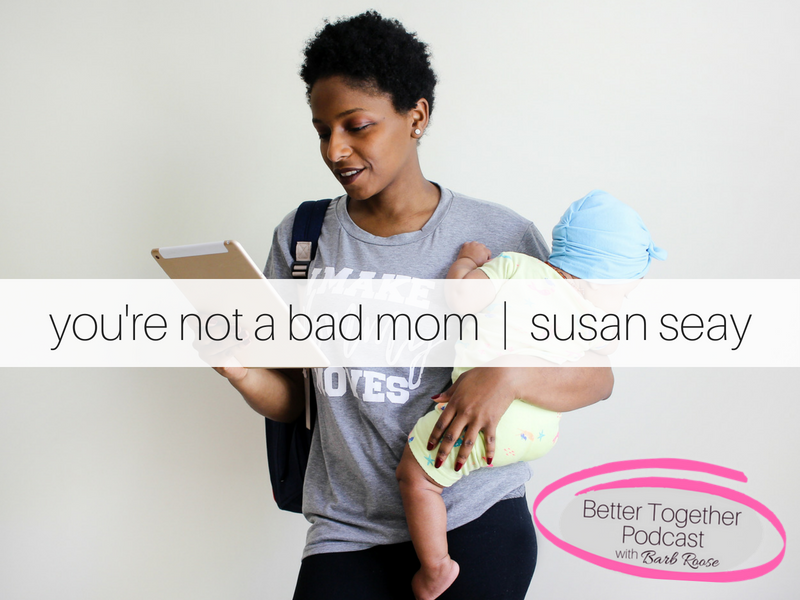
I became so burdened with my efforts to be a “good mom” and trying to do all the things a “good mom” should do. My list of “should’s” was so long I was ready to give up. In fact, I did give up. I announced it one night at dinner with a simple- “I’m done!” -Susan Seay, mother of seven (yes, seven!)
Mom, do you ever “should” all over yourself?
I should do another load of laundry…
I should stay up late and make cookies for my daughter’s class…
I should volunteer to drive carpool, even though I’m working late this week.
Sometimes those “should” feel so heavy and make us feel like we’re buried under unreasonable expectations.
If you’ve ever struggled with the “should,” you’ll love my conversation with my dear friend, Susan Seay. She’s a speaker and author living in Austin, TX. Susan and her husband, Ron are the parents to seven, yes seven kids. Not only that but Susan is a homeschool mom, who also supports and consults with other homeschooling moms on a national level. Susan is the author of Intentional Motherhood: Parenting on Purpose When Life Gets Busy.
Susan and I have been friends online for almost a year, but we met IRL (in real life) in July at the She Speaks Conference, hosted by Proverbs 31 Ministries. Susan actually flew from her home in Texas to help me out with my workshops –that’s a great friend! On top of that, I got to see Susan in action as she provided gentle and loving encouragement to every woman who crossed her path. If you meet Susan, she’s going to make your life better, whether you talk to her for one minute or an hour.
As a speaker and author, Susan’s wheelhouse is that she is a mentor for moms. And as the mother of seven, she’s got some great expertise in that area.
During our Better Together conversation today, Susan talks about a trap that is so easy for moms to fall into – the quest to be the mom that tries to do everything.
Susan and I will discuss:
The crazy questions that people ask when they find out that she has seven kids;
A GENIUS trick that Susan used when her kids lost their minds in the grocery store;
What unreasonable expectations makes moms tired and discouraged;
Stories of encouragement that will put a smile on your face;
Overcoming the trap of perfection.
About Susan Seay…
Through the “Mentor 4 Moms” Podcast and the relatable style found in her book The Intentional Parent: Parenting On Purpose When Life Gets Busy, you get a sense of Susan’s heart to provide encouragement to moms combined with helpful practical tools. As a wife and mom to 7, she truly understands the challenges of trying to be an Intentional Parent. Susan has been a mentor to women locally in Austin, Tx and Internationally for over a decade.
Are you struggling with a worry that you can’t seem to pray away? Sometimes, the roots of our worries are buried so deep into our hearts and minds that we need to give God special permission to dig deep and remove it.
Have you always been worried about money? Do you always worry about the people in your life getting hurt or abandoning you? Are you quick to flip out when uncertainty just won’t get certain fast enough?
Some of our toughest worries are like that stubborn plaque that mere brushing can’t remove. To eliminate those deep down, stuck-on worries, we must be willing to put up with being uncomfortable while God’s expert hand goes to work. Like a dental hygienist’s hook, God uses a secret weapon to scrape and chip away those hard-to-remove roots of worry from our lives.
Warning: This secret weapon is rejected by most Christians in the US because it makes most Christians feel too uncomfortable.
What is this secret weapon? Fasting.
By definition, fasting is to abstain from all or some things of food or drink, especially as a religious observance.
I know that bringing up fasting makes most Christians uncomfortable. If that’s you, I promise that it’s okay. It’s safe for you to be a little squirmy right now. My friend, no one is judging you. Especially not me! I refused to fast for years, but God gently led me toward fasting and I believe that God wants to gently lead you there as well.
Let’s start here – How do you feel about fasting?
Don’t know much about it.
Intimidated or uncomfortable just thinking about it.
Tried it, but not a good experience.
Fasted in the past, but not recently.
Periodic or regular fasting.
For many years, I tried fasting, but it wasn’t a good experience. I like food and it didn’t make sense as to why God would ask me to give it up during a fast. But then the pain of my life exceeded my cares about comfort. I encountered a spiritual battle so fierce and so difficult that I had to give God permission to use this secret weapon in my life. Not just so that I could survive my worry battle, but so that I could thrive in the midst of difficult circumstances.
What Jesus’ teaches us…
In Matthew chapter 4, God’s Spirit led Jesus into the desert to be tempted for 40 days and 40 nights. Think about what it must’ve been like for Jesus in the desert. There, He was fully exposed to harsh weather conditions and no protection from wild animals. He had no friends to call on and no place to lay His head.
Let’s not forget that Jesus didn’t eat for a very long time! Can you imagine going all that time without food? In the early days when I tried to fast, it only took about three or four hours before I wanted to give up and grab a snack. In this case, Jesus fasted for more than a month. If we calculate based on our Western diet, Jesus fasted 120 meals. And we feel like we could die after skipping just one meal!
Then the devil shows up. Note to self: Satan always show up when you’re in the midst of a difficult battle.
Why did God’s Spirit lead Jesus into the desert to be tempted?
It seems harsh that God would allow Jesus to endure spiritual temptation on an empty stomach. But God did this so that we could see how the power of God living within us can help us overcome our human desires, like worry, that can get out of control.
They say that a the way to a man’s heart is through his stomach. Thankfully Jesus proves that this isn’t the case. When the devil showed up, his first appeal was to Jesus’ hunger: “If you’re the Son of God, tell the stones to become loaves of bread” (Matthew 4:3).
When I read this verse, it’s not hard for me to imagine Satan holding a platter of fresh, hot bread with rich, melted butter slowly rolling down the sides. I can almost taste the yeasty aroma wafting through the air and floating under Jesus’ nose. Did Satan hope that Jesus would rationalize a reason to convert the stones on the ground in the hot, filling meal that would satisfy Jesus’ hunger, but scald his soul?
As a woman who has dealt with emotional eating as away to cope with stress and worry, I find that Jesus’ response in verse 4 ministers to my soul. Here’s what Jesus said: “People do not live by bread alone, but by every word that comes from the mouth of God.”
Jesus’ response to Satan reveals an essential need in my life: I can’t deal with my worry until I learn how to depend on God. It wasn’t until I fasted that I realized how often I sought comfort and security in other places instead of God.
When we voluntarily abstain from anything in our lives, it doesn’t take long for us to become uncomfortable with its absence as well. We’re upset by the loss of what comforts us and the exposure of that discomfort unsettles us. Richard Foster sums ups it up so well: “More than any other discipline, fasting reveals what controls us.”
When we fast, our thoughts and emotions reveal the rawest parts of us. Friend, when you fast and pray, ugly and very unspiritual thoughts WILL surface. That’s a good thing! This is the place where our most stubborn sin and fear hide away. But, once those places are exposed, God works on clearing them out so that we can experience freedom.
Jesus’ example of fasting isn’t just one that we can read and admire; it points to a pattern of discipleship that should be a part of every believer’s life. In Matthew 6:16, Jesus began his teaching on fasting with the phrase, “When you fast…” If you don’t have a “when” in your life, then perhaps today God’s gentle hand is leading you one step toward beginning that journey.
Do you need to fast?
Sometimes people get confused about whether or not Christians should fast. Jesus teaching on fasting emphasizes what not to do while fasting but it doesn’t discourage fasting itself. Here’s what Jesus says about fasting:
And when you fast, don’t make it obvious, as hypocrites do, for they try to look miserable and disheveled so that people will admire them for fasting. I tell you the truth, that is the only reward they will ever get. But when you fast, comb your hair and wash your face. Then no one will notice that you are fasting, except your Father, who knows what you do in private. And your Father, who sees everything, will reward you. (Matthew 6:16-18)
Jesus teaches that fasting should be the part of every believer’s life. But, Jesus entrusts us to figure out what kind of fasting we need. How you fast is between you and God. There is no perfect way to fast. If you need to start with just one meal, okay. If you need to start with fasting from one tv show, fine. Give yourself compassion if you halt a fast sooner than planned. Just keep praying and letting God’s Spirit move through you and within you – that’s the ultimate goal!
In my life, fasting happens on a weekly basis. I’m not super-spiritual. It’s actually the opposite. I share this just so you know how real and difficult my worry battle has been. I fast weekly because my faith needs it. It’s hard every time, but my fast day is when I trust God to work out my worry. I write about my personal fasting habits in my Joshua Bible study and Winning the Worry Battle book.
Next steps for you…
If you feel like God might be calling you to fast in order to deal with some stubborn worry in your life, here are a few next steps inspired by Campus Crusade Bill Bright’s classic guide on fasting:
Identify WHY you need to fast – Do you need spiritual renewal, guidance, healing, resolution, courage or grace to handle a situation?
Identify TYPE of fast – What do you use to give yourself comfort when you are stressed? Once you identify whether it’s food, social media, Netflix, alcohol, relational distractions, then that’s what you give up.
Identify how LONG – Pray and ask God to give you insight on how long you should fast. If prayer doesn’t provide clarity, then talk to a friend.
Pray – Anytime that you fast, prayer should be a part of the experience. Otherwise, you’re just going hungry, right?! You can use the time that you’d normally eat as time to talk to God or in silence.
LEAVE A COMMENT: How do you feel about fasting? What’s easy or intimidating for you?
Thank you to those of you who continue to reach out to ask how our family is doing. You just don’t even know how much your words have encouraged my heart!
However, a few of your emails linger in my mind, particularly those of you who wrote something like this: “Barb, thank you for speaking up. I’m in the same situation with my husband, but it’s not something we talk about in our family.”
If you sent one of those emails, you are God’s answer to my prayer: “God, do I really have to keep talking about this? This is so hard! Can’t I just go back to posting Bible verses and pictures of flowers?”
In the past few weeks, God has led me down a different path. A scarier and harder path. Along the way, I’ve been so blessed by how you’ve prayed for my family, especially my kids and my husband. I believe that with God all things are possible. But, I also know that many of you prayed, yet your marriage still ended. I am so sorry for your heartache. The hard truth that I must embrace is that God will either heal my marriage or He will heal me. Since I don’t know what will happen, my plan is to walk by faith each day and leave the future to God.
Today, I’m sharing my journey from keeping our situation a secret, maintaining privacy and being led to make it public.
First, vocabulary time. Here’s the difference between bad secrets, privacy, and making something public:
Bad Secret: Important information that affects the welfare of others but that information is withheld or there is a refusal to purposefully talk about it.
Private: Information given to those who need awareness or protection but isn’t widely circulated to everyone else.
Public: Putting it out there on Facebook…
Are ALL secrets bad?
`No. Not all secrets are bad. If there is something in your life that you don’t want to talk about and it affects only you, then keep it to yourself. Did you get cut from the cheer squad in high school but you don’t like to talk about it? You do you. Lose your first job out of college before you met your spouse? No worries.
However, a bad secret is a hush-hush matter that we don’t want to talk about it AND people have been hurt because of it. That’s a bad secret.
I spent three years keeping my husband’s suspected drinking problem a secret from my kids and family. I didn’t know how to talk about it. All I knew is that something was changing in our lives, but not for the better. Even though I started talking to a counselor, I never said a word to anyone else. Meanwhile, my fears mounted. I started losing my temper often. I cried a lot. Still, I kept silent.
Then, a major event happened and that was when I realized that I couldn’t keep silent any more…
My journey from secrecy to privacy…
After an alcohol-related crisis in 2011, my husband and I separated for two weeks. This was at my insistence. I was angry. I wasn’t kind or gracious about his struggle. All I could think about was my pain and what had happened to me. Now, it hurt too much to be silent, so I told the ladies in my small group at the time. I felt so sick sharing my secret, but they responded with compassion. Oddly enough, I felt less sick after talking.
About this same time, I called my father-in-law, Brent. He was the first person that I opened up and really talked with about my husband’s struggle. My father-in-law struggled with alcohol addiction until his 50’s before finding freedom in AA. His addiction cost him a lot, but he finally broke free of his painful past by walking the hard-fought road to recovery. Brent gave me helpful language to talk about addiction. Most of all, he didn’t criticize me for talking. He had compassion for the situation that we were in.
Once I began felt more comfortable after talking with my father-in-law, I began conversations with my husband, other family members, close friends, and my kids. I must be honest, the conversations in those early years didn’t go well. I was angry and scared, so I blamed, argued, and got defensive. I also discovered that I had to daily surrender my fears to God in order for counseling and recovery to actually make a difference. I knew that in order to give my kids the best chance for their future, we needed to talk openly and purposefully about what was happening in our family.
Surrounding myself with safe, wise, and trusted voices was essential to privacy. Anything less will drive you back to secrecy. What do safe, wise and trusted voices sound like? They know how to listen well. They do not shut down your opinions. Most of all, they don’t “should” all over you! Instead, they let you discover the path and they love and cheer you along the way.
This is why I’m a huge fan of recovery groups like Celebrate Recovery,Alcoholics Anonymous (AA), and Al-Anon. There’s a better chance of finding safe voices to help you break away from secrecy than any place else. What happens next is up to you. As they say in recovery, “It only works if you work it.” (By the way, you may be super angry the first time you attend a recovery meeting. It’s okay. Most all of us felt that way, too. Go for three meetings and then decide if you should keep going.)
Since my situation was no longer a secret, I began to get better. I talked. I learned. I felt healing come into my life.
But, I didn’t feel the need to talk about our family’s situation publicly, whether in books, keynote messages or social media. Privacy worked for me.
Until this year…
The line between private and public is a personal decision.
The tipping point is whether or not sharing one’s experience can making a lasting and positive impact on the lives of others.
(If you go to my church, you know that I totally ripped off that italicized phrase!)
I hadn’t planned on talking publicly about my marriage separation or my husband’s battle with alcohol addiction until later – much later. Like years from now. In my mind, I planned to tell our story in a blog post, book or keynote message. I planned to start my story with something sounded like: Well, there’s a story that I need to tell you about a difficult time in my life long ago. But praise God it’s over and we’re all together and doing great.
But that is not the story that I get to tell.
While writing this post, it occurred to me that my father-in-law was the person who helped me move from secrecy to privacy. Then, it was his death a month ago (July 19) that moved me from privacy to talking publicly. I will forever be grateful to Brent for being there and helping me learn how to talk about something that I didn’t know how to talk about.
My father-in-law passed away from a massive heart attack in my husband’s arms. Two days after Brent’s death, I felt God telling me that it was time to talk publicly about our situation. I immediately felt sick to my stomach. All of the fear and feelings that once came with secrecy came roaring back when I felt God calling me to talk publicly.
I began praying and asking God for wisdom to do what it seemed that He was leading me to do. I reached out to three wise friends who suggested that I wait until I had the margin to write and respond to emails. Ten days later, I spent an entire day writing that first public blog post. Seven girlfriends reviewed my blog to make sure that it was as kind, honest, and respectful as I possibly could be. Next, I sent the post in advance to my kids and husband. Then I sent it to my family and my husband’s side of the family. After they had a few days of time, then, I shared the public news.
How did it feel? I felt nauseous and sick.
I really wanted to escape the entire matter. I’ve had to fight waves of fear. I’m sharing them because if you’re facing some real and raw fears about sharing a secret or taking publicly, I want you to know that you’re not alone…
What if my husband’s side of the family stops speaking to me? What if talking publicly is the final straw and my husband walks away for good? What if people aren’t cool around my kids?
I wish that I could tell you that these fears have completely gone away. They haven’t. But, just because they are fears, I have the tools to help me not be afraid. I handle those fears when they pop up and I move on.
For those who are grappling with family secrets, I hope that sharing my story gives you a chance to think about what God may want you to do with your story. Notice how important it was for me to have safe and wise voices in my life to support me. Also, the choice to share can’t be made by anyone else other than you. Don’t let others force you into speaking up or out if you aren’t ready.
If you feel like it might be time to move from secrecy to privacy or from privacy to making something public, remember this: It’s okay if it feels really hard; It’s okay if you feel like you want to throw up; Do it with kindness and respect so that others can support you; It’s okay if you do it scared. Most of all, you’ll survive.
LEAVE A COMMENT: Why is talking about our family secrets so hard?
If you read my blog post last week, you know that I had to make a painful, but necessary decision to move out of my home due to a long-term, on-going addiction issue. Friends, I want to thank you for your respectfulness of our family, especially my husband and children in your comments. We are ever so grateful for your prayers.
Do you remember that scene at the beginning of Dorothy and the Wizard of Oz when Dorothy gets hit in the head by a piece of wood and she wakes up in the middle of a tornado? There she is sitting on her bed, flying through the air and watching parts of her life fly by the window. Dorothy can’t do anything in that moment but watch and go with the uncontrollable flow.
This is a pretty apt description of my life.
Like the rotating wind in a tornado, my life is spinning real fast. Storms are uncontrollable and scary. Not only that, but they can cause a lot of damage! Last week, a small tornado struck the town next to me. A Facebook video showed a SUV sitting in a parking lot minding its own business before high winds whisked it away from its former place. Likewise, much of what I’ve known, loved, protected, wished for, or dreamed about feels swept up and away. I see everything and everyone moving around me, but much of my life is out of place. Each day I wonder when and how things will land. I wonder what will be left when the fierce winds die down…
What will survive the storm undamaged? What treasures will be broken, but salvageable? What will be mourned, swept up and thrown away?
The past six weeks have been pretty rough and painfully raw. However, the reality is that this crisis has been going on for a long time. It’s become a form of normal that I’d never wish on anyone. We’ve broken and been put back together at other times. So many times I’ve wondered how much could one relationship endure? For the past year, I feared another separation. I wonder if the third time will be the charm or if we’re looking at three strikes and we’re out. I don’t know.
If we jump out of my story for a moment, I’ve heard from so many of you. Wow. There’s a large and silent community of spouses whispering another form of “me, too.” In the middle of my tornado, I’ve felt an instant connection of new friends who understand the tension between the need to speak a painful truth while trying to protect the privacy of kids and struggling spouses. I’m so proud of each of you that shared your story with me and I’m praying for each and every one of you!
Then, I received a few emails from individuals who struggled on and off with alcohol addiction. They wrote to say that they needed to recommit to recovery and they asked me to pray for their families. Wow. Just wow.
God is always at work. Even in my crazy, swirling, unpredictable tornado.
One of the questions that I’m asked is “How do you get through this?” I like this question so much more than “How are you doing?” I don’t have an answer for that question because too much has happened. But, I do have an answer for the first question: Let God lead and the answers will come.
Letting God lead is the necessary cure for anyone that struggles with patience. Like me. Anyone else struggle with patience?
In my blog last week, I mentioned that I would share some of the mistakes that I’ve made. Impatience caused many mistakes and much heartache. Years ago, I pulled together a poorly-planned family intervention to force my husband into recovery. I was tired of hurting, so I decided that it was time to “fix” him. It was a disaster because I got in a hurry and pushed an agenda that God wasn’t in charge of. Yes, I prayed about the intervention, but I didn’t let God lead the timing. I made myself in charge of that.
When we don’t let God lead our plans, then our plans often lead us toward an outcome that we don’t want. In my case, Fear plus impatience equaled disaster.
Can you think of a few times when you struggled to let God lead and ended up with a disaster? Any of these resonate with you? Your dream guy isn’t proposing fast enough so you compromise your standards in order to keep him…. You find a just-over-the budget dream home, but panic because you’re afraid of not getting it so you take out a hefty loan that keeps you up at night… Your spouse is struggling or not getting with your program so you resort to nagging or lecturing to pressure him straighten up his wayward behavior.
It’s been said that while the early bird gets the worm, it’s the second mouse gets the cheese. Don’t jump too quick for something that God isn’t ready to give you.
How do we let God lead?
I love the story of the Israelites crossing the Jordan River before they entered the Promised Land (Joshua 3). God told Joshua to instruct the millions of Israelites to let the ark of the covenant start out toward the river before them. Joshua told the people to keep a half-mile distance or a 15-minute walk between themselves and the ark. Since the ark was the physical presence of God, the big picture principle behind command to stand back was this: Let God lead.
For me, this distance is also symbolic. Sometimes we get in a hurry when we’re trying to get something done. We pray and ask God for help or favor. At first, we try to be patient. But when God’s taking too long to get us what we want, we rush ahead into the unknown just because we’re too scared to stand still. But there was a reason why God told the people to wait for the ark to lead. “Then you will know which way to go, since you have never been this way before.” (Joshua 3:4 NIV).
When life is uncertain, this is the most important time to slow down and let God lead. Let’s be honest, when you don’t really know what you’re doing or where you’re going, there’s a greater chance that you’ll mess up or hurt others figuring things out. But, God knows exactly what He is doing in your life at all times! There are no dark corners in God’s vision. He will always lead you to His best for you.
What’s a clue that you’re rushing ahead of God? You know that you’re rushing ahead of God when you start stressing out, controlling people and worrying about details. When you wait on God to lead you through uncertain times, you ‘re far enough back to let God pave the way for you.
Learning to be patient and let God lead is a hard lesson. But every time I let go and let God, He shows up and leads me through uncertainty in a way that allows me to sleep well each night and manage through tough days with peace, strength and courage.
Eight months ago, we were all feeling tremendous pain and strain from an addiction that was advancing and not retreating. I began praying for direction. I stayed put and waited for God to reveal an answer. Six months ago, an event occurred and I heard a clear whisper in my heart that it was time. It wasn’t time to move in that moment, but time to begin the process. First, I sat down with my husband and let him know. I asked him again to pursue recovery because we didn’t want to leave. As the months unfolded without any change, I kept praying, wiping many tears and starting to prepare for what I’d hoped wouldn’t need to come.
But it did. So, I let God lead even though I didn’t want to go.
It was amazing how God dropped the details into place. An affordable and ideally located place to live opened up. As a bonus, the apartment was owned by a friend. The timing of the move left room for my girls and I to settle in and to grieve before getting back to work. By letting God lead, I didn’t have to force a single solution. He provided what needed, even in the middle of what seemed like chaos to me.
Letting God move means that we learn to wait on Him. Even when our lives feel like a tornado or we stuck in a season of uncertainty, we wait. God likes to make us wait so that we can watch Him move miraculously in our favor.
LEAVE A COMMENT: Do you struggle with letting God lead? When do you get impatient and want to rush ahead of God?
Barb Roose is a speaker and author who is passionate about teaching women to live beautifully strong and courageous so that they experience God’s great adventure of faith and purpose for their lives.
Check out Barb’s new releases, Stronger Than Stress: 10 Spiritual Practices to Win the Battle of Overwhelm book and Stronger Than Stress: 10 Spiritual Practices to Win the Battle of Overwhelms Bible study.
Barb lives in NW Ohio and is proud mother of three adult kids. Whenever possible, Barb prefers to eat dessert first. Visit Barb’s online home at barbroose.com.