by Barb Roose | Apr 25, 2018 | Joshua & Winning the Worry Battle
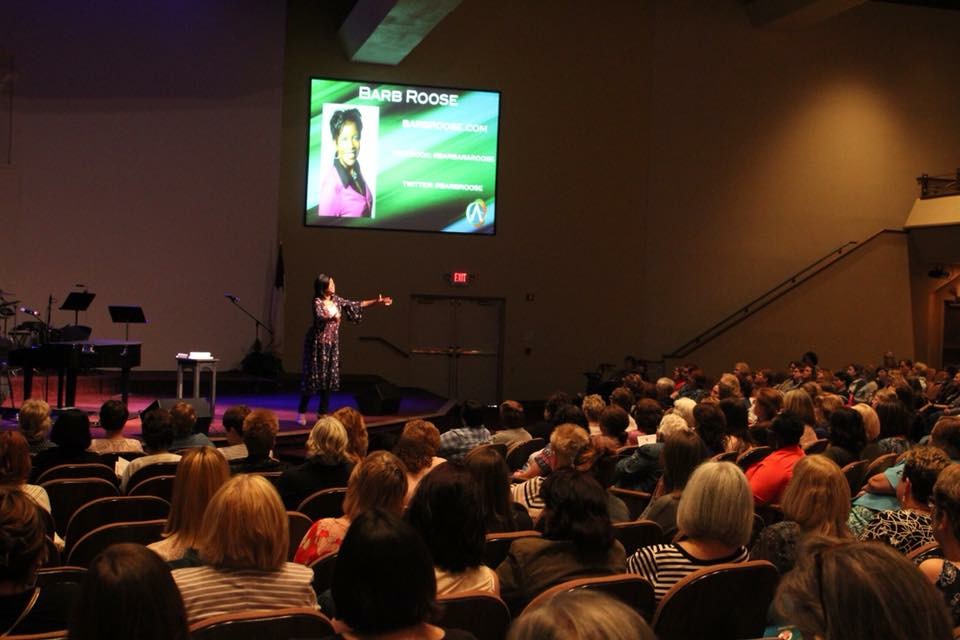
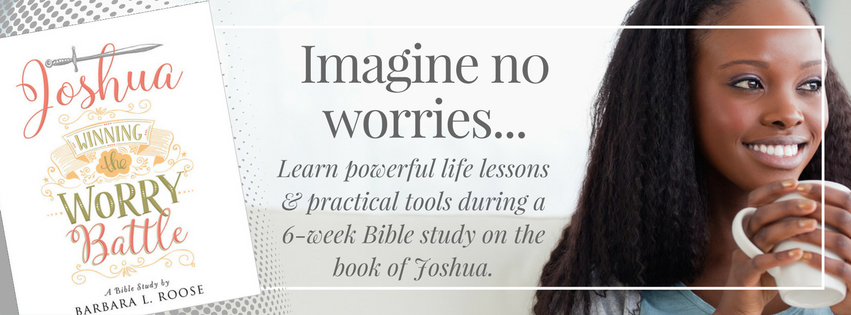
Last week was an incredible week! On Tuesday, I celebrated the launch of my new Bible study, Joshua: Winning the Worry Battle AND my new book, Winning the Worry Battle. It was a thrill to partner with the lead pastor of my church, Ben Snyder, to host a launch event titled, “Finding Freedom from Worry and Anxiety” Event on Tuesday, April 17. Here’s a quick slideshow of some of the fun photos from last week. (Pictures change every six seconds 🙂
[ngg_images source=”galleries” container_ids=”13″ display_type=”photocrati-nextgen_basic_slideshow” gallery_width=”800″ gallery_height=”600″ cycle_effect=”fade” cycle_interval=”6″ show_thumbnail_link=”0″ thumbnail_link_text=”[Show thumbnails]” order_by=”sortorder” order_direction=”ASC” returns=”included” maximum_entity_count=”500″]
Over 400 people attended the one-hour event at my church and the event ran on Facebook Live with over 1700 views. Rather than just host a “buy my book” event, I dreamed of encouraging and equipping people to win their worry battle. Ben and I talked about the spiritual impact of worry and anxiety. My friend and church communications director, Eric, was our emcee and he worked behind the scenes to help me organize the entire night. I interviewed my friend and fellow leader, Lauren Snyder. Eight years ago, Lauren had to fight her own worry battle when a friend of hers passed away after battling cancer. Lauren talked about how God led her toward health and wholeness with the help of her healthcare provider, wise voices in her life, and an ongoing commitment to community and accountability.
After the Tuesday night launch event, I joined the Aspire Women Events tour for three days of events in Cincinnati, Medina, and Pittsburgh, Pennsylvania. What a thrill! Holy moly friends, it was such a wonderful experience! Not only did I have a chance to share a message from my new Joshua Bible study and Winning the Worry Battle book, but I partnered in ministry with some extraordinary women. Aspire Events emcee and worship leader, Mia Koehne has an incredible talent for music and an inspiring personal story. Comedians Anita Renfroe and Kristin Weber made my face cheeks hurt with their hysterical stories and great songs.
The cherry on top of every event is connecting with the ladies, whether they stop by to buy a book or just want to say “hi.” God uses the women that I meet to bless me, encourage me, and remind me of just how much God takes care of us.
Friends, for those who have been praying for me over these months, thank you. You know that it’s been a long road. Writing two books in less than a year, losing my dad, and navigating a few other life situations has made for quite challenging year. So, to God to be the glory! He has brought me through and I am celebrating with you!
Thank you all for your love and support!

by Barb Roose | Mar 27, 2018 | Christian Living/Discipleship, Joshua & Winning the Worry Battle

By Barb Roose
For most of my adult life, I thought that being a worrier was a sign that I cared about others.
If I worried about someone that meant that I cared about their safety and happiness. So, I would devote my mental energy to identifying all of the ways that my family or friends might miss optimum happiness, hurt or kill themselves. It didn’t matter if they were thinking about trying a new hairstyle or daring to attend a college across the country, I was going to point out everything that could possibly go wrong so that they could avoid a tragedy.
But, what happens to us when we spend our time thinking about all of the things that could hurt, harm or kill the people in our lives? Eventually, our minds get stuck in that kind of worst-case scenario thinking. Did you know that 85% of what we’re afraid of happening never actually happens? So, when you’re churning all of the “what-if” scenarios about your daughter going on a missions’ trip or your son heading off to college, 85% of what you are stressing out about won’t happen.
Why do we believe that worrying is a symbol of caring for others?
If we worry about people because we care about them, then why does worry only produce negative feelings in us? I don’t know about you, but the more I allowed myself to worry, the more trapped I felt in a world of worry. Instead of feeling happiness for the people that I loved, I began to only feel fear, which opposes and tries to suffocate the power of love.
Here are three ways that worry makes us feel crazy:
1. Worry pretends to be productive.
When nothing changes, you feel crazy because you thought that by worrying you were actually doing something to make positive change happen.
2. Worry doesn’t have to work hard work to take over your mind.
Worry feels like your subscription to Netflix. It’s always available and once you begin streaming WorryFlix, you end up binge-worrying your entire life before you know it.
3. Worry produces horrible feelings that stress you out during the day and keep you up at night.
Isn’t it amazing how something in your mind makes your body respond in real ways? While you’re imagining the worst, your heart is racing and you feel real fear. Have you ever finished worrying and REAL tears were streaming down your face? And it was all in your imagination…
How worry made me feel crazy and out of control…
Seventeen years ago, my battle with worry peaked when one of my kids was struggling at school. Her teacher sent home notes and we had numerous meetings. I loved my sweet girl, but my fear over her future consumed me. Dozens of “what if” worst case scenarios drove me crazy! For weeks, I stressed out over my child’s health during the day and I paced the floor because I couldn’t sleep at night. Like Jesus said in Matthew 6:27, all of my worries didn’t add a single quality moment to my life or my child’s life.
So, what changed? I had to admit that worry was my flawed way of playing God instead of taking the time to pray to God.
Then, I had to replace those places in my mind where worry got good and comfortable with God’s Word. I had to commit myself to filling my brain with Bible verses that spoke against worry like this one:
Give all your worries and cares to God, for He cares about you.
—1 Peter 5:7
If you’ve always been a worrier, can I suggest that you either memorize this verse or type it into your cell phone. Whenever worry tries to take up space in your life, allow God to use this verse to kick that worry out of your mind and replace it with peace. Trust me, it does work! But, you’ve got to put the work into it!
Do I still worry at times? Yes! I’ll always have to fight against worry, but I don’t have to live as a worrier.
When you know how to use God’s Word to win against worry, you will wake up energized every day and excited about life because you know that God will give you victory over any worry that comes your way. Don’t waste another day of your life fighting a losing worry battle!
Don’t waste another day of your life fighting a losing worry battle!
LEAVE A COMMENT BELOW: Are you a worrier? What things do you worry about most?

About Barb Roose…
Barb loves reaching women and teaching them to win at life with God-empowered strength and dignity. She is the author of multiple books and Bible studies, including April 2018 releases, Joshua: Winning the Worry Battle (Bible study) and Winning the Worry Battle. She is the host of the Better Together Podcast and loves diving into tough topics that women want to know. Barb and her husband, Matt, are the parents of three daughters. Barb loves Jesus, travel, her FitBit, chocolate-peanut butter ice cream, and fabulous high heel shoes.
by Barb Roose | Mar 14, 2018 | Joshua & Winning the Worry Battle
By Barb Roose
Over the past 15 years, I’ve learned a lot about how to allow God to give me victory over fear and worry. I created the C.A.L.M. Technique for myself to reduce my physical distress so that I could pray. This easy-to-use tool works to slow down my heart rate, break the pattern of negative thinking, and relax my body. Then, I can invite God into my distress and ask Him to fight my battles for me. The C.A.L.M Technique isn’t just a neat idea – I use it! (I used it last week.) Recently, I had a chance to teach it to the folks at my church and that was pretty cool. Would you like to learn it?
C.A.L.M. Technique
- Count to 10 (Inhale on the number; Exhale the word MISSISSIPPI)
- Acknowledge God’s presence by saying: God, I know that You’re here with me right now.
- List – Tell God what you are afraid of or worried about
- Meditate – Keep repeating the following: God is here and He will take care of me/this.
When it comes to the counting, you will need to boss your emotions so that you can push your count to 10. Those supercharged emotions will definitely fight the technique. But, stick with it because it does work! This is one of those tools that becomes more effective the more you use it. Your body will calm down. I love this tool because it equips us to walk in the blessing of God’s promise in Joshua 1:9:
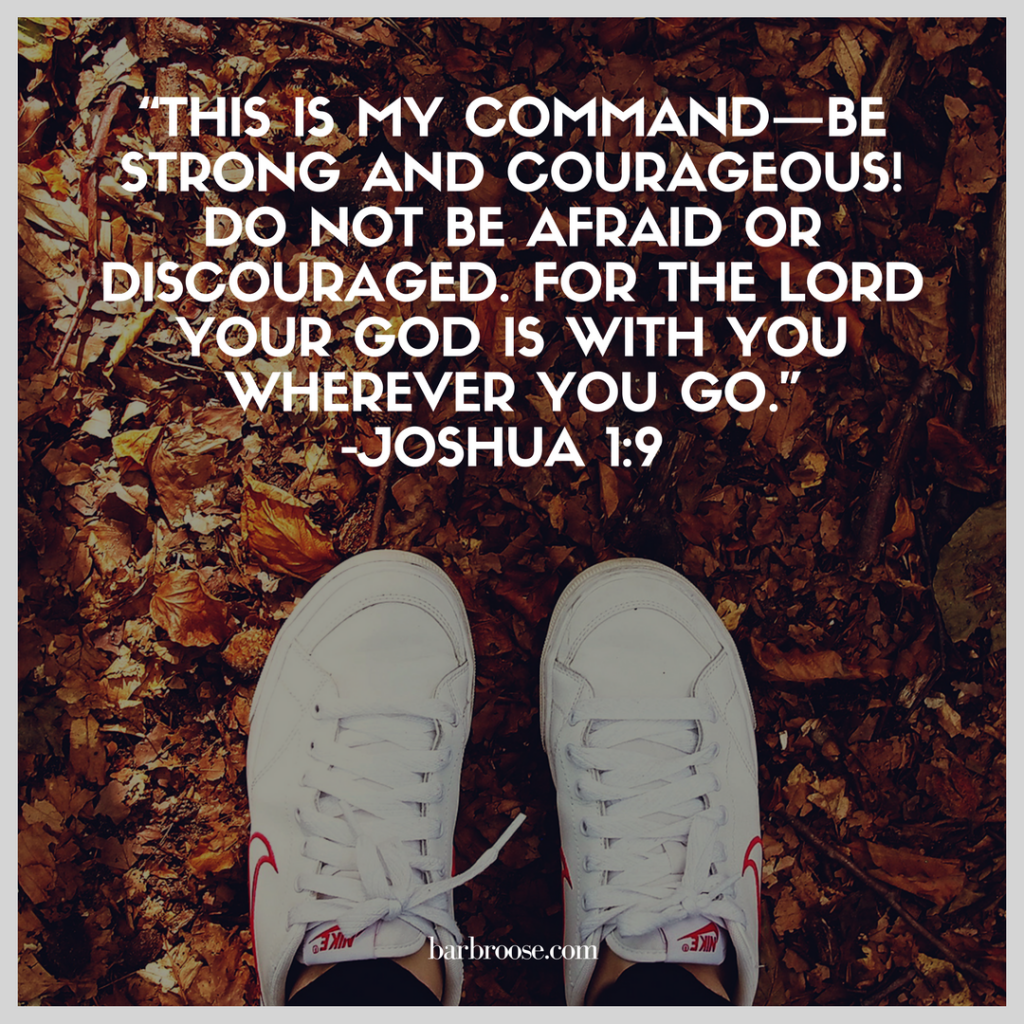
The point of this exercise is to reduce your physical distress and open up a conversation with God. I love this tool because it equips us to walk in the blessing of God’s promise in Joshua 1:9: “This is my command—be strong and courageous! Do not be afraid or discouraged. For the Lord your God is with you wherever you go.”
I don’t know what’s on your mind today. But, if you’re prone to meltdowns like me, practice the C.A.L.M. technique a few times so that you can use this tool to help you calm down during anxious times and connect with the God who promises to take care of you.
*Looking for MORE tools? Order my new book, Winning the Worry Battle releasing next month for even more practical tools to help you fight your worry battle! Click here to find out where you can order your book today!
SaveSave
by Barb Roose | Feb 12, 2018 | Joshua & Winning the Worry Battle
by Barb Roose
One Sunday afternoon I received a Facebook message from someone asking for help.
This sweet lady, whom I’ll call Leah, lost her father recently. If you’ve lost a parent or any loved one, you know that the grief runs deep. Dealing with the grief requires time, rest, and lots of self-care. Yet, she was unable to care for herself because others had pushed the worries and cares in their lives from their life onto her.

Leah was overwhelmed, except the worries weren’t her own. She was drowning in the worries of loved ones around her. I’ve known Leah almost my entire life. She manages her personal affairs well and plans for the future. Yet, she felt ensnared because of her fear of uncertainty and worries about her adult children. One was experiencing a second, unplanned pregnancy and another had neglected taking care of some serious legal issues and was looking at jail time. Leah told me that she promised money, time, and energy to help her loved ones get through their situation. But she also admitted that this cycle of being stressed out and bailing out had been going on for years. In fact, before Leah’s father passed away, he gently warned Leah that taking on other people’s problems would destroy her. He was right.
I diagnosed Leah’s condition as “Secondhand Worry.”
You might be suffering from Secondhand Worry if someone tells you about his or her problems and then, you end up suffering physical and emotional worry symptoms. Another symptom of Secondhand Worry is when worry drives you to assume responsibility for someone else’s problem. (If you’re familiar with recovery principles, that kind of Secondhand Worry is worry-driven enabling.)
Here are some practical examples:
• Your spouse has trouble with a manager, and you begin to worry about his job loss.
• Your child struggles with a subject at school, you worry that he or she will end up living on your couch well into their adult years.
The problem with Secondhand Worry is that we experience all of the symptoms associated with worry like sleepless nights, stressed out feeling, lack of appetite or overeating, frayed nerves BUT the situation isn’t even about us.
If you can relate to Leah, it’s a difficult place to be. Life is hard enough trying to fight in faith for our own victory over worry. It’s not possible for us to fight someone else’s battle, too.
For the past few months, I’ve been studying Old Testament book of Joshua and there is a situation where Joshua ends up with a case of secondhand worry. God prohibited the Israelites from making treaties with the inhabitants of Canaan, yet Joshua and the leaders were snookered by a group of Gibeonites with a fictitious story and some deceptive visual aides (Joshua 9:9-13). Instead of consulting God for wisdom, Joshua and the leaders made a treaty with the lying Gibeonites, whose deception was driven by fear. As a result, the Israelites ended up being responsible for a group of people that God warned them against.
Are you feeling responsible for people in your life who should be responsible for themselves? Do they keep coming back to you over and over again with endless excuses and sad stories?

If you’ve been caught in Secondhand Worry, you know what it’s like to hemorrhage money or spend sleepless nights because someone in your life didn’t manage his or her business. I’ve said it before and I’ll say it again, don’t let someone else’s worry wear you out!
Years ago, my friend and licensed therapist Tim challenged me to admit that I was struggling with Secondhand Worry. In fact, we had a few heated sessions because I told him that he just didn’t understand! What if I didn’t intervene and something horrible happened? Then, Tim made this powerful statement: We have to let the people in our lives discover their own need for God.
Is there someone in your life that you love, but you realize that it’s time to step back and let them discover their need for God?
It’s not my role to advise you not to help, but realize that your helping has the potential to hurt both of you. It’s hurting them because instead of allowing their consequences to push them toward God, you might be putting yourself in the way. It’s hurting you because you’re carrying a heavy load of someone else’s mess. Perhaps the person will see God more clearly once you get out of the way…
I recognize that the answers to the questions of how to handle your situation might be complex. No doubt there will be emotions involved. That is why prayer is so important. When you pray, God’s wisdom can cut through your emotions and deliver clarity. Furthermore, in prayer, God’s Holy Spirit may reveal or remind you of something that wasn’t present during your conversation with that person.
If you determine that it would not be healthy to aid someone, saying “no” is difficult, but you’ve got to do it — both for their sake and yours! Here are a few things that you can say instead:
- I’m so sorry about your situation, but I am unable to help you at this time.
- That is so difficult! Can I help you put together a plan that you can use to deal with this situation? (Only if you can plan without taking responsibility!)
- I know that you can figure this out. Keep me posted on how you are doing.
It feels bad saying “no” to helping someone, but remember, you aren’t saying that they aren’t worthy of help, only that you are no longer getting in the way of God helping them.
SHARE A COMMENT BELOW: What’s the hardest part about stepping back and letting your loved ones and friends take care of their own problems?
SaveSave
SaveSave
SaveSave
by Barb Roose | Jan 24, 2018 | Better Together Podcast, Women's Topics

I grew up in a family of fabulous singers. But, I am not one of them…
My grandmother traveled with a gospel choir and played as the church pianist for at least 20 years. I grew up watching my mom and aunts sing, too. Their voices are powerful, beautiful and amazing.. They can blow! If we’re friends on social media, you’ve seen photos of my sister, Tonya, who is an opera singer. Watching to her perform always bring a smile to my face that lasts far after her performance is over.
You might be wondering if I can sing. The answer is…meh.
If you happen to pull your car up next to mine in traffic, I guarantee that I’m singing in the car. I am an awesome car singer. The acoustics are wonderful for my marginal vocal ability. If I turn up the radio high enough, I sound exactly like the vocalists in the song. If I turn off the radio and keep singing, just be happy that my windows are up.
In my 20’s I struggled with my less-than-super singing. Since I was from a singing family, having an okay singing voice wasn’t good enough when everyone around me sounded so great.
To increase my confidence, I took voice lessons in my mid-20’s. I felt better when I sang on my ensemble church worship team. But as soon as I had to sing on my own, my confidence faltered and my voice always fell flat. I often wanted to run off the stage and hide. Oh, how I used to beat myself up! Why couldn’t I keep my confidence?
Do you ever struggle with your confidence?
I love it when women tell me their dreams. Some women desire certain job or career title. I get frequent emails from women who want to write or speak. Having a dream is a good thing! But, what do you do when you dream is undermined by your lack of confidence? Some of us have a Debbie Downer living in the dirty corner of our mind telling us things like:
“You don’t belong…”
“She’s more talented than you…”
“Why do you think that you’re special…”
“If you fail, everyone will laugh…”
Six Words to Say to Yourself
Yesterday, I finished Lynn Cowell’s new Bible study, Make Your Move: Finding Unshakeable Confidence Despite Your Fears and Failures. Lynn is a speaker and author who writes and speaks to equip mothers with wisdom so that those mamas can raise wiser daughters. Her six-week Bible study featured weekly profiles of six groups of women in the Bible and lessons in Christ-Courage and confidence, like Shiprah and Puah, the two Hebrew women who refused to follow the Pharoah’s order to kill infants like Moses.
One of my favorite moments was studying Deborah, one of Israel’s judges. Not only was she assigned to be God’s spokesperson to Israel, but she’d received a gigantic assignment: to instruct the Israelites during battle. Just to be clear, Deborah was a judge, not a warrior. But, she went because that is what God called her to do.
As I studied her story a few weeks ago, I was pushing to finish my new book, Winning the Worry Battle. It’s been a tough few months writing back-to-back projects, losing my dad, traveling and then moving through the editing process. For the first few weeks of January, I felt like I was fisting-fighting the Debbie Downer in my mind because I was mentally worn out from the past few months of life. What if you flake out and don’t finish? What if your writing isn’t any good? What if no one buys it?
But, as I studied Deborah, she speaks six words that immediately refilled my soul.
In Judges 5, Deborah and Barak sing a song of victory after winning the battle. As they sing over defeating their enemies, Deborah slips in six powerful words. They are tucked into verse 21:
The Kishon River swept them away—
that ancient torrent, the Kishon.
March on with courage, my soul!.
– Judges 5:21
Did you see those precious words: “March on with courage, my soul!”?
I’ve read, remembered and breathed those words at least a hundred times in the past three weeks. There’s are two powerful lessons for us to remember when we’re under pressure and questioning whether we can actually do what God’s called us to do.
First, Deborah knew how to encourage herself when she needed it. Her encouragement fueled her confidence.
Second, if we trust and know what God has called us to do, let’s stop undermining our confidence while we’re doing it.
How can you encourage yourself today?
- Do I even need to say this? Stop calling yourself names like stupid, idiot, worthless or loser! Those names are not helpful and they will hurt your confidence. As I wrote in my Enough Already book, “Beating yourself up won’t change a thing!”
- Learn how to become a rock star at encouraging yourself. Encouraging yourself is not prideful! The Bible is filled with proclamations of God’s everlasting love for us. Even when we mess up, God loves us. Whispering phrases like, “I made a mistake, but I’m not a mistake,” “I can keep going because God will help me” and “I am not alone, God is with me” – these are how we keep our confidence. Can you start saying these phrases to yourself?
So, how does my story end?
After a few years of constant confidence struggles, I finally stopped singing. I’d taken a temporary break to give birth to my now 17-year daughter. By the time I was ready to begin serving at church again, the music team had re-organized and I found a new ministry where God began to lay the foundation for the work that He’s given me to do today.
Once I began following my natural gifts and talents, I found peace. Not only that, but I could learn and grow with so much freedom. Confidence came from being who God called me to be! I love Lynn’s words in the study. She writes, “We each have different gifts, talents and callings. I am simply a woman doing the assignments God gives to me.
Whatever God has called you to do in this season of life matters, my friend. You don’t need to compare yourself to what the women around you are doing because you’ve got your own amazing work to do. Whether you’re raising your children, working your 9-5 or caring for your parents, confidence comes from knowing that you’re doing the best at what God calls you to do.
Creating a conversation around Christ-confidence is such a vital discussion. Check out Lynn’s Bible study by clicking here. You can also listen to my recent podcast with Lynn by clicking the audio player below:
SHARE YOUR STORY: What are some of the lessons that you’ve learned about being a confident woman?
SaveSave
SaveSave
SaveSave