by Barb Roose | Aug 15, 2016 | Christian Living/Discipleship
This year’s summer Olympics has been a breath of fresh air!
Have you had a chance to see team USA in action? For the past week, United States athletes like Michael Phelps, Kate Ledecky, Simone Biles, Simone Manuel and so many others have given us so much to cheer about!
For me, when I see are Olympic athletes take the world stage, I am filled with such a deep sense of pride. I feel like those athletes are my people!

photo credit below
Now, I’ve never met any of our Olympic athletes. I don’t know where they are from and I know very little about their lives. Yet, when they compete I cheer like crazy for them because they are wearing red, white and blue.
In fact, I believe that the Summer Olympics has divine timing…
Over the past three months, America has been more divided than it any other time in recent memory. And we are divided over so many things from the hate-filled election season, split opinions over social issues and an escalation in our centuries-old struggle with racism that’s tearing our country in half.
Yet, even as the United States is more divided than ever, this year’s Olympics reminds of how good unity can feel. We’re reminded that we could cheer for people that we don’t know and consider them “our people.” We’re reminded that we can celebrate athletes who don’t look anything like us and yet, feel like we’re winning right along with them.
Other than the Olympics, when’s the last time that you’ve seen that happen in the United States?
I’ve struggled for the past two months because there are no easy answers to the problems that divide us. I’ve been asking, “God, what do you want me to do?” My greatest fear was that I couldn’t make a difference.
After the first police shooting, I shared a story about my experience with race in America. To my surprise, hundreds and hundreds of people responded. A week later I wrote another story about my fears while raising bi-racial children and again, people responded.
Social media has proven over and over again that when our lips or fingers are typing, people are not listening. Our opinions often create more opposition.
But, as I prayed, God seemed to impress upon my heart the power of a story. I shared my story and people listened – and they responded. I began to wonder if God wanted me to create space for people to share where they come from and what they’ve been through.
Friends, let’s be honest: We don’t know how to talk to each other about race. BUT, we do know how to do a share our story.
Recently, I was reminded of the power of our stories.
Two weeks ago, I was in Roatan, Honduras. It’s a beautiful tropical island off the coast of La Ceiba, Honduras. I’ve traveled to La Ceiba many times on missions work. This time, I flew over La Ceiba and landed in Roatan to speak at a women’s conference on that beautiful tropical island.

Beautiful Roatan, Honduras
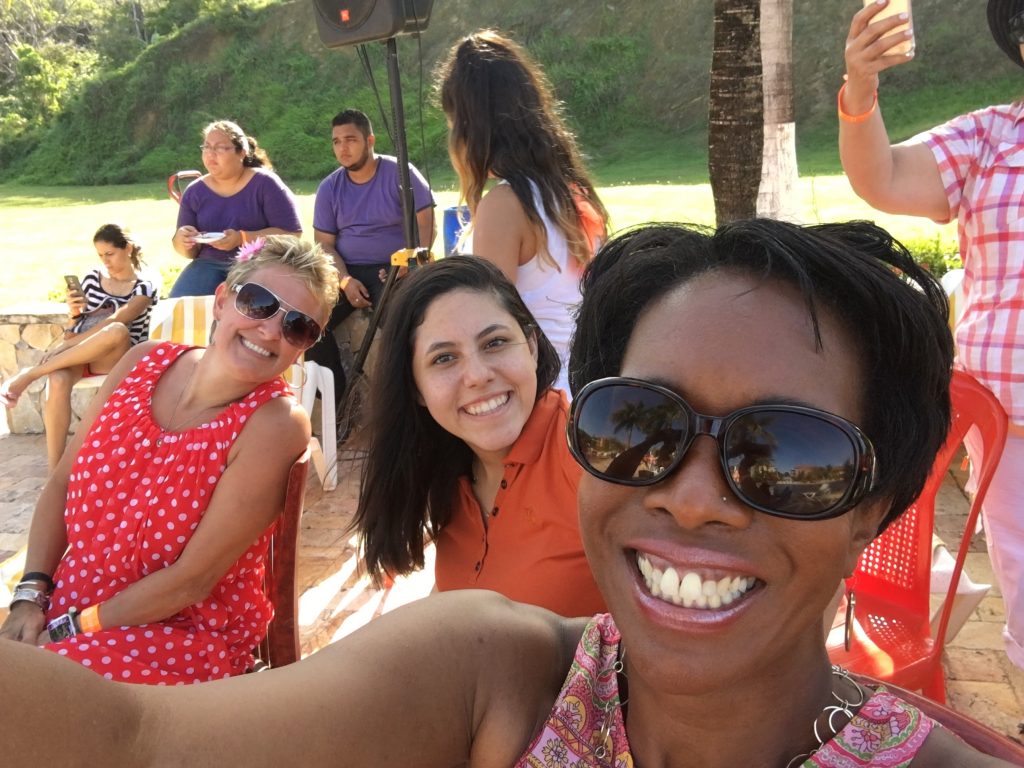
I’m hanging out with my friend and International Missions coordinator, Karen and my lovely translator, Sofia.
A gorgeous view of our final evening at the conference right on the edge of the Caribbean.
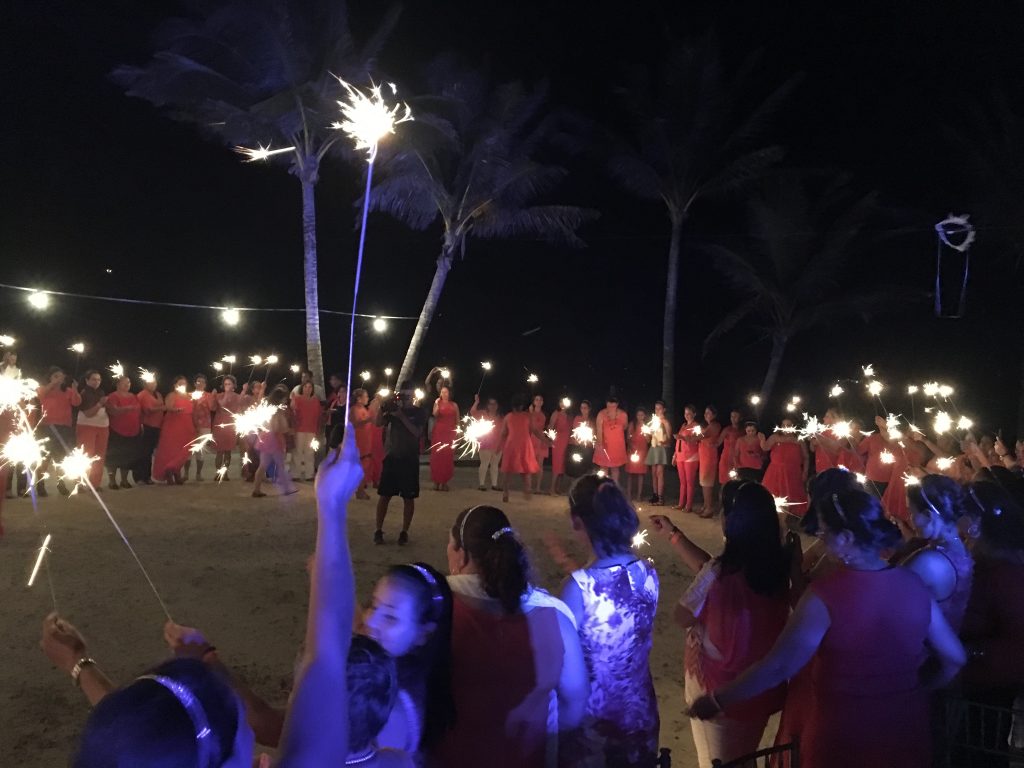
Celebrating the final night of the conference with sparklers and fireworks.
Before I spoke during the morning session, I was sitting at breakfast with my traveling companion, Karen. We joined six other Honduran women already sitting at the table. We were from different countries and spoke different languages. We had different socioeconomic and educational experiences. Yet, we were all sitting around the same table eating the same breakfast. Since my Spanish is muy mal, I asked our translator to offer a question to the women in order to break the silence. I didn’t even know what to ask. But, in that moment, God impressed upon my heart a simple list question: “Would you tell me about your families?”
For the next hour, those women spoke through our translator. They shared eloquently about their heartache, hardships as well as the trials and triumphs in their lives. Each one of the women had been through incredible hardship, yet their eyes lit up as they spoke of God’s faithfulness and how they overcame fear.
One woman told the story of a son who had been imprisoned in another country and she had not seen him in two years. However, the day before she left for the conference, he was miraculously released two years early and on his way home. Another woman shared of the death of her 13-year-old son from hydrocephaly and then a number of years later, she lost a young daughter to Down syndrome. Our translator shared of how her husband lost the use of his legs after suffering nerve damage during surgery. She shared how strong they’ve become in their faith as a result of this situation and she smiles and gives thanks to God anyways.
What a precious experience, friends! I gained a greater perspective on my life because of what those women went through. Spiritually speaking, God became even bigger to me because I had a chance to hear how He worked in their lives and in their circumstance. I was so blessed!
On that morning, I was reminded of how small our lives and faith remains when we only know our own story.
What if the first step was your decision to understand more about race was asking a question to discover more about where people have come from and what they’ve gone through?
Perhaps, you’ll consider asking someone who looks different than you out to coffee or inviting their family over to your home for dinner. Instead of worrying about what to say or obsessing about saying the wrong thing, consider beginning with the question: “Would you tell me about your family?”
Friends, I know that a single question isn’t going to be the magic fix that we need to heal of the miles-wide racial divide in America. BUT, we could reconcile the divide as we learn our stories one at a time?
I’m not sure what the answer to that question is, but what I do believe that it’s a positive step in the right direction.
SHARE YOUR STORIES WITH US!
I’ve launched a 30-day experiment called the “(g)race project.” Over the next 30 days, I’m asking 30 questions about race, grace and faith on this Facebook page. Just click here to join. You are invited to share your stories with us. My prayer is that over the next 30 days, we can begin to reconcile our country’s racial divide, one story at a time.

Photo credit: Aug 11, 2016; Rio de Janeiro, Brazil; Simone Manuel (USA) celebrates after the women's 100m freestyle final in the Rio 2016 Summer Olympic Games at Olympic Aquatics Stadium. Mandatory Credit: Erich Schlegel-USA TODAY Sports ORG XMIT: USATSI-GRP-746 ORIG FILE ID: 20160811_jel_usa_488.jpg
by Barb Roose | Aug 2, 2016 | Reflections, Women's Topics
Three tips to calm down, step back and not freak out when people act all funky around you.
by Barb Roose

photo credit: reachingutopia.com
Yesterday, my husband and I were eating breakfast. Actually, he was eating breakfast while I stared at his plate. I slowly sipped a half a cup of orange juice because I planned to do my yoga workout later that morning. If you’ve done yoga, you know that eating before a workout is an express ticket pass to nausea and in my case, vomiting.
Without any food to keep my mouth busy, I decided to strike up a conversation. Attempt #1:
ME: “How do you feel about the upcoming election?”
HUBBY: “I’m taking a break from the coverage.”
ME: “Oh.” Strike One.
I sipped my juice and looked down again at the newspaper searching for a new topic of conversation. There wasn’t much to work with. Conversation attempt #2: “Hey babe, the National Amateur Baseball Federation is going to be in town.”
And you thought that my life was more interesting that yours…
My husband quirked an eyebrow and I took that as a cue that he wanted to hear more. So, I read the entire list of the conventions that would be in our area. Still, no response. So, I made one last attempt “Did you see the new patents issued in the business section today?”
I kid you not. I actually said that.
Matt kept eating and listened patiently as I read the list of new patents given out and I can never get those lame two minutes back ever again. Afterward, he thanked me for breakfast and hustled upstairs leaving me at the dining room table to sulk. Here I was available for thrilling conversation on a Monday morning and it seems that my husband had better things to do. Of all the nerve!
As I sat at the dining room table as the only guest to my Monday Morning Pity Party, I churned on how hurt I was over the morning’s lack of conversation. Clearly, I cared my deeply about our relationship more than my hubby. Armed with sufficient indignation, I worked up more woe-is-me sentiments:
If he really cared about me, he would have…
I can’t believe that he…
Why am I the only one who…
My husband bounded down the steps less than 10 minutes later. He grabbed his keys and kissed me on the cheek. Turns out, he’d been pre-occupied at breakfast with a list of important tasks. His goal that morning was to get out the door to take care of business before heading to work.
Interesting. He was pre-occupied with something that had ABSOLUTELY NOTHING to do with me.
And yet, I’d spent the last 15 minutes of my life making our morning interaction ALL ABOUT ME…
THE FOUR LETTERS THAT I NEED TO TATTOO SOMEWHERE ON MY BODY
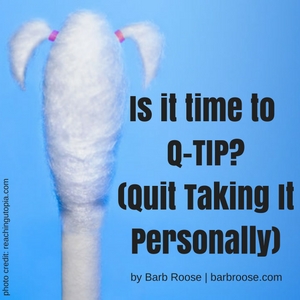
Have you ever heard of the phrase Q-TIP? It stands for Quit Taking It Personally. I heard this phrase about a month ago and when I manage to remember it, this phrase quickly changes my outlook on negative relational situations.
There are times in life when we feel that others are out to make our lives miserable by their actions or their attitudes. The closer we are to the individual, the more painful their behavior feels. Here are some examples of times when we’re tempted to take things personally:
- The co-worker who is always rude when you ask her to cover your shift.
- The Facebook friend who keeps posting stupid videos about the candidate that she knows that you can’t stand.
- The sister or sibling who constantly gossips about you or your kids.
- The neighbor who borrowed $200 last summer and hasn’t paid you back yet.
- The family member who lies or steals from you because of an addiction.
- When your best friend is always, always late. Like always. All of the time. She couldn’t be on time even if time stood still.
REPEAT AFTER ME: THEIR RUDE, CARELESS OR BAD BEHAVIOR HAS NOTHING TO DO WITH ME.
I love this quote:

In these situations, our first thought that they are intentionally trying to hurt our feelings or ruin our day with their funky behavior. Therefore, we conclude that their funky-funkiness is 100% absolute, undeniable proof that they do not care about us like we care about them.
So, what happens next? We get funky right back! Unfriend. Unfollow. Block. Ignore. Blame. Retaliate. They hurt our feelings and so we’re going to hurt their back, right?
Here’s the reality: When someone acts like a jerk or unintentionally hurts you, he or she is acting based on their own stress, selfishness, anger or pain. It has nothing, absolutely NOTHING to do with you.
How does Q-TIP help us? Here are three ways that remembering this phrase can change or your day – or even your life:
- “Q-TIP” reminds me not to jump to conclusions.
There is always a backstory to whatever people are saying or doing in front of us. As the popular saying goes, “Be kind, for everyone you meet is fighting a hard battle.” Friends, we’re all slugging through life and we’re all doing the best that we can.
So, can we give people “grace and space.” If someone acts funky toward you, step back, stay calm and be silent. Hustle out of there if he or she has a track record of getting physically angry!
Wait for him or her to calm down and then, consider whether or not you need to speak up and address the situation.
Speak up because you respect yourself, not because you expect them to change or apologize.
2. “Q-TIP” reminds me that I don’t have to “feel their feelings.”
Oh, my sweet sisters! How many of us have messed up ourselves by getting too wrapped up in the lives of others? There’s a difference between holding someone’s hand for support versus being their emotional crutch. Honey, don’t let someone wear you out with her drama!
3. “Q-TIP” frees me to care about people, without having to control them.
We always get in trouble when we try to “fix” someone’s feelings. If we end up in a situation with someone who’s in a bad mood, let them be Mr. or Mrs. Grumpypants. Don’t try to talk them out of it. Why? Because they aren’t thinking about you in that moment, but they will turn on you because they’re looking for an outlet for their frustration. Don’t let it be you!
Thanks for checking out today’s post. I’d love for you to share a comment and tell me which one of these three Q-TIPS might be the most helpful for you? By the way, if you think that your friends might enjoy this post, use the share buttons at the top or bottom to pass it along!

by Barb Roose | Jul 18, 2016 | Reflections
My husband and I were talking about the events of the past few weeks. We've spent a lot of time parsing through the different shootings and political or media angles that Americans are struggling to understand.
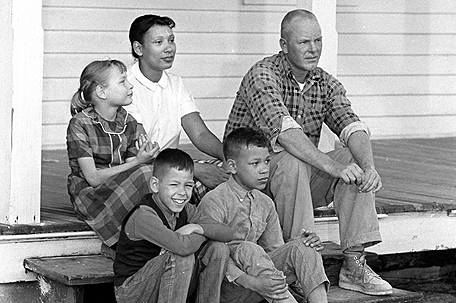
During our conversation, it struck me that it takes A LOT for people of different races to actually be able to talk about race without getting angry or defensive. It is truly a hard thing to do. In our home, talking about race is complex. My husband is Caucasian and I’m African-American. We married only 25 years after Loving vs. Virginia (1967) legalized interracial marriage in all 50 states.

Richard and Mildred Loving and their children. A movie about their court case will release in Fall 2016.
My husband and I come from different backgrounds, experiences, and perspectives. He grew up in a small, rural community and I was raised in a small town. Yet, we have to talk about race because it impacts our lives often. And not all of those conversations are easy. Some have been excruciatingly difficult.
I never set out to marry someone from a different race. I don’t think that my husband did either. Love happens, y’all. When we married, both sides of our families struggled with our union. And not just because of race. Also, because back then we were young, broke and expecting a child.
And one question persisted: “But what about your children?”
When I was in labor with my oldest child in 1992, our family held its collective breath. Not me. I needed to push a kid out. As I pushed, I also wondered whether we were having a boy or a girl. I also wondered if our baby would be light or dark. Which side of the melatonin gene pool would win?
When our child was born, skin-color took a backseat to love. For a short period of time. Our oldest daughter was the first grandchild on one side of the family and the first granddaughter on the other. Everyone fell in love at first sight.
We hoped that love would win out for good. It did for us. But not for everyone.
Raising our oldest opened our eyes to an entirely new experience with race. We still laugh about the time when my husband was out at the library with our oldest daughter. Someone asked him: “So, when did you get her?” It took my husband a few moments to realize that the person assumed that our daughter was adopted because of her latte-colored skin. My husband replied: "From the hospital."
When our middle daughter was born in 1995, her skin color was lighter than my very fair husband’s skin. It freaked me out. When I placed my hand next to hers, the stark contrast overwhelmed me. A fear settled into my heart: What if no one believes that she’s mine? What if someone tries to take her from me?

Top left: Our oldest daughter; bottom left: our youngest daughter and our middle daughter is on the right.
If she was lost in a store or sick, I worried that someone in authority would question whether or not I was her mother.
Embedded within that worry was the fear that someone would look at my child’s light skin and decide that based on my skin color that some other mother - a Caucasian mother - was better for my daughter.
Was my fear irrational or not? Well, if I had a dollar for all of the times that I was asked if she was my daughter, I’d own a lot more shoes! In fact, I actually carried a family photo in my wallet until my middle daughter started calling me, “Mommy.”
Our youngest daughter arrived in August 2000 after a difficult pregnancy. She was our miracle baby. We gave thanks that she came out healthy. I also gave thanks because she came out mocha like than me, albeit a shade lighter. I was surprised and relieved. Also, selfish. Finally, I birthed a kid that I didn’t have to worry that someone would question whether I was her mother.
My kids' skin and hair color created an unwelcomed spectacle. When they were toddlers, I didn't put them on display, but people felt comfortable making all kinds of comments.
Over the years, I heard all of the comments, "Oh, bi-racial children are just the cutest." I'd smile and thank them - then move it along before my kids became a sideshow attraction.
At other times I would be asked, "Wow, are all of these yours?" I'm not sure if you've ever been questioned about whether or not your child was yours, but it's an experience that you'll want to skip. Quick tip: If you aren't sure about whether or not someone's child is theirs or not, don't ask. Unless you see that kid on a "Missing Child" poster, it's actually none of your business. If curiosity is killing you, try offering, "Tell me about your family."
Being the mama of three bi-racial girls with three different types of hair textures was a challenge. We owned A LOT of hair product. And none of their hair was exactly like mine. Their dad's genes showed up and scared me. Talk about a learning curve! I did not realize that Caucasian hair tangled so easily. Those tangles were no joke! I spent too much of my life combing out tangles. I spent my childhood in braids and mom only had to wash my hair a few times a month. With three bi-racial kids and daily hairwashing, there was a lot of crying in my house. Mostly by me. One of my daughters was just a few seconds from getting her hair completely buzzed....
One of the toughest race-related conversations my husband and I had was over what race circle our kids would fill-in on standardized testing. Talk about lots of long conversations! When my oldest daughter began school, kids still had to choose one racial demographic. That was stressful! We didn’t want our girls to deny any part of who they were for any reason.
We considered our nation’s history with race and decided at that time that we never wanted our kids to deny the African-American part of them. So, we made the decision for her to fill-in the African-American circle.Thankfully, a few short years later testing demographics expanded and all three girls could fill-in “bi-racial.” Now that my kids are older, I navigate the positives and consequences of the decisions that we made for them long-ago.
Fast-forward a lifetime. Our oldest two daughters are adults and one is in high school. We've navigated all types of experiences in life. Some good. Some bad. Some heartbreaking. Some experiences are still filtering through...
My girls are walking their own journey with race. I’m sure that there are a few stories that they’ll tell us in the years to come. I ask myself: Did we talk about race enough?
I hope so. Probably not. Maybe...
But, I hope that we raised them to feel connected to both sides of their heritage. Did we? I think, but I also wonder if it was enough. As their parents, we did our best to put them in environments where they could make friends of all races. We live in an urban neighborhood and our kids’ private Christian school grew in diversity over the years. In fact, one of our girls had three besties in high school. This group of brilliant young women were called “The United Nations” because of their diversity – and one of the girls actually landed a scholarship because of her friendships with the other girls. I love that story!
It's the kind of story that gives me hope.
I’m praying that if we can’t figure out how to get ourselves out of this mess, maybe our children will see our mistakes and steer a path far away from our prejudice and racism.
Thanks for stopping by! Join the conversation in the comments. What suprised you about my story? What is your experience? Let's listen and respect each other in the comments.

by Barb Roose | Jul 7, 2016 | Reflections

One night, I walked into a neighborhood pub. As soon as the door closed behind me, an unknown voice yelled: “What’s that nigger doing in here?”
Was someone talking about me?
I stopped. The room silenced. An electric pause buzzed the air.
My mind calculated what I’d just heard. Then, a thought: Oh, I KNOW that he did not just say that to me.
Another moment passed. A volcano of rage started to bubble deep within. Let me take my shoes off. Earrings, too. Somebody – SOMEBODY, hold my purse.
That incident happened over 20 years ago, however, I remember it like yesterday. On that night, I walked in to enjoy some dinner. Except someone decided that I didn’t belong.
Not based on my personality,
Not based on my family background,
Not based on my ability to pay,
Not based on my company,
BUT based on my skin color, I was unacceptable.
I gazed around the room wondering if anyone would speak up or even say something – anything.
Silence.
So, what did I do?
I held my head high, glided through the hushed crowd and took my seat at the table. Yes, I did.
I suspect that some of you are questioning, “Was it really that bad?” or “Are you sure?” You’re shocked that those things could have happened to me.
But they did. In my early adult years, I learned how to ignore the sales staff that helicoptered while I shopped for shoes. I learned the importance of not messing with my purse while browsing merchandise. I embraced driving 10 miles UNDER the speed limit in certain communities – especially if I was driving at night.
Those situations never shocked me, but I hesitated to recount them because of the shocked-responses from others. Racism thrives in part because it shocks the majority into disbelief. I’ve heard responses such as:
“Are you sure?”
“I can’t believe it…”
“That can’t be!”
“Say it ain’t so!”
Unless you’ve been a direct victim or eyewitness of someone who’s experienced racism, stories about racism will always be shocking.
Yesterday, a cell phone camera captured police restraining an African-American man named Alton Sterling on the ground. Then, those same officers fatally shot Sterling while restraining him. Much of America is in shock. But, not those who’ve been wrestled to the ground like Sterling. Not those of us who’ve witnessed our fathers and brothers stopped for no reason, hassled or pulled from their cars. We’re not in shock. We’re a lot of things – angry and sad sums up a lot. It seems that each #shootingincident buries us deeper into the struggle over of the color of our skin and the fear that lurks within.
There’s nothing about our first-world mindset that wants to accept that racism could be just as pervasive as it was when men began wearing white sheets and Africans exited boats in chains. Apparently, we’re not as awesome as we think we are. Seriously, we discovered how to fly, found a vaccine for polio, developed a nuclear bomb, put a man on the moon, learned how to record on a VCR, taught Grandma how to use Facebook and elected a black man as president twice —
Yet, we can’t accept that racism is woven deeply into the fabric of our American experience.
In our mental model, racists hang out with murders or pedophiles. So, a racist couldn’t possibly be the fun neighbor up the street or the sales manager in your office. We don’t want to call someone a racist unless we can SEE them being racist.
But, how do we call out people who harbor racism in their hearts? Even more so, how do we call it out in ourselves?
You just thought that I called you racist. I didn’t. Only you can answer that. But, I do want you to consider how you’ve been impacted by the roots of racism in your family of origin.
What you believe about race is influenced by the generations of conversations and experiences that happened long before you were born. Your great-grandparents sat and around the table and talked about race. Your grandparents heard them. Your parents heard your grandparents. You listened to your parents. I’m not saying that you agreed with all that was said, but you’ve got to be aware of how those words and stories influenced your thoughts, feelings or behaviors.
Questions to consider:
- When you were a kid hanging out at family gatherings, how did your family talk about race or people from different races?
- Are there any race-related incidents in your family’s history that turned into stories that you were told as a child? How did those incidents impacted how your family lived?
- What are your operating stereotypes? (Asians are smart, black women are loud, black men are scary, white people are fake)
- What are some of the hot-button issues that you know would create tension if you discussed them with someone of another race? Why would those issues create tension?
- What would a friendship with someone from another race look like? (It would not be a true friendship unless you could talk about race.)
So, what now?
- Love must lead the way.
Some of you are tired of hearing people like me talk about ‘love.’ For you, love is for Valentine’s Day. Love is something that gets hot and heavy on Friday night. You don’t really believe that love is a potent power in our universe that can actually affect change. Maybe it’s because we really don’t know how to love. We’ve cheapened it and now, we think that the strategy of love has failed us. Except, our back-up plans of ignorance, hate and anger haven’t worked either.
I love Martin Luther King Jr’s vision for the future. He had hope because he believed in people. He believed in us! He knew that racism would never be eliminated by laws or lawsuits – even though he fought for legal and social justice. But Dr. King preached the same thing Jesus preached long ago: Unconditional love is the only road to the elimination of racism. Racism will die once our unconditional love for each other comes alive.
Love is not a feeling. Love is an action. Love is THE ONLY strategy that can save us from society-destructing ourselves. You’ve got to remove your limits on your love for people. Here’s the ultimate test for love: Decide now that you will lay down your life for another human, no matter their race or culture. When you decide to display that kind of love, then you carry the torch of hope for our tortured nation.
Check out Dr. King’s words:
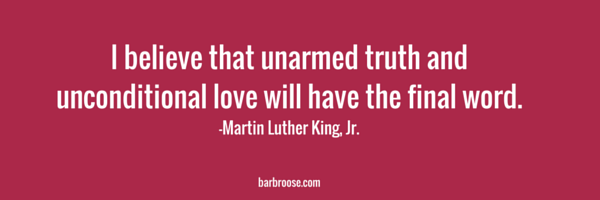
“I refuse to accept the view that mankind is so tragically bound to the starless midnight of racism and war that the bright daybreak of peace and brotherhood can never become a reality… I believe that unarmed truth and unconditional love will have the final word.”
2. Labels lie. Relationship reveals the truth.
Here’s the thing: We feed what we believe. As long as we believe that all black men might steal our purse or that all white people will stab us in the back, those lying labels will keep us far apart from each other. When we stop looking for evidence to feed our faulty beliefs, then we’ll be willing to open ourselves up.
What would it look like for you to develop a relationship with someone from another race? It’s more than having a “black friend at the office” or “having a white girl to roll with on Friday night.” It means that you get to know someone well enough that you can talk about the things that matter in life. It means that you can agree to disagree – still love each other. It means that you can come from different cultural or socioeconomic perspectives and still respect each other’s viewpoint, even though you may not completely understand it.
3. Start new conversations with your family
If you ever expect that future generations will move away from where we are today, then we have to give them a new target. Focusing them on the target of developing authentic relationships begins with authentic conversation.
How can you have new conversations with your kids or older family members? Consider this:
- Eliminate “them” and “they” when talking with your kids about race. Use actual names and tell personal stories when you talk with your kids about people from different races or cultures.
- Discover how race has impacted your family by talking with older members of your family. Start with the question: “What do you think about what happened to Alton Sterling?” Now, the tension reappears once they finish talking. How do you respond to their answer? Pastor Andy Stanley suggests these questions that you can ask without fear of offending: What led you to that viewpoint? Have you always believed this way?
- Can you promise me that you’ll memorize this verse before talking to ANYONE? Here it is: “Be quick to listen, slow to speak and slow to get angry.” -James 1:19
Speaking out about race isn’t easy. Our experiences with race are just as personal as they are collective. So, thank you for stopping by and checking out this post. I’d love to hear your thoughts on how we as individuals can be the light of hope in American’s dark night of racism. Please leave a comment below.

by Barb Roose | Jun 13, 2016 | Christian Living/Discipleship, Scripture Devotional, Women's Topics
This post is for my Jesus-loving Christian friends out there.
As we mourn the horrific national tragedy in Orlando, I’m holding my breath.
Why?
#BecauseChristians
Y’all know what I mean. And y’all know who I mean.
It’s already painful enough to look at the faces of the victims and watch the anguished grief across their family members’ faces.
It’s already hard enough to watch politicians turn this tragedy into an election-season ping-pong match.
It’s already scary enough listening to pundits discuss whether or not we need to re-evaluate an our constitutional right to privacy.
Now, I’m holding my breath as Christians take to social media. And I’m praying, too. I’m praying that God will allow the Facebook accounts of stupid, hateful Christians to get hacked and shutdown. Yes, I mean that.
I hate that certain groups of Christians will show up in the public arena saying that they are there in Jesus’ name. Then, they will proceed to spew hate and try to pass it off as Jesus’ truth.
(I know that somebody out there right now wants to see my “salvation card.” Don’t worry. I’ve got it, honey.)
I get you, Holier-Than-Thou, Christian. I know how much you want to speak the “truth in love.”
I’m totally down with speaking the truth in love. But why do we treat truth like a giant sledgehammer and then dispense love like the size of a tiny bandaid?
Here’s what someone from the LGBT community wrote on social media:
“People got hurt. This isn’t the time to condemn them for sin YOU think they’re doing.”
News Flash: LGBT people already know our script. And they aren’t deaf, so they’ve heard us out there beating them with truth in love:
We’ve yelled it at them.
We’ve screamed it at them.
We’ve used it to kick them out of our families.
We’ve written it on our signs and picketed them.
Is it no wonder that this community is eager to shut the door in our faces? We’ve given them no reason to keep it open.
As I was praying this morning for the people who died and their families, God prompted me to stop praying and go read 1 Corinthians 13. Since it came to me out of the blue during prayer, I stopped opened my YouVersion app. I saw Paul’s words through the context of the Orlando tragedy.
If I could speak all the languages of earth and of angels, but didn’t love others, I would only be a noisy gong or a clanging cymbal.
2 If I had the gift of prophecy, and if I understood all of God’s secret plans and possessed all knowledge, and if I had such faith that I could move mountains, but didn’t love others, I would be nothing.
3 If I gave everything I have to the poor and even sacrificed my body, I could boast about it; but if I didn’t love others, I would have gained nothing. (1 Corinthians 13:1-3)
As believers, God has endowed us with the revelation of who He is through His Spirit. Not only that, but we’ve been given super-naturally charged spiritual gifts to do great things in Jesus’ name. And we’ve been given the Great Commission to bring the eternity-changing message of Christ to all people.
Yet, Paul points out there just ONE ingredient in our super-natural secret sauce that determines whether or not we will be effective or ineffective.

LOVE.
Notice how often he repeats the qualifier “…but didn’t love others.” That phrase identifies the great eraser of all of the things that we set out to do in Jesus’ name.
Now, let’s not get coy with the word “love.” Don’t get twisted. God defines “love” for us in the next few verses:
4 Love is patient and kind. Love is not jealous or boastful or proud 5 or rude. It does not demand its own way. It is not irritable, and it keeps no record of being wronged. 6 It does not rejoice about injustice but rejoices whenever the truth wins out.
This is the definition of love. This is hard love, y’all. This is the kind of love that I fail at often with my husband and kids. This is the kind of love that I struggle to show the people that I already know and like.
You know what else occurred to me while reading these verses: These verses also capture HOW we must bring “Tell the Truth in Love. “
Our famous “truth in love” phrase comes from Ephesians 4:15:
“Then we will no longer be immature like children. We won’t be tossed and blown about by every wind of new teaching. We will not be influenced when people try to trick us with lies that sound so cleaver they sound like the truth. Instead we will speak the truth in love, growing in every way more and more like Christ, who is the head of his body, the church.”
Paul was talking to believers who needed to be wary of false prophets with in the church. “Truth in Love” is a fruit of our discipleship that shows our growing maturity in Christ.
Okay, let’s start putting this together:
First – oh, this is fun: The Greek word “truth” in Ephesians 4:15 and the word “truth” Jesus uses to describe himself in John 14:6 are from the same root word “alethes.”
Now, let’s think about this:
Who is the Truth? Jesus ((John 14:6)
Why did Jesus come? Because God so LOVED the world (John 3:16).
Jesus IS Truth IN Love.
Our opinions are not ‘truth in love.’
Our passionate pleas are not ‘truth in love.’
Our best intentions are most definitely not ‘truth in love.’
Jesus IS TRUTH IN LOVE.
And if we realize that Jesus IS Truth In Love, then we don’t have to worry about love watering down the truth. Love opens the door so that truth can come into dark and desperate places where both are needed.
Jesus came to sacrifice himself for us. He gave up his eternal home in heaven while we were still dirty, perverted, stinky, sin-ridden people (Romans 5:8).
And it was his love for us and obedience to God that took him to the cross. And by Jesus’ sacrifice we are healed and made whole (Isaiah 53:5)
So, out of love, God met our greatest spiritual need: eternal salvation. But, have we gotten so used to being clean and whole that we’ve forgotten who we once were in God’s eyes?
Yes. The answer is YES, doggone it!
We’ve forgotten that we are being saved everyday through sanctification – a fancy word for God’s continual work in us (Galatians 2:20, 2 Peter 3:18). Let’s not forget that God knows the crap that we’ve still got floating in our hearts, minds and lives, friends. Yet, as we grow in maturity, our ability to speak the Truth In Love, to show Jesus in our hearts, minds and lives grows every day, too.
And that becomes evident in our speech, our interactions and our ability to connect with people of all races, ages, cultures and yes, sexual identities.
But, Barb “they” don’t listen to us.
So, that’s where verse 7 comes in: Love never gives up, never loses faith, is always hopeful, and endures through every circumstance.
Unfortunately, the LGBTQ community isn’t going to be open to us for a long time. Why?
Because they don’t trust us. They don’t like us. They are afraid of us. Many hate us. And we’ve earned every single bit of it. So, we will keep bringing the Truth In Love for as long as it takes. We’ve caused a lot of pain and we’ve broken a lot of trust.
Remember, once upon a time, we treated God the same way. He didn’t give up on us. I don’t know about you, but I’m so thankful that God didn’t abandon me when I refused Him.
His condemnation didn’t bring me to the cross. It was His love that drew me to the cross. (Romans 2:4)
Friend, I know that you are uncomfortable. The “what-if’s” are closing in:
What if other Christians judge me for having someone from the LGBTQ community over to dinner? Will my friends wonder if I’m still a committed Christian?
If I’m hanging out with someone who believes differently from me, am I slack on my faith if I don’t do a full gospel presentation and altar call before dessert?
How can I know if my friends are truly committed to Christ if I see them hanging out with Muslim people or LGBTQ people?
So here are three words to remember: Live like Jesus.
Check this out:
Later, Levi invited Jesus and his disciples to his home as dinner guests, along with many tax collectors and other disreputable sinners. (There were many people of this kind among Jesus’ followers.) -Mark 2:15
So, all of the things that we’re worried about, Jesus did them. And he wasn’t worried about what other people thought. Also, notice how MANY people that we avoid were attracted to Jesus. Hmmm…
Jesus came to our sorry, pitiful, fallen world and he became Truth In Love for us.
For me.
For you.
For the people that we’re afraid of.
For the people that make us uncomfortable.
For the people who live differently that us.
Jesus didn’t shy away from people who needed love, not condemnation. He never shied away rom the truth.
But he always won people with love.
Thanks for reading,