by Barb Roose | Aug 14, 2018 | Women's Topics
by Barb Roose
Thank you to those of you who continue to reach out to ask how our family is doing. You just don’t even know how much your words have encouraged my heart!
However, a few of your emails linger in my mind, particularly those of you who wrote something like this: “Barb, thank you for speaking up. I’m in the same situation with my husband, but it’s not something we talk about in our family.”
If you sent one of those emails, you are God’s answer to my prayer: “God, do I really have to keep talking about this? This is so hard! Can’t I just go back to posting Bible verses and pictures of flowers?”
In the past few weeks, God has led me down a different path. A scarier and harder path. Along the way, I’ve been so blessed by how you’ve prayed for my family, especially my kids and my husband. I believe that with God all things are possible. But, I also know that many of you prayed, yet your marriage still ended. I am so sorry for your heartache. The hard truth that I must embrace is that God will either heal my marriage or He will heal me. Since I don’t know what will happen, my plan is to walk by faith each day and leave the future to God.
Today, I’m sharing my journey from keeping our situation a secret, maintaining privacy and being led to make it public.
First, vocabulary time. Here’s the difference between bad secrets, privacy, and making something public:
- Bad Secret: Important information that affects the welfare of others but that information is withheld or there is a refusal to purposefully talk about it.
- Private: Information given to those who need awareness or protection but isn’t widely circulated to everyone else.
- Public: Putting it out there on Facebook…
Are ALL secrets bad?
`No. Not all secrets are bad. If there is something in your life that you don’t want to talk about and it affects only you, then keep it to yourself. Did you get cut from the cheer squad in high school but you don’t like to talk about it? You do you. Lose your first job out of college before you met your spouse? No worries.
However, a bad secret is a hush-hush matter that we don’t want to talk about it AND people have been hurt because of it. That’s a bad secret.
I spent three years keeping my husband’s suspected drinking problem a secret from my kids and family. I didn’t know how to talk about it. All I knew is that something was changing in our lives, but not for the better. Even though I started talking to a counselor, I never said a word to anyone else. Meanwhile, my fears mounted. I started losing my temper often. I cried a lot. Still, I kept silent.
Then, a major event happened and that was when I realized that I couldn’t keep silent any more…
My journey from secrecy to privacy…
After an alcohol-related crisis in 2011, my husband and I separated for two weeks. This was at my insistence. I was angry. I wasn’t kind or gracious about his struggle. All I could think about was my pain and what had happened to me. Now, it hurt too much to be silent, so I told the ladies in my small group at the time. I felt so sick sharing my secret, but they responded with compassion. Oddly enough, I felt less sick after talking.
About this same time, I called my father-in-law, Brent. He was the first person that I opened up and really talked with about my husband’s struggle. My father-in-law struggled with alcohol addiction until his 50’s before finding freedom in AA. His addiction cost him a lot, but he finally broke free of his painful past by walking the hard-fought road to recovery. Brent gave me helpful language to talk about addiction. Most of all, he didn’t criticize me for talking. He had compassion for the situation that we were in.
Once I began felt more comfortable after talking with my father-in-law, I began conversations with my husband, other family members, close friends, and my kids. I must be honest, the conversations in those early years didn’t go well. I was angry and scared, so I blamed, argued, and got defensive. I also discovered that I had to daily surrender my fears to God in order for counseling and recovery to actually make a difference. I knew that in order to give my kids the best chance for their future, we needed to talk openly and purposefully about what was happening in our family.
Surrounding myself with safe, wise, and trusted voices was essential to privacy. Anything less will drive you back to secrecy. What do safe, wise and trusted voices sound like? They know how to listen well. They do not shut down your opinions. Most of all, they don’t “should” all over you! Instead, they let you discover the path and they love and cheer you along the way.
This is why I’m a huge fan of recovery groups like Celebrate Recovery, Alcoholics Anonymous (AA), and Al-Anon. There’s a better chance of finding safe voices to help you break away from secrecy than any place else. What happens next is up to you. As they say in recovery, “It only works if you work it.” (By the way, you may be super angry the first time you attend a recovery meeting. It’s okay. Most all of us felt that way, too. Go for three meetings and then decide if you should keep going.)
Since my situation was no longer a secret, I began to get better. I talked. I learned. I felt healing come into my life.
But, I didn’t feel the need to talk about our family’s situation publicly, whether in books, keynote messages or social media. Privacy worked for me.
Until this year…
The line between private and public is a personal decision.
The tipping point is whether or not sharing one’s experience can making a lasting and positive impact on the lives of others.
(If you go to my church, you know that I totally ripped off that italicized phrase!)
I hadn’t planned on talking publicly about my marriage separation or my husband’s battle with alcohol addiction until later – much later. Like years from now. In my mind, I planned to tell our story in a blog post, book or keynote message. I planned to start my story with something sounded like: Well, there’s a story that I need to tell you about a difficult time in my life long ago. But praise God it’s over and we’re all together and doing great.
But that is not the story that I get to tell.
While writing this post, it occurred to me that my father-in-law was the person who helped me move from secrecy to privacy. Then, it was his death a month ago (July 19) that moved me from privacy to talking publicly. I will forever be grateful to Brent for being there and helping me learn how to talk about something that I didn’t know how to talk about.
My father-in-law passed away from a massive heart attack in my husband’s arms. Two days after Brent’s death, I felt God telling me that it was time to talk publicly about our situation. I immediately felt sick to my stomach. All of the fear and feelings that once came with secrecy came roaring back when I felt God calling me to talk publicly.
I began praying and asking God for wisdom to do what it seemed that He was leading me to do. I reached out to three wise friends who suggested that I wait until I had the margin to write and respond to emails. Ten days later, I spent an entire day writing that first public blog post. Seven girlfriends reviewed my blog to make sure that it was as kind, honest, and respectful as I possibly could be. Next, I sent the post in advance to my kids and husband. Then I sent it to my family and my husband’s side of the family. After they had a few days of time, then, I shared the public news.
How did it feel? I felt nauseous and sick.
I really wanted to escape the entire matter. I’ve had to fight waves of fear. I’m sharing them because if you’re facing some real and raw fears about sharing a secret or taking publicly, I want you to know that you’re not alone…
What if my husband’s side of the family stops speaking to me?
What if talking publicly is the final straw and my husband walks away for good?
What if people aren’t cool around my kids?
I wish that I could tell you that these fears have completely gone away. They haven’t. But, just because they are fears, I have the tools to help me not be afraid. I handle those fears when they pop up and I move on.
For those who are grappling with family secrets, I hope that sharing my story gives you a chance to think about what God may want you to do with your story. Notice how important it was for me to have safe and wise voices in my life to support me. Also, the choice to share can’t be made by anyone else other than you. Don’t let others force you into speaking up or out if you aren’t ready.
If you feel like it might be time to move from secrecy to privacy or from privacy to making something public, remember this:
It’s okay if it feels really hard;
It’s okay if you feel like you want to throw up;
Do it with kindness and respect so that others can support you;
It’s okay if you do it scared.
Most of all, you’ll survive.
LEAVE A COMMENT: Why is talking about our family secrets so hard?
SaveSave
SaveSave
by Barb Roose | Mar 27, 2018 | Christian Living/Discipleship, Joshua & Winning the Worry Battle

By Barb Roose
For most of my adult life, I thought that being a worrier was a sign that I cared about others.
If I worried about someone that meant that I cared about their safety and happiness. So, I would devote my mental energy to identifying all of the ways that my family or friends might miss optimum happiness, hurt or kill themselves. It didn’t matter if they were thinking about trying a new hairstyle or daring to attend a college across the country, I was going to point out everything that could possibly go wrong so that they could avoid a tragedy.
But, what happens to us when we spend our time thinking about all of the things that could hurt, harm or kill the people in our lives? Eventually, our minds get stuck in that kind of worst-case scenario thinking. Did you know that 85% of what we’re afraid of happening never actually happens? So, when you’re churning all of the “what-if” scenarios about your daughter going on a missions’ trip or your son heading off to college, 85% of what you are stressing out about won’t happen.
Why do we believe that worrying is a symbol of caring for others?
If we worry about people because we care about them, then why does worry only produce negative feelings in us? I don’t know about you, but the more I allowed myself to worry, the more trapped I felt in a world of worry. Instead of feeling happiness for the people that I loved, I began to only feel fear, which opposes and tries to suffocate the power of love.
Here are three ways that worry makes us feel crazy:
1. Worry pretends to be productive.
When nothing changes, you feel crazy because you thought that by worrying you were actually doing something to make positive change happen.
2. Worry doesn’t have to work hard work to take over your mind.
Worry feels like your subscription to Netflix. It’s always available and once you begin streaming WorryFlix, you end up binge-worrying your entire life before you know it.
3. Worry produces horrible feelings that stress you out during the day and keep you up at night.
Isn’t it amazing how something in your mind makes your body respond in real ways? While you’re imagining the worst, your heart is racing and you feel real fear. Have you ever finished worrying and REAL tears were streaming down your face? And it was all in your imagination…
How worry made me feel crazy and out of control…
Seventeen years ago, my battle with worry peaked when one of my kids was struggling at school. Her teacher sent home notes and we had numerous meetings. I loved my sweet girl, but my fear over her future consumed me. Dozens of “what if” worst case scenarios drove me crazy! For weeks, I stressed out over my child’s health during the day and I paced the floor because I couldn’t sleep at night. Like Jesus said in Matthew 6:27, all of my worries didn’t add a single quality moment to my life or my child’s life.
So, what changed? I had to admit that worry was my flawed way of playing God instead of taking the time to pray to God.
Then, I had to replace those places in my mind where worry got good and comfortable with God’s Word. I had to commit myself to filling my brain with Bible verses that spoke against worry like this one:
Give all your worries and cares to God, for He cares about you.
—1 Peter 5:7
If you’ve always been a worrier, can I suggest that you either memorize this verse or type it into your cell phone. Whenever worry tries to take up space in your life, allow God to use this verse to kick that worry out of your mind and replace it with peace. Trust me, it does work! But, you’ve got to put the work into it!
Do I still worry at times? Yes! I’ll always have to fight against worry, but I don’t have to live as a worrier.
When you know how to use God’s Word to win against worry, you will wake up energized every day and excited about life because you know that God will give you victory over any worry that comes your way. Don’t waste another day of your life fighting a losing worry battle!
Don’t waste another day of your life fighting a losing worry battle!
LEAVE A COMMENT BELOW: Are you a worrier? What things do you worry about most?

About Barb Roose…
Barb loves reaching women and teaching them to win at life with God-empowered strength and dignity. She is the author of multiple books and Bible studies, including April 2018 releases, Joshua: Winning the Worry Battle (Bible study) and Winning the Worry Battle. She is the host of the Better Together Podcast and loves diving into tough topics that women want to know. Barb and her husband, Matt, are the parents of three daughters. Barb loves Jesus, travel, her FitBit, chocolate-peanut butter ice cream, and fabulous high heel shoes.
by Barb Roose | Mar 14, 2018 | Joshua & Winning the Worry Battle
By Barb Roose
Over the past 15 years, I’ve learned a lot about how to allow God to give me victory over fear and worry. I created the C.A.L.M. Technique for myself to reduce my physical distress so that I could pray. This easy-to-use tool works to slow down my heart rate, break the pattern of negative thinking, and relax my body. Then, I can invite God into my distress and ask Him to fight my battles for me. The C.A.L.M Technique isn’t just a neat idea – I use it! (I used it last week.) Recently, I had a chance to teach it to the folks at my church and that was pretty cool. Would you like to learn it?
C.A.L.M. Technique
- Count to 10 (Inhale on the number; Exhale the word MISSISSIPPI)
- Acknowledge God’s presence by saying: God, I know that You’re here with me right now.
- List – Tell God what you are afraid of or worried about
- Meditate – Keep repeating the following: God is here and He will take care of me/this.
When it comes to the counting, you will need to boss your emotions so that you can push your count to 10. Those supercharged emotions will definitely fight the technique. But, stick with it because it does work! This is one of those tools that becomes more effective the more you use it. Your body will calm down. I love this tool because it equips us to walk in the blessing of God’s promise in Joshua 1:9:
The point of this exercise is to reduce your physical distress and open up a conversation with God. I love this tool because it equips us to walk in the blessing of God’s promise in Joshua 1:9: “This is my command—be strong and courageous! Do not be afraid or discouraged. For the Lord your God is with you wherever you go.”
I don’t know what’s on your mind today. But, if you’re prone to meltdowns like me, practice the C.A.L.M. technique a few times so that you can use this tool to help you calm down during anxious times and connect with the God who promises to take care of you.
*Looking for MORE tools? Order my new book, Winning the Worry Battle releasing next month for even more practical tools to help you fight your worry battle! Click here to find out where you can order your book today!
SaveSave
by Barb Roose | Feb 21, 2018 | Better Together Podcast
“I read Bill’s words as he confessed that he had lied to his family and had stolen, and spent, $1,000,000 from his aunt’s trust fund. It was obvious he confessed at trial to get a reduced sentence. I was numb and in shock. I had asked God for the total truth but had never dreamed that the truth would be so painful.
How could my husband and best friend, who I had known since I was five, be a liar, a thief , and a convicted felon? It was excruciating.” -from Lynn’s Story: A Journey of searing, Inspiring Growth and Ultimate Healing

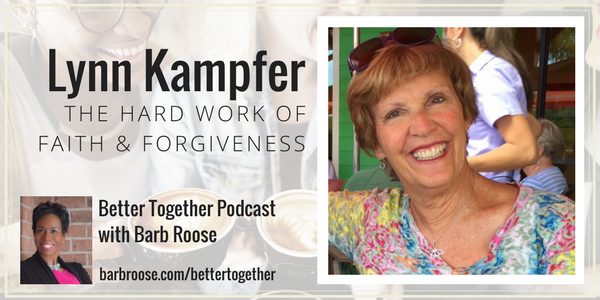
For over 30 years, former corporate trainer Lynn Kampfer lived what most people would consider the American Dream. Married to her childhood sweetheart and raising two kids, Lynn and her family enjoyed the best that life had to offer.
Yet, as Lynn began to search for God the outer edges of her lovely life began to crack and crumble. In this episode of the Better Together podcast, Lynn shares not only her dramatic story but more importantly, incredible lessons learned about God’s faithfulness, provision, forgiveness, and hope. Lynn will definitely inspire you as she shares about surviving breath-taking heartache and how to thrive even as life takes an unwelcome left turn.
As you listen to today’s podcast, I want you to draw hope and encouragement from Lynn’s story especially if you feel like your life is falling apart.
What you’ll hear from today’s podcast:
- How God plants seeds in our lives, even when we’re unaware;
- Even after rock bottom, things can always get worse;
- When you don’t forgive, you’re in a prison doing hard time with the person who hurt you;
- Two important things to know and do when beginning the journey toward forgiveness;
- How God never abandons us when the unthinkable in life actually happens.
Forgiveness is a difficult and often misunderstood concept.
There’s not enough space in this post to properly cover the topic, but I hope that you listen to Lynn’s podcast because you can learn a lot from her journey to forgiveness. It wasn’t easy, but she is so wise in how she journeyed through it.
POST A COMMENT BELOW: Can you tell us about your forgiveness journey? What was hard? How did God help you? If you’re still struggling, how can we pray for you?
by Barb Roose | Feb 12, 2018 | Joshua & Winning the Worry Battle
by Barb Roose
One Sunday afternoon I received a Facebook message from someone asking for help.
This sweet lady, whom I’ll call Leah, lost her father recently. If you’ve lost a parent or any loved one, you know that the grief runs deep. Dealing with the grief requires time, rest, and lots of self-care. Yet, she was unable to care for herself because others had pushed the worries and cares in their lives from their life onto her.

Leah was overwhelmed, except the worries weren’t her own. She was drowning in the worries of loved ones around her. I’ve known Leah almost my entire life. She manages her personal affairs well and plans for the future. Yet, she felt ensnared because of her fear of uncertainty and worries about her adult children. One was experiencing a second, unplanned pregnancy and another had neglected taking care of some serious legal issues and was looking at jail time. Leah told me that she promised money, time, and energy to help her loved ones get through their situation. But she also admitted that this cycle of being stressed out and bailing out had been going on for years. In fact, before Leah’s father passed away, he gently warned Leah that taking on other people’s problems would destroy her. He was right.
I diagnosed Leah’s condition as “Secondhand Worry.”
You might be suffering from Secondhand Worry if someone tells you about his or her problems and then, you end up suffering physical and emotional worry symptoms. Another symptom of Secondhand Worry is when worry drives you to assume responsibility for someone else’s problem. (If you’re familiar with recovery principles, that kind of Secondhand Worry is worry-driven enabling.)
Here are some practical examples:
• Your spouse has trouble with a manager, and you begin to worry about his job loss.
• Your child struggles with a subject at school, you worry that he or she will end up living on your couch well into their adult years.
The problem with Secondhand Worry is that we experience all of the symptoms associated with worry like sleepless nights, stressed out feeling, lack of appetite or overeating, frayed nerves BUT the situation isn’t even about us.
If you can relate to Leah, it’s a difficult place to be. Life is hard enough trying to fight in faith for our own victory over worry. It’s not possible for us to fight someone else’s battle, too.
For the past few months, I’ve been studying Old Testament book of Joshua and there is a situation where Joshua ends up with a case of secondhand worry. God prohibited the Israelites from making treaties with the inhabitants of Canaan, yet Joshua and the leaders were snookered by a group of Gibeonites with a fictitious story and some deceptive visual aides (Joshua 9:9-13). Instead of consulting God for wisdom, Joshua and the leaders made a treaty with the lying Gibeonites, whose deception was driven by fear. As a result, the Israelites ended up being responsible for a group of people that God warned them against.
Are you feeling responsible for people in your life who should be responsible for themselves? Do they keep coming back to you over and over again with endless excuses and sad stories?

If you’ve been caught in Secondhand Worry, you know what it’s like to hemorrhage money or spend sleepless nights because someone in your life didn’t manage his or her business. I’ve said it before and I’ll say it again, don’t let someone else’s worry wear you out!
Years ago, my friend and licensed therapist Tim challenged me to admit that I was struggling with Secondhand Worry. In fact, we had a few heated sessions because I told him that he just didn’t understand! What if I didn’t intervene and something horrible happened? Then, Tim made this powerful statement: We have to let the people in our lives discover their own need for God.
Is there someone in your life that you love, but you realize that it’s time to step back and let them discover their need for God?
It’s not my role to advise you not to help, but realize that your helping has the potential to hurt both of you. It’s hurting them because instead of allowing their consequences to push them toward God, you might be putting yourself in the way. It’s hurting you because you’re carrying a heavy load of someone else’s mess. Perhaps the person will see God more clearly once you get out of the way…
I recognize that the answers to the questions of how to handle your situation might be complex. No doubt there will be emotions involved. That is why prayer is so important. When you pray, God’s wisdom can cut through your emotions and deliver clarity. Furthermore, in prayer, God’s Holy Spirit may reveal or remind you of something that wasn’t present during your conversation with that person.
If you determine that it would not be healthy to aid someone, saying “no” is difficult, but you’ve got to do it — both for their sake and yours! Here are a few things that you can say instead:
- I’m so sorry about your situation, but I am unable to help you at this time.
- That is so difficult! Can I help you put together a plan that you can use to deal with this situation? (Only if you can plan without taking responsibility!)
- I know that you can figure this out. Keep me posted on how you are doing.
It feels bad saying “no” to helping someone, but remember, you aren’t saying that they aren’t worthy of help, only that you are no longer getting in the way of God helping them.
SHARE A COMMENT BELOW: What’s the hardest part about stepping back and letting your loved ones and friends take care of their own problems?
SaveSave
SaveSave
SaveSave