by Barb Roose | Mar 20, 2018 | Better Together Podcast, Uncategorized

“On what should have been the most beautiful day of my life, a switch flipped in my body?”
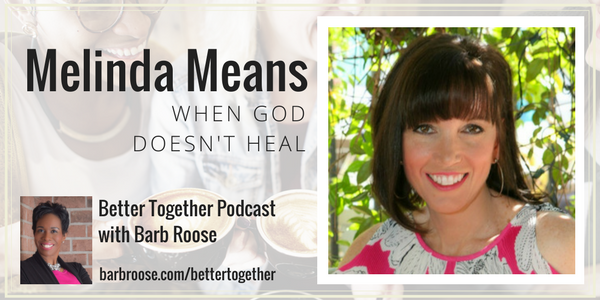
Have you or someone you know struggled with chronic pain? For 20 years, speaker and author, Melinda Means fought chronic pain and autoimmune disorders that she jokingly referred as the “gift that keeps on giving.”
Melinda is the author of the book, Invisible Wounds: Hope While You are Hurting. As we talked today, she reflects on the years of constant doctors appointments, diseases, and treatments, she felt like the woman in New Testament who struggled with uncontrolled bleeding for 12 years (Mark 5).

Raging within, Melinda’s suffering body was a spiritual wound that spread deep and wide. “I didn’t understand how God could love me and still let me suffer. I know that my earthly father would have healed me from my debilitating pain if he could. So, if my earthly father would heal me because beloved me, then why wouldn’t my heavenly father heal me?”
During my conversation with Melinda, we talk with great candor about the difficult questions that we ask God when we’re in physical, emotional, or spiritual pain. If you’ve ever grappled with questions like why God hasn’t taken away your pain or why your prayers for healing have gone unanswered, then today’s podcast conversation is for you.
What you’ll hear in this week’s podcast:
- The story of Melinda’s 20-year struggle with chronic pain and spiritual struggle with her faith;
- What happened when Melinda prayed a radical prayer in the midst of her pain;
- The ONE thing that you can do if you are in the midst of a physical/spiritual struggle;
- A beautiful new gift God bestowed on Melinda that you can enjoy and download for yourself!
PODCAST EPISODE RESOURCES:
Melinda’s website | Melinda’s book | Melinda’s Facebook page
Finding Joy Ladies Night Out Tickets on iTickets
SHARE YOUR STORY: Are you dealing with something in your life that God hasn’t healed yet? Maybe it’s a chronic illness, a broken relationship, or an unfilled longing that keeps breaking your heart. Share your story in the comments below and bring home to another person who is listening today.
by Barb Roose | Mar 14, 2018 | Joshua & Winning the Worry Battle
By Barb Roose
Over the past 15 years, I’ve learned a lot about how to allow God to give me victory over fear and worry. I created the C.A.L.M. Technique for myself to reduce my physical distress so that I could pray. This easy-to-use tool works to slow down my heart rate, break the pattern of negative thinking, and relax my body. Then, I can invite God into my distress and ask Him to fight my battles for me. The C.A.L.M Technique isn’t just a neat idea – I use it! (I used it last week.) Recently, I had a chance to teach it to the folks at my church and that was pretty cool. Would you like to learn it?
C.A.L.M. Technique
- Count to 10 (Inhale on the number; Exhale the word MISSISSIPPI)
- Acknowledge God’s presence by saying: God, I know that You’re here with me right now.
- List – Tell God what you are afraid of or worried about
- Meditate – Keep repeating the following: God is here and He will take care of me/this.
When it comes to the counting, you will need to boss your emotions so that you can push your count to 10. Those supercharged emotions will definitely fight the technique. But, stick with it because it does work! This is one of those tools that becomes more effective the more you use it. Your body will calm down. I love this tool because it equips us to walk in the blessing of God’s promise in Joshua 1:9:
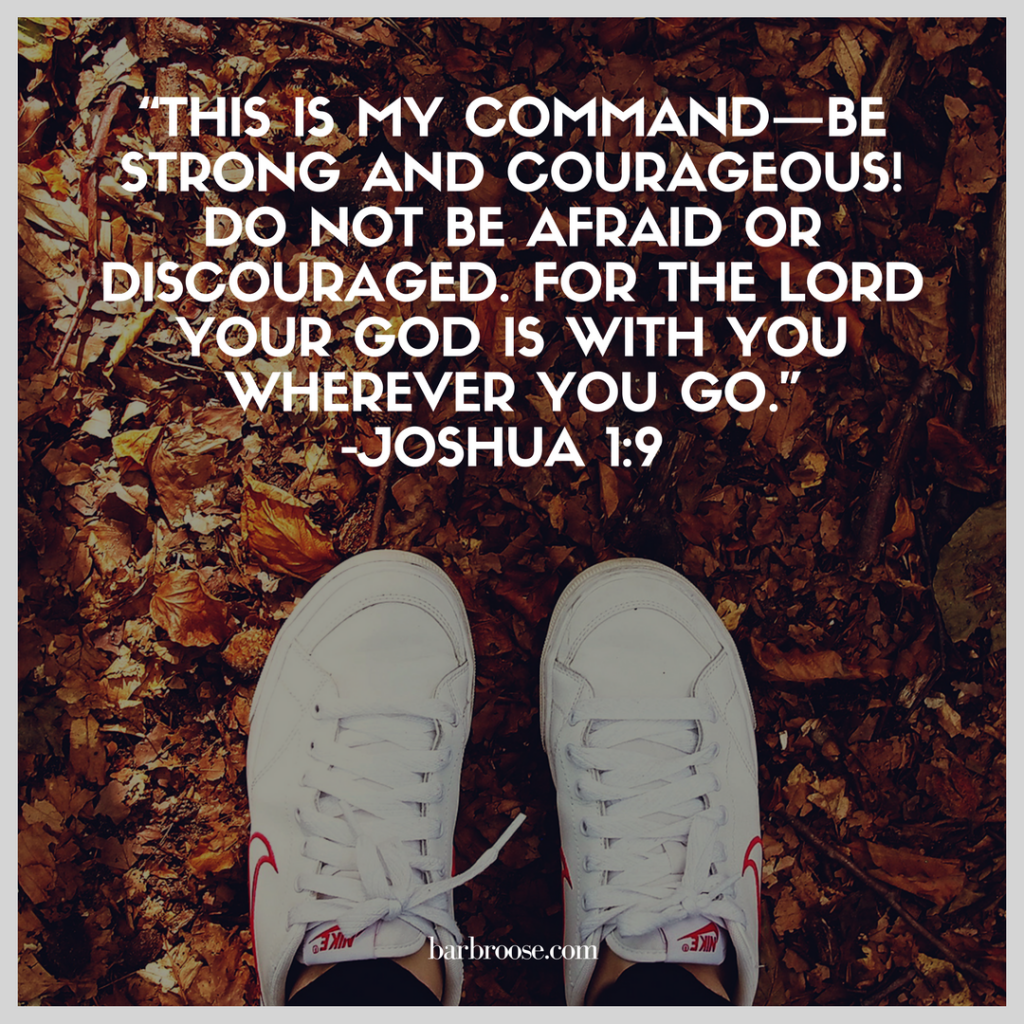
The point of this exercise is to reduce your physical distress and open up a conversation with God. I love this tool because it equips us to walk in the blessing of God’s promise in Joshua 1:9: “This is my command—be strong and courageous! Do not be afraid or discouraged. For the Lord your God is with you wherever you go.”
I don’t know what’s on your mind today. But, if you’re prone to meltdowns like me, practice the C.A.L.M. technique a few times so that you can use this tool to help you calm down during anxious times and connect with the God who promises to take care of you.
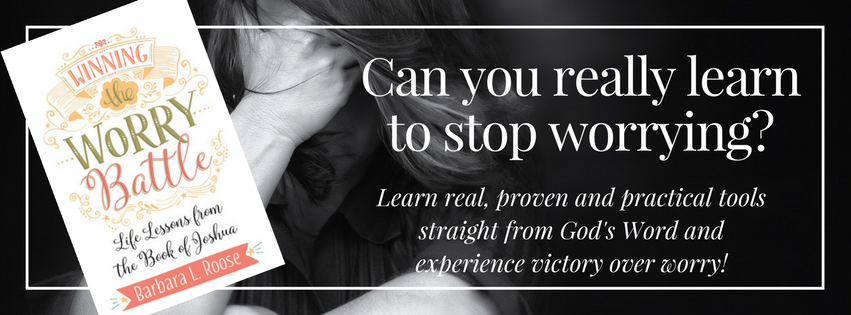
*Looking for MORE tools? Order my new book, Winning the Worry Battle releasing next month for even more practical tools to help you fight your worry battle! Click here to find out where you can order your book today!

SaveSave
by Barb Roose | Mar 7, 2018 | Better Together Podcast
“They took me into the counseling room. The doctor gently told me that they tried everything that they could, but they were not able to revive my husband. So, I went home to do the hardest thing that I ever had to do.”
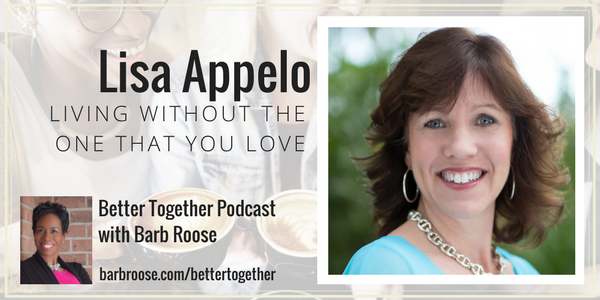
Lisa Appelo’s life changed forever in just one night.
On this new episode of Better Together podcast, I have a heartbreaking, yet hope–filled conversation with writer and speaker, Lisa Appelo. She’s a Florida native and a homeschooling mom to seven kids, now aged 27 to 10.
During our interview, Lisa tells us about the night in summer 2011 when she woke up in the middle of the night and realized that her 47-year old husband Dan was having a heart attack. After the paramedics took her husband to the hospital, Lisa went upstairs and noticed her kids huddled together with their arms around each other.
Not only did Lisa face the devastating loss of her high-school sweetheart husband, but the reality of being alone and a single mom to seven kids from college-aged down to just four years old.
In the difficult months that followed, Lisa remembers the powerful presence of friends and prayer holding her family up.
“I do remember thinking and knowing that we were being carried by prayer.”
Yet, as you listen to our interview, you’ll hear the incredible hope that Lisa share about the blessings and abundance of God. She talks about the pain of walking with her kids through the loss of their dad and the practical ways that she helped her kids open up and talk about their fears and loss.
During this episode, Lisa encourages us to remember:
- Grief comes in many forms and we don’t get over it, but we do learn to “live where we are”;
- We learn to live with the love, but without the person;
- God has as much abundance planned for us AFTER our loss as before our loss.
SHARE YOUR EXPERIENCE IN THE COMMENTS BELOW: Is there a place in your life affected by grief? Have you lost a loved one, a dream, or a relationship? How are you dealing with your grief and what resources do you find most helpful in the grieving process?
CONNECT WITH LISA:
Lisa’ website | Twitter | Instagram | Facebook
100 Days with Christ Bible Study Journal and Reading Plan
FIND OUT MORE ABOUT FINDING JOY LADIES NIGHT OUT EVENT! Click here for more details!
by Barb Roose | Feb 21, 2018 | Better Together Podcast
“I read Bill’s words as he confessed that he had lied to his family and had stolen, and spent, $1,000,000 from his aunt’s trust fund. It was obvious he confessed at trial to get a reduced sentence. I was numb and in shock. I had asked God for the total truth but had never dreamed that the truth would be so painful.
How could my husband and best friend, who I had known since I was five, be a liar, a thief , and a convicted felon? It was excruciating.” -from Lynn’s Story: A Journey of searing, Inspiring Growth and Ultimate Healing
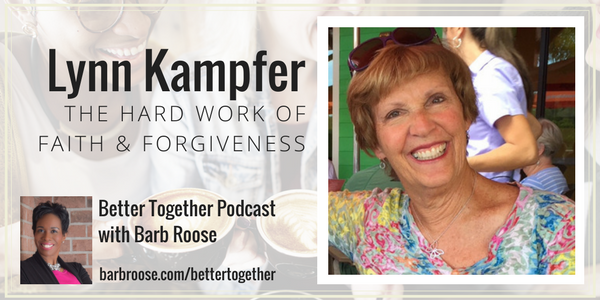
For over 30 years, former corporate trainer Lynn Kampfer lived what most people would consider the American Dream. Married to her childhood sweetheart and raising two kids, Lynn and her family enjoyed the best that life had to offer.
Yet, as Lynn began to search for God the outer edges of her lovely life began to crack and crumble. In this episode of the Better Together podcast, Lynn shares not only her dramatic story but more importantly, incredible lessons learned about God’s faithfulness, provision, forgiveness, and hope. Lynn will definitely inspire you as she shares about surviving breath-taking heartache and how to thrive even as life takes an unwelcome left turn.
As you listen to today’s podcast, I want you to draw hope and encouragement from Lynn’s story especially if you feel like your life is falling apart.
What you’ll hear from today’s podcast:
- How God plants seeds in our lives, even when we’re unaware;
- Even after rock bottom, things can always get worse;
- When you don’t forgive, you’re in a prison doing hard time with the person who hurt you;
- Two important things to know and do when beginning the journey toward forgiveness;
- How God never abandons us when the unthinkable in life actually happens.
Forgiveness is a difficult and often misunderstood concept.
There’s not enough space in this post to properly cover the topic, but I hope that you listen to Lynn’s podcast because you can learn a lot from her journey to forgiveness. It wasn’t easy, but she is so wise in how she journeyed through it.
POST A COMMENT BELOW: Can you tell us about your forgiveness journey? What was hard? How did God help you? If you’re still struggling, how can we pray for you?
by Barb Roose | Feb 12, 2018 | Joshua & Winning the Worry Battle
by Barb Roose
One Sunday afternoon I received a Facebook message from someone asking for help.
This sweet lady, whom I’ll call Leah, lost her father recently. If you’ve lost a parent or any loved one, you know that the grief runs deep. Dealing with the grief requires time, rest, and lots of self-care. Yet, she was unable to care for herself because others had pushed the worries and cares in their lives from their life onto her.

Leah was overwhelmed, except the worries weren’t her own. She was drowning in the worries of loved ones around her. I’ve known Leah almost my entire life. She manages her personal affairs well and plans for the future. Yet, she felt ensnared because of her fear of uncertainty and worries about her adult children. One was experiencing a second, unplanned pregnancy and another had neglected taking care of some serious legal issues and was looking at jail time. Leah told me that she promised money, time, and energy to help her loved ones get through their situation. But she also admitted that this cycle of being stressed out and bailing out had been going on for years. In fact, before Leah’s father passed away, he gently warned Leah that taking on other people’s problems would destroy her. He was right.
I diagnosed Leah’s condition as “Secondhand Worry.”
You might be suffering from Secondhand Worry if someone tells you about his or her problems and then, you end up suffering physical and emotional worry symptoms. Another symptom of Secondhand Worry is when worry drives you to assume responsibility for someone else’s problem. (If you’re familiar with recovery principles, that kind of Secondhand Worry is worry-driven enabling.)
Here are some practical examples:
• Your spouse has trouble with a manager, and you begin to worry about his job loss.
• Your child struggles with a subject at school, you worry that he or she will end up living on your couch well into their adult years.
The problem with Secondhand Worry is that we experience all of the symptoms associated with worry like sleepless nights, stressed out feeling, lack of appetite or overeating, frayed nerves BUT the situation isn’t even about us.
If you can relate to Leah, it’s a difficult place to be. Life is hard enough trying to fight in faith for our own victory over worry. It’s not possible for us to fight someone else’s battle, too.
For the past few months, I’ve been studying Old Testament book of Joshua and there is a situation where Joshua ends up with a case of secondhand worry. God prohibited the Israelites from making treaties with the inhabitants of Canaan, yet Joshua and the leaders were snookered by a group of Gibeonites with a fictitious story and some deceptive visual aides (Joshua 9:9-13). Instead of consulting God for wisdom, Joshua and the leaders made a treaty with the lying Gibeonites, whose deception was driven by fear. As a result, the Israelites ended up being responsible for a group of people that God warned them against.
Are you feeling responsible for people in your life who should be responsible for themselves? Do they keep coming back to you over and over again with endless excuses and sad stories?

If you’ve been caught in Secondhand Worry, you know what it’s like to hemorrhage money or spend sleepless nights because someone in your life didn’t manage his or her business. I’ve said it before and I’ll say it again, don’t let someone else’s worry wear you out!
Years ago, my friend and licensed therapist Tim challenged me to admit that I was struggling with Secondhand Worry. In fact, we had a few heated sessions because I told him that he just didn’t understand! What if I didn’t intervene and something horrible happened? Then, Tim made this powerful statement: We have to let the people in our lives discover their own need for God.
Is there someone in your life that you love, but you realize that it’s time to step back and let them discover their need for God?
It’s not my role to advise you not to help, but realize that your helping has the potential to hurt both of you. It’s hurting them because instead of allowing their consequences to push them toward God, you might be putting yourself in the way. It’s hurting you because you’re carrying a heavy load of someone else’s mess. Perhaps the person will see God more clearly once you get out of the way…
I recognize that the answers to the questions of how to handle your situation might be complex. No doubt there will be emotions involved. That is why prayer is so important. When you pray, God’s wisdom can cut through your emotions and deliver clarity. Furthermore, in prayer, God’s Holy Spirit may reveal or remind you of something that wasn’t present during your conversation with that person.
If you determine that it would not be healthy to aid someone, saying “no” is difficult, but you’ve got to do it — both for their sake and yours! Here are a few things that you can say instead:
- I’m so sorry about your situation, but I am unable to help you at this time.
- That is so difficult! Can I help you put together a plan that you can use to deal with this situation? (Only if you can plan without taking responsibility!)
- I know that you can figure this out. Keep me posted on how you are doing.
It feels bad saying “no” to helping someone, but remember, you aren’t saying that they aren’t worthy of help, only that you are no longer getting in the way of God helping them.
SHARE A COMMENT BELOW: What’s the hardest part about stepping back and letting your loved ones and friends take care of their own problems?
SaveSave
SaveSave
SaveSave